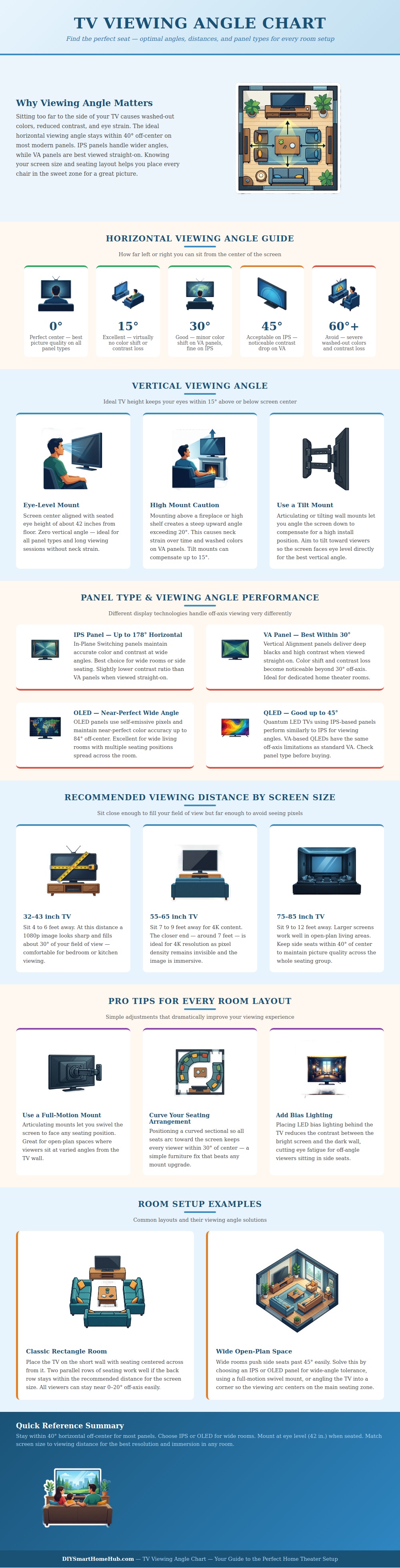
Viewing angles is another critical factor in the quality of a television. The viewing angles for a television will determine if the televisions picture appears the same to everyone in the room who is viewing the television. If the individuals who view the television are positioned directly in front of the televisions, the televisions will display a clear and colorful image for those individuals.
However, if the individuals who view the televisions are positioned at a wide viewing angle to the televisions, the television picture may lose some of it’s color and contrast. Many individuals will experience a loss of quality from the television because their viewing angle to the televisions is too widely, and the reason for such a loss in quality is the way in which the televisions light reaches the viewer eyes. The horizontal viewing angles for televisions are the most significant for determining the quality of the picture that the televisions display.
How to Get the Best TV Viewing Angles
The horizontal viewing angles for televisions is dependent upon the type of panel that is utilized for the televisions. If the television employs IPS panels, those panels are designed to maintain color accuracy even at wide viewing angles, so such a panel type is best for those who wish for individuals who sit to the sides of the television to view the picture from those angles. VA panels will display deeper blacks on the televisions when individuals view the televisions from directly in front of the televisions.
However, VA panels will lose some of their color and contrast for those individuals who attempt to view the televisions from an wide viewing angle. OLED televisions are also controlled by the individual pixels of the televisions. Each pixel make its own light, and because each pixel makes its own light, the television maintains the same picture regardless of the viewing angle for those individuals who view the picture.
In addition to the viewing angles for the televisions, the vertical viewing angles for televisions also impact the viewers who enjoy the televisions. The vertical viewing angles for the televisions can lead to discomfort in those who watch television. If televisions are mounted high upon the wall, the viewers for the televisions are required to look up at the televisions for long periods of time.
Such viewing of the televisions from high positions can lead to strain for the neck of the individuals who view the televisions. To avoid such strain for the viewers, it is best to mount the televisions so that the center of the televisions is at the same level as the seated eyes of the viewers. Should the televisions need to be placed in high positions in the room, such as above a fireplace, the user should mount the televisions to utilize a tilting mount to angle the televisions toward the viewers.
The distance that an individual should sit from the televisions also works in conjunction with the viewing angles for the televisions. The distance from the individual to the televisions will impact how the individual views the resolution of the televisions. If an individual is sitting too close to the televisions, the individual may be able to view the individual pixels that make up the televisions picture.
If, however, an individual is sitting too far from the televisions for the televisions to appear as if they are filling the viewers field of view, the individual will also experience difficulties in becoming immersed in the image displayed by the televisions. An individual should, therefore, find the distance between themselves and the televisions that allows for the television to exhibit its resolution and fill the viewers field of view. Once the proper distance is established, the viewing angles for the televisions in the room should be considered.
The shape of the room in which the televisions will be placed will impact the viewing angles for the individuals in the room. The shape of the room will dictate the type of televisions that should be purchased for that room. If the room in which the televisions are to be purchased is long and rectangular in shape, it will allow for the individuals in the room to all have the same viewing angles of the televisions.
However, if the room is wide, the individuals in the room may have viewing angles that are too wide for the televisions. Therefore, the individuals in a wide room should purchase an IPS or OLED televisions. In either case, the user may mount the televisions on a full-motion mount to move the televisions toward the viewers, or the furnitures in the room may be arranged so that the viewers are all positioned at viewing angles that are most comfortable with the televisions.
An error that many individuals make in purchasing televisions is selecting the televisions based off how the televisions will look upon the wall in the room. The televisions often displayed for prospective buyers are always viewed from perfect viewing angles. In contrast, the viewer’s eyes in the individual’s home will be different than those in the store.
When purchasing televisions for the home, individuals should consider in what positioning the televisions will be placed in order to control the viewing angles. Another tool that is often used when individual viewers must view the televisions from angles wider than the televisions are designed to display their screens is the implementation of bias lighting. Bias lighting is a lighting source that is positioned behind the televisions.
Bias lighting reduces the contrast between the televisions bright screen and the dark wall behind the televisions. This contrast in brightness between the televisions and the wall can make it more difficult for individuals who view the televisions from the sides to focus upon the televisions. By reducing that contrast, the televisions become easier to view for the individuals who are positioned to the sides of the televisions.
Thus, bias lighting is one tool that can be utilized for controlling viewing angles, even if the televisions are positioned in a way that makes it difficult to avoid viewing the televisions from wide angles. Overall, matching the panel type to the shape of the room and viewing angles, the mounting height for the televisions should be adjusted to provide for everyone in the room an enjoyable viewing experience of the televisions. You should of considered the room shape before buying.