Surge Protector Joules Calculator
Estimate a practical joule rating for a Type 3 plug-in surge protector using connected watts, device sensitivity, location exposure, clamping voltage, and service-life buffer.
Joule ratings describe energy absorption capacity, not a guarantee that every surge is stopped. Lower clamping/VPR and a functioning ground remain important parts of protection.
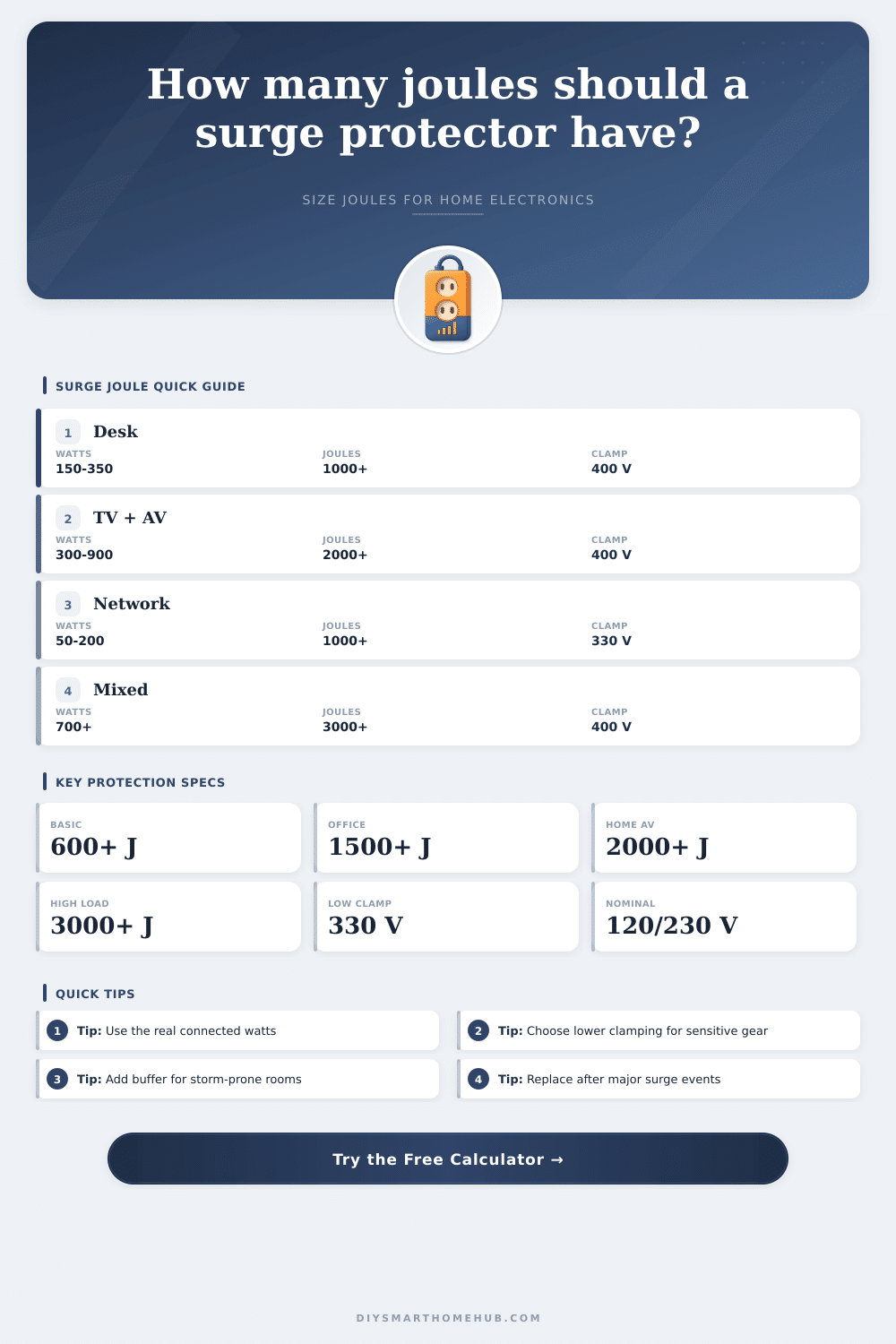
| Rating Class | Common Joules | Good Fit | Calculator Floor |
|---|---|---|---|
| Entry protection | 600 to 999 J | Lamp, charger, basic electronics | Basic electronics |
| Office / network | 1000 to 1999 J | Router, modem, desk, small printer | Network or office |
| AV and smart hub | 2000 to 2999 J | TV, console, audio receiver, hub shelf | TV / AV gear |
| High reserve | 3000 J and up | Mixed rack, workstation, storm exposure | High-end or mixed gear |
| Listed VPR | Meaning | Calculator Factor | Typical Use |
|---|---|---|---|
| 330 V | Lower pass-through voltage on 120 V products | 1.15 | Sensitive network and AV electronics |
| 400 V | Common balanced clamp class | 1.00 | General home electronics |
| 500 V | Higher pass-through threshold | 0.90 | Less sensitive loads with high joule reserve |
| 230 V systems | Use local listed protection rating | Voltage adjusted | Match the product to local mains standard |
| Device Class | Minimum Floor | Sensitivity Factor | Modeled Event Energy |
|---|---|---|---|
| Basic electronics | 600 J | 1.00 | 90 J per medium event |
| Network / smart hub | 1000 J | 1.25 | 110 J per medium event |
| Office desk | 1500 J | 1.40 | 130 J per medium event |
| TV / AV equipment | 2000 J | 1.55 | 150 J per medium event |
| High-end mixed rack | 3000 J | 1.75 | 175 J per medium event |
| Exposure Setting | Factor | Use When | Typical Result |
|---|---|---|---|
| Low | 0.80 | Urban service, few outages, good grounding | Can size closer to minimum floor |
| Typical | 1.00 | Average residential electronics room | Balanced joule target |
| Storm-prone | 1.35 | Frequent lightning or utility switching | Moves AV gear toward 3000 J |
| Rural / overhead | 1.65 | Long overhead runs or exposed service | Favors high reserve protection |
| Generator / unstable | 1.45 | Portable generator or voltage disturbances | Adds reserve for repeated stress |
Basic Power Strip
Outlet expansion only when no joule rating or VPR is listed. It should not be counted as surge protection in this calculator.
Type 3 Surge Strip
Plug-in point-of-use protection with joule rating, VPR/clamping data, and grounded outlet requirement.
UPS With Surge
Adds battery backup for brief outages. Still check joules, VPR, VA capacity, and protected outlet count.
Whole-Home SPD
Panel-level Type 1 or Type 2 protection reduces surge stress before point-of-use strips absorb remaining energy.
| Scenario | Load Range | Suggested Floor | Secondary Check |
|---|---|---|---|
| Single laptop desk | 100 to 250 W | 1000 J | 2 to 4 A outlet load |
| Smart TV plus console | 300 to 600 W | 2000 J | 400 V or lower VPR |
| Router, modem, mesh | 40 to 150 W | 1000 J | Low clamping preferred |
| Home theater cabinet | 600 to 1200 W | 3000 J | Check 15 A circuit limit |
| Mixed room equipment | 700 W and up | 3000 J+ | Use several protected zones |
A surge protector is an device that sits between the electronic equipment and the electrical surges that can travel through the household wiring. A surge protector will act as a barrier between the equipment and the electrical surges that will threaten the equipment with damage. Most people will only notice a surge protector when the electronic equipment stops working due to an electrical surge.
Using a surge protector calculator will allow you to determine the joule rating that is appropriate for your electronic equipment. Using a surge protector calculator will allow you to find the proper joule rating for your electronic equipment without guessing what the joule rating should be for that equipment. The joules on a surge protector indicates the total energy that can be absorbed by the device before the components of the protector will degrade.
How to Use a Surge Protector Calculator
The joule rating of the surge protector does not describe the energy of an electrical surge such as lightning but the total amount of energy that the surge protector can absorb over an extended period of time. Most electrical surges are not as powerful than the electrical surge from a lightning strike. Most electrical surges are actualy small electrical spikes.
Using a surge protector calculator will allow the device to calculate the joule rating of the surge protector based off the wattage of the electronic equipment, the number of devices, the sensitivity of the equipment, and where the equipment will be exposed to electrical surges. The wattage of the electronic equipment that will be plugged into the surge protector has to be entered into the calculator. The wattage will determine the current that will pass through the surge protector.
The number of electronic devices that will be using the surge protector has to be entered into the calculator. The more devices that are plugged into the surge protector increases the chance of the surge protector failing. The more outlets that are in use, the more likely the surge protector will fail.
Using a surge protector calculator allows for the target joule rating to be adjusted upward if there are many devices to be protected. The sensitivity of the electronic devices that the surge protector will protect will affect the joule rating of that protector. Devices such as routers and televisions contains components that is sensitive to over-voltage.
A surge protector calculator will recognize the sensitivity of these devices and allow for them to have a higher joule rating then basic appliances such as lamps and phone chargers. The user can select the class of equipment that is to be protected on the calculator for the target joule rating to be customized for that type of equipment. The location of the electronic equipment can affect the exposure of that equipment to electrical surges.
Equipment located in a home that has underground power services in a mild climate will experience fewer electrical surges than a device located in a rural area that has overhead power lines and experiences thunderstorms throughout the area. The exposure setting on the calculator will allow for adjustments in the target joule rating of the surge protector. The input of the location will allow for the surge protector to have a reserve in case of electrical surges that may threaten the connected device.
The clamping voltage, also known as VPR, indicates at what voltage the surge protector will begin to divert electrical surges. The lower the voltage, the more likely that the surge protector is going to protect the equipment from electrical surges. A lower clamping voltage indicates that the surge protector will absorb more electrical surges.
These variable will be calculated into the target joule rating so that the user does not have to make this decision for themselves. Finally, the service life of the surge protector and the need for a buffer can be entered into the calculator. The service life will allow the surge protector to handle the natural degradation of the device.
The buffer accounts for the difference between the conditions of the equipment in the calculations of the manufacturer and the actual conditions in which the surge protector will be used. The output of the surge protector calculator is not an exact measurement of the power of the electrical surges that can pass through the devices, but it does provide an estimate of how many joule of energy the devices will absorb. Once the calculator calculates the joule rating, that value can be matched to a product that contains that joule rating.
Most retailers will have various class of surge protectors with joule ratings grouped within classes. Using these reference tables will allow you to choose the appropriate surge protector for your electronic devices. To allow the surge protector to last as long as possible, ensure that it is plugged directly into an electrical outlet that is grounded.
Do not use an extension cord to plug the surge protector into an electrical outlet. If the surge protector has an indicator light, it should be replaced after any instance in which the indicator light is triggered. Any surge protector should also be replaced after several years of continuous protection of the electronic equipment.
The metal oxide varistors that are contained within the surge protector will degrade each time that it absorbs the energy of an electrical surge. This degradation cannot be seen on the outside of the surge protector. However, the status window of the surge protector will indicate the number of times that it has absorbed the energy of electrical surges.
Inspect the surge protector every few months to ensure that it is still able to protect the electronic devices from electrical surges. There are other methods of protecting electronic devices in addition to surge protectors. Whole-house protectors that are installed at the electrical panel will reduce the size of the electrical surges that enters the rooms in the house.
However, these devices do not eliminate the need for surge protectors to be placed next to the electronic devices that are to be protected. The whole house surge protector will handle the largest electrical surges in the home and the local surge protector will handle any remaining electrical energy that passes through the devices to the electronic equipment. While many people feel that a joule rating that is high is the best for protecting their electronic devices, the joule rating is just one of the many variable in the protection equation.
High joule ratings are useless if the surge protector also has a high clamping voltage or if it does not contain a ground connection to the electronic devices. The surge protector calculator will require the user to select both the joule rating and the clamping voltage to create the best surge protector for their electronic devices.