Split AC Power Consumption Calculator
Estimate split air conditioner running power, cooling capacity, daily kWh, monthly kWh, load-adjusted compressor use, standby energy, and circuit current from real unit specifications.
Split AC Power Results
| Nominal split AC size | Cooling capacity | Typical rated input | Common use case |
|---|---|---|---|
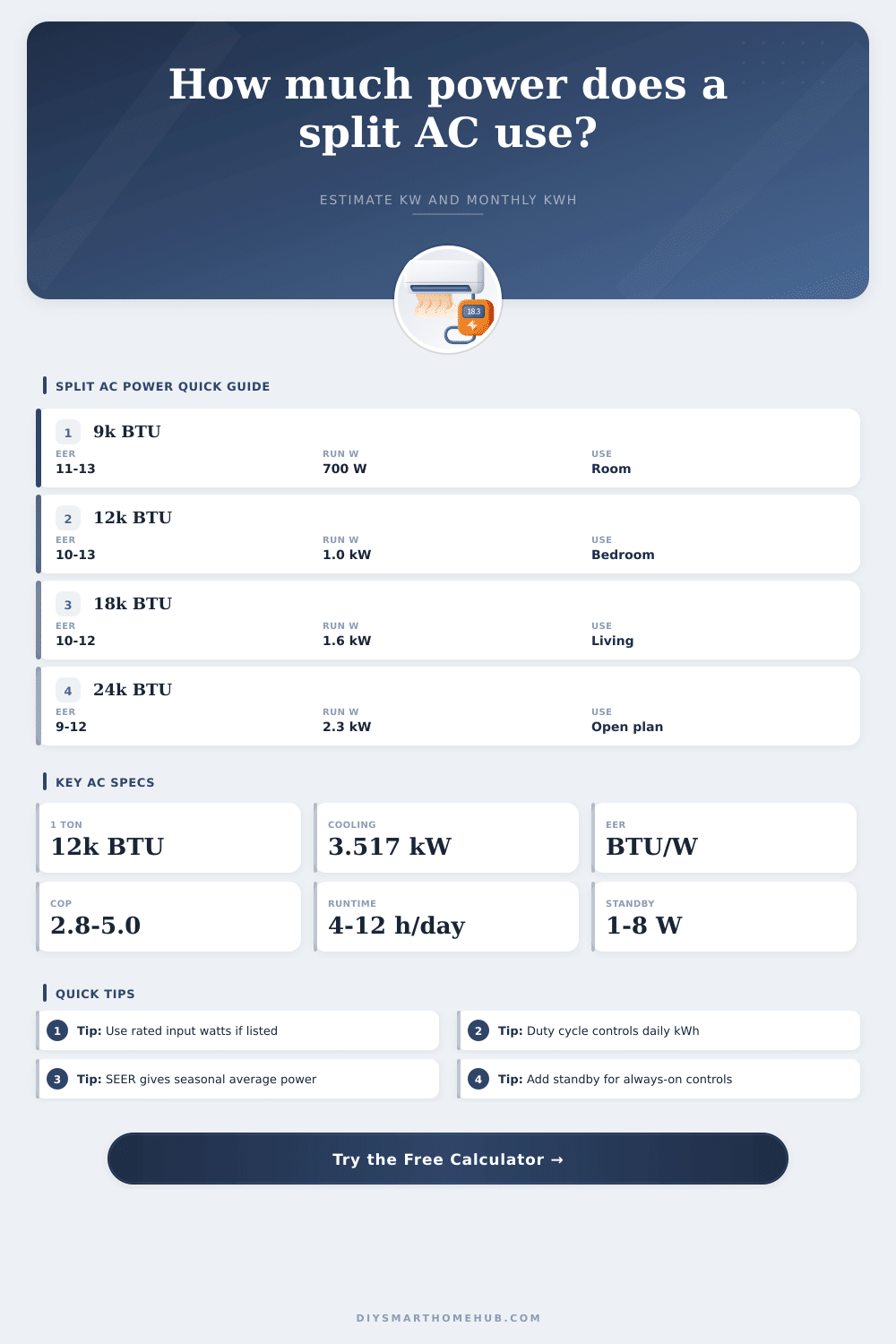
| Small 3/4 ton mini split | 9,000 BTU/h, 2.64 kW cooling | 600 to 900 W at rated load | Small bedroom or office zone |
| One-ton split AC | 12,000 BTU/h, 3.52 kW cooling | 850 to 1,300 W at rated load | Bedroom, den, or small studio |
| 1.5-ton wall split | 18,000 BTU/h, 5.28 kW cooling | 1,400 to 2,000 W at rated load | Living room or larger zone |
| Two-ton split system | 24,000 BTU/h, 7.03 kW cooling | 2,000 to 2,800 W at rated load | Open plan area or high load room |
| Three-ton ductless outdoor unit | 36,000 BTU/h, 10.55 kW cooling | 3,000 to 4,200 W at rated load | Large zone or multi-head system |
| Rating type | Formula used by calculator | Example for 12,000 BTU/h | Best use |
|---|---|---|---|
| EER | Input W = BTU/h / EER | EER 12 = 1,000 W | Rated full-load power estimate |
| SEER or SEER2 | Seasonal average W = BTU/h / SEER | SEER2 18 = 667 W | Seasonal energy planning |
| COP | Input kW = cooling kW / COP | COP 3.5 = 1.00 kW | Metric spec sheets and heat pump data |
| Nameplate watts | Input W = listed AC input W | 950 W = 0.95 kW | Best for a known model or measured load |
| Tons of cooling | BTU/h = tons x 12,000 | 1.5 tons = 18,000 BTU/h | Converting common HVAC sizing language |
| Operating pattern | Powered hours per day | Typical load or duty cycle | Calculation note |
|---|---|---|---|
| Evening bedroom cooling | 6 to 9 hours | 35% to 65% | Often cycles down after the room reaches setpoint |
| Overnight humid climate | 8 to 12 hours | 45% to 75% | Latent moisture load can keep the compressor active |
| All-day home office | 8 to 11 hours | 40% to 70% | Solar gain and electronics raise afternoon load |
| Open-plan living area | 5 to 10 hours | 55% to 90% | Larger volume and doors increase cycling time |
| Server closet or equipment room | 12 to 24 hours | 55% to 100% | Internal heat can create steady cooling demand |
| Scenario | Suggested inputs | Primary output to watch | Secondary output to watch |
|---|---|---|---|
| Small inverter bedroom | 9k BTU, SEER2 21, 8 h, 45% | Daily kWh | Standby share |
| Standard 12k bedroom | 12k BTU, EER 11.5, 9 h, 65% | Running kW | Monthly kWh |
| High-efficiency 12k zone | 12k BTU, SEER2 25, 10 h, 50% | Daily kWh | Implied COP |
| Living room split AC | 18k BTU, EER 11, 7 h, 70% | Monthly kWh | Running current |
| Open plan two-ton unit | 24k BTU, EER 10.5, 8 h, 75% | Running amps | Full-load input |
| Equipment room cooling | 12k BTU, nameplate W, 24 h, 85% | Daily kWh | Monthly kWh |
Understanding an air conditioners electricity bill require an understanding of several technical factor. By understanding these different factor, a person can understand the reason that an air conditioner consume the amount of power that it does. An air conditioners electricity bill is determined by the amount of electricity that the air conditioner pull from the wall and the length of time that the air conditioner is running to maintain a specific temperature within the air conditioners environment.
While many peoples may believe that an air conditioners cooling capacity is the same than its consumption of electricity, these are two completely different measurement. Cooling capacity is measured in BTUs, which represent the amount of heat that an air conditioner can remove from an area. Electricity consumption is measured in watts, which represents the amount of power that an air conditioner draw from the electrical grid.
What Makes Your Air Conditioner Use More Electricity
Air conditioner efficiency relate the cooling capacity of the appliance with its consumption of electricity. Two common electricity rating for air conditioners include the SEER and EER ratings. The SEER, or seasonal energy efficiency ratio, calculate the efficiency of an air conditioner over an entire cooling season.
The EER, or energy efficiency ratio, also measure seasonal efficiency, but only during the period in which an air conditioner is performing at its peak efficiency. Air conditioners that include inverter systems change the amount of power that they use based on the temperature of the room. An inverter air conditioner can change the rate at which its compressor work; it does not turn on and off with the desired temperature of the environment.
The duty cycle of an air conditioner is a measurement of how long the compressor run. Air conditioner compressor pump do not run continuously; they cease running when the air conditioners environment reach the temperature that it is programmed to maintain. Rooms with good thermal insulation require the air conditioner to turn on and off less often, resulting in a lower duty cycle and lower electricity bill.
Poor insulation force the air conditioner to work harder to maintain the set temperature of the room. Air conditioners also work harder in areas that experience extreme temperature. The greater the temperature difference that the air conditioner must control, the higher its duty cycle and electricity bill will become.
Standby power is another concept that must be considered when calculating the electricity consumption of an air conditioner. Standby power is the electricity consumed by the air conditioner while its compressor is off. Many air conditioners use some of this standby power to operate WiFi module, control boards, and crankcase heater.
Although the amount of electricity used for these functions is small, the amount of standby power used over the course of a calendar month is an addition to the air conditioners total electricity consumption. Other technical specification that relate to the consumption of electricity by an air conditioner include its running current and power factor. The running current, or amperage, of an air conditioner is the amount of electricity that it draw from the electrical circuit.
The amperage of the air conditioner must be considered when installing the unit into an electrical circuit to ensure that the circuit breaker does not trip. Power factor is a measurement of the efficiency of an air conditioner in convert electricity to work. Air conditioners with high power factors use less electricity to accomplish the same work of air cooling as air conditioners with low power factor.
Reference tables can be used to compare an air conditioners nameplate data with the industry standard for air conditioners. By comparing the electricity consumption of an air conditioner to other air conditioners with similar cooling capacity, it is possible to determine whether the air conditioner is efficiently performing its cooling function. By sealing the gaps in windows or by raising the thermostat temperature setting in an air conditioned room, it is possible to reduce the electricity consumption of the air conditioner.
By reducing the thermostats target temperature for a room, the air conditioner will have to change its cooling environment less often. This reduction of the air conditioners duty cycle will lead to a reduction in the amount of electricity that the air conditioner consume. By measuring the amount of electricity that an air conditioner consume, a homeowner can understand the electricity bill that they will be sending to the electrical company.