LED Strip Power Consumption Calculator
Estimate strip load, current draw, power supply sizing, and energy use from real LED strip wattage, length, voltage, brightness, and run time.
Calculated Power Plan
Formula Breakdown
The spec grid follows the selected strip type and updates before every calculation.
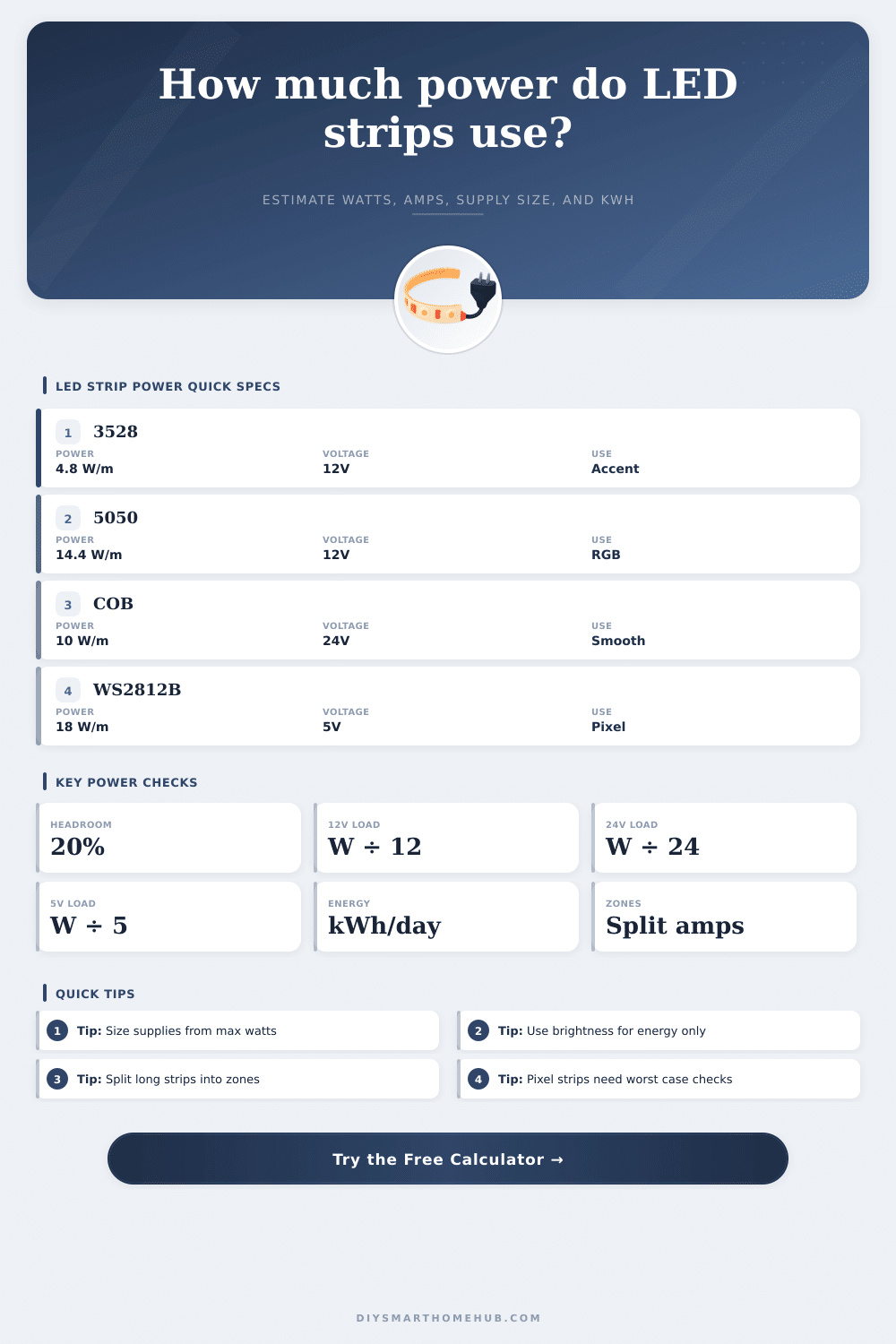
| Strip type | Rated power | Equivalent | Current at 12V | Typical use |
|---|---|---|---|---|
| 3528 single color, 60 LEDs/m | 4.8 W/m | 1.46 W/ft | 0.40 A/m | Low-brightness accents, shelves, toe kicks |
| 5050 RGB, 30 LEDs/m | 7.2 W/m | 2.19 W/ft | 0.60 A/m | Short decorative color runs |
| COB continuous, 480 LEDs/m | 10 W/m | 3.05 W/ft | 0.83 A/m | Dot-free linear lighting and display edges |
| 5050 RGB, 60 LEDs/m | 14.4 W/m | 4.39 W/ft | 1.20 A/m | Standard bright RGB room and cabinet zones |
| 2835 high density, 120 LEDs/m | 18 W/m | 5.49 W/ft | 1.50 A/m | High-output white task lighting |
| WS2812B or SK6812, 60 LEDs/m | 18 W/m max | 5.49 W/ft | 3.60 A/m at 5V | Addressable pixels at full white worst case |
| 24V high output, 120 LEDs/m | 19.2 W/m | 5.85 W/ft | 0.80 A/m at 24V | Longer high-output architectural runs |
| Calculated load | With 20% headroom | Current at 5V | Current at 12V | Current at 24V |
|---|---|---|---|---|
| 24 W | 28.8 W | 5.76 A | 2.40 A | 1.20 A |
| 60 W | 72 W | 14.40 A | 6.00 A | 3.00 A |
| 96 W | 115.2 W | 23.04 A | 9.60 A | 4.80 A |
| 144 W | 172.8 W | 34.56 A | 14.40 A | 7.20 A |
| 240 W | 288 W | 57.60 A | 24.00 A | 12.00 A |
| Category | Best fit | Power behavior | Voltage note |
|---|---|---|---|
| Low-power accent | 3528 or low-density 2835 | Lowest watts per meter, easier small supplies | 12V is common for short accent zones |
| Bright task lighting | 2835 high density or high-output 24V | Higher load, size supply from maximum watts | 24V reduces current for longer runs |
| Color room lighting | 5050 RGB, 30 or 60 LEDs/m | Full white uses more power than single-color scenes | 12V controllers and amplifiers are widely available |
| Addressable effects | WS2812B or SK6812 RGBW | Worst-case white can reach about 18 W/m | 5V draws high current and needs shorter feeds |
| Smooth visible line | COB continuous strip | Moderate power with no visible LED spacing | 12V and 24V variants both exist |
| Project | Example length | Strip rating | Max load | Typical split |
|---|---|---|---|---|
| Bookshelf accent | 2 m / 6.6 ft | 4.8 W/m | 9.6 W | 1 small zone |
| Under cabinet task run | 3.5 m / 11.5 ft | 10 W/m | 35 W | 1 to 2 zones |
| Bedroom ceiling cove | 12 m / 39.4 ft | 14.4 W/m | 172.8 W | 2 to 4 feeds |
| Media wall glow | 5 m / 16.4 ft | 10 W/m | 50 W | 1 zone |
| Covered patio perimeter | 18 m / 59.1 ft | 19.2 W/m | 345.6 W | 3 to 6 feeds |
To calculate the electrical requirements for your project, you must determine how much electricity the LED strip lighting require. The electricity that the power supply can provide to the LED strip lighting must be sufficient to meet the LED strip lightings requirements for electricity. If the power supply provides less electricity to the LED strip lighting then the LED strip lighting requires, the LED strip lighting may flicker or overheat.
Therefore, before you install the LED strip lighting, you must calculate the total wattage and the total amperage that the LED strip lighting requires. The type of LED strip lighting that you select will determine how much electricity it draw. For example, LED strip lighting with low density of LEDs per meter draws less electricity than LED strip lighting with more higher densities of LEDs per meter.
How to Calculate Power Needs for LED Strip Lights
Furthermore, LED strip lighting with a low voltage draws more amperage than LED strip lighting with higher voltages to deliver the same amount of wattage. The higher amperage means that the wiring for the LED strip lighting will have to be thicker. Therefore, you must account for the voltage of the LED strip lighting when purchasing the LED strip lighting.
The length of the LED strip lighting that you purchase will also impact how much electricity the LED strip lighting will use. LED strip lighting comes in one meter length, so the more meters of LED strip lighting that you buy, the higher the total wattage that your power supply will have to provide. Additionally, the longer your LED strip lighting, the greater the voltage drop in the LED strip lighting.
Voltage drop results in LED strip lighting that is more dim at the end of the LED strip lighting than at the beginning of the LED strip lighting. To avoid voltage drop, divide your LED strip lighting into zone. Dividing your LED strip lighting into zones ensures that each portion of your LED strip lighting emit the same brightness as the other portions of the LED strip lighting.
The power supply for your LED strip lighting should be sized to handle the maximum brightness of your LED strip lighting. The average brightness of your LED strip lighting only determine how much electricity the LED strip lighting will use every day. However, the maximum brightness of your LED strip lighting determine the size of the power supply.
You must purchase a power supply that can handle the electricity requirements of your LED strip lighting at its maximum brightness to ensure that the power supply will not fail to provide power to the LED strip lighting. Furthermore, add some extra wattage to your power supply. Power supplies with extra wattage last longer and do not overheat during operation.
The electrical requirements of addressable pixel LED strip lighting are more specific. With addressable pixel LED strip lighting, the maximum brightness is not when the addressable pixel LED strip lighting is in its average brightness. Instead, the maximum brightness of addressable pixel LED strip lighting is when all the LED are white and at full brightness.
Addressable pixel LED strip lighting run at 5 volts, which creates high amperage. Therefore, you must calculate the maximum load of the addressable pixel LED strip lighting to ensure that the controller and power supply can handle such amperage. Once you calculate the electrical requirements of your LED strip lighting, you can calculate how much electricity the LED strip lighting will use each day.
The electricity that your LED strip lighting will use each day will depend on the length of time that the LED strip lighting will be on each day and the brightness level of the LED strip lighting. If you have a long run of LED strip lighting, for example, that is on at a low brightness level, it will use less electricity than an LED strip lighting with a shorter length that is on at a high brightness level. The LED strip lighting calculator will calculate the maximum electrical draw of the LED strip lighting and the amount of electricity the LED strip lighting will use daily.
By calculating the electrical requirements of your LED strip lighting, you can create an accurate shopping list for the components for your LED strip lighting project. By calculating the electrical requirements, for instance, you will know the wattage of the power supply and the amperage of each zone of the LED strip lighting that you will install. Knowing the wattage and the amperage that your LED strip lighting requires ensure that your power supply can meet the requirements of your LED strip lighting.
If all the component of your installation match the specifications of your LED strip lighting, your installation will be successful.