Smart Sprinkler Zone Runtime Calculator
Calculate sprinkler zone minutes from zone flow, irrigated area, nozzle precipitation rate, target water depth, distribution uniformity, soil intake, slope, and cycle-soak limits.
📌Real zone presets
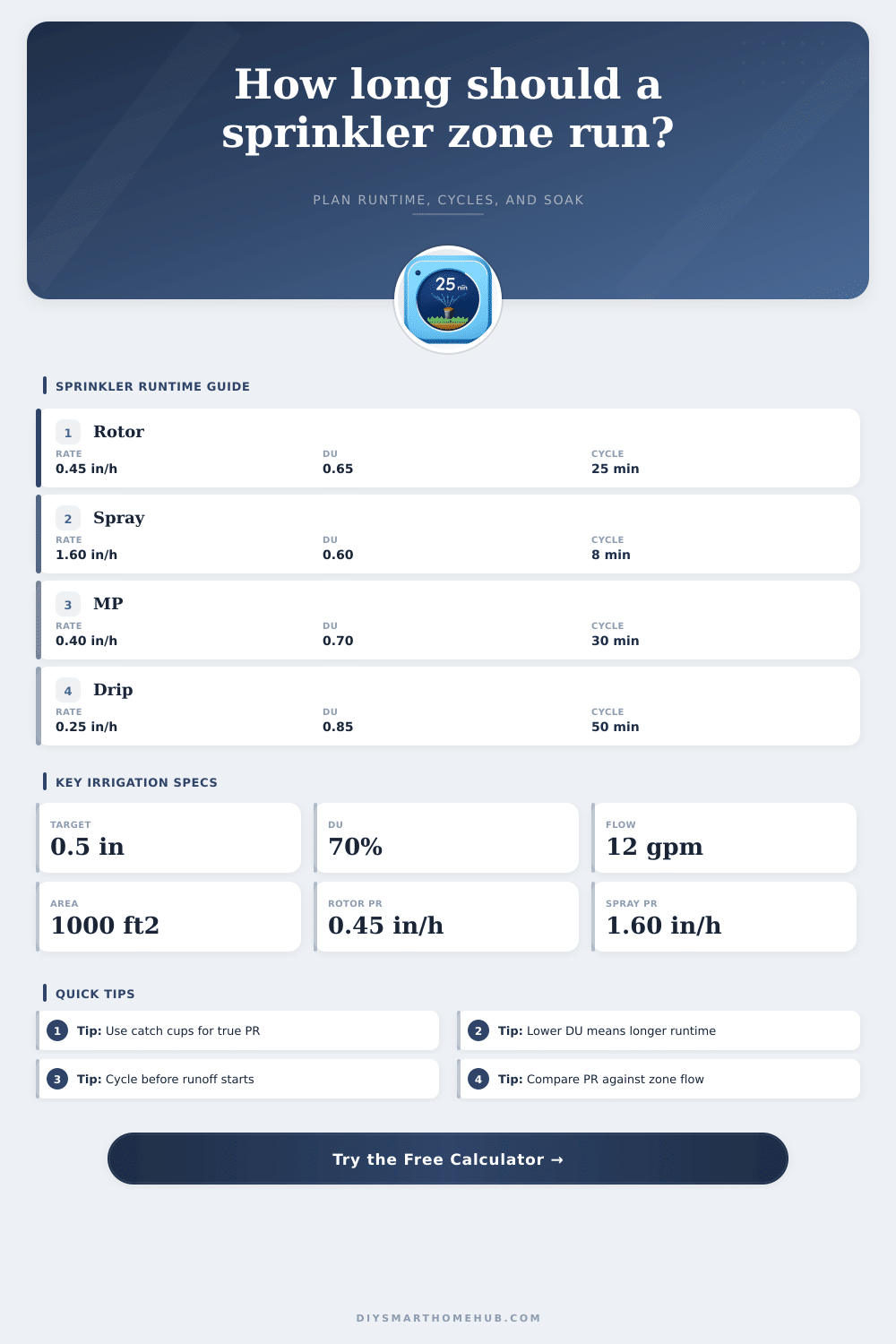
Loaded preset: Front Rotor Lawn. The calculator sizes runtime from measured nozzle rate, then checks the zone flow rate against irrigated area.
⚙Zone runtime inputs
Formula breakdown
📊Sprinkler and nozzle spec comparison grid
📘Reference tables
Soil intake and max cycle guide
| Soil | Intake | 15% slope cap | Use |
|---|
Nozzle precipitation comparison
| Nozzle type | Typical PR | DU range | Runtime behavior |
|---|
Common target depths
| Goal | Net depth | Metric | Calculator use |
|---|---|---|---|
| Light turf refresh | 0.25 in | 6 mm | Short cycle |
| Standard turf event | 0.50 in | 13 mm | Weekly split |
| Deep turf event | 0.75 in | 19 mm | Deep soak |
| New seed mist | 0.10 in | 3 mm | Frequent |
| Shrub bed drip | 0.60 in | 15 mm | Slow soak |
Preset runtime benchmarks
| Preset | Total min | Cycles | Flow PR check |
|---|
💡Calculation tips
Determining teh correct runtime for each irrigation zone is a necessary part of creating an effective irrigation plan. If each zone irrigates for too little time, your grass will dry out and become patchy. However, if each zone irrigates for too much time, the water that falls on the land will either pool upon the surface or run off the curb.
The correct time for each irrigation zone depend on several specific factor. These factors are the type of nozzle on each head, the type of soil in each zone, the slope of the land in each zone, the uniformity of the irrigation heads coverage in each zone, and the amount of water that should fall on the root zone. People often guess at the time that each irrigation zone should run.
How to Find the Right Run Time for Each Irrigation Zone
However, these guesses is often incorrect because they do not account for these specific factors. The precipitation rate of each irrigation zone is the first factor that must be considered when determining the time that each zone should run. The precipitation rate of each zone determines how many inch of rainfall the nozzles will deliver each hour.
Fixed spray nozzles will deliver the most rainfall, followed by gear rotors and rotating stream nozzles. Inline drip nozzles will deliver the least amount of rainfall. However, the precipitation rate is not the only factor that must be considered when determining the runtime for each irrigation zone.
It is also necessary to calculate the distribution uniformity of the irrigation heads in each zone. The distribution uniformity will determine how much rainfall falls on each plant zone. If the distribution of rainfall is too even, the time for each irrigation zone will have to be increased to ensure that the driest spot within the irrigation zone receives the necessary amount of water.
A calculator can determine the time for each irrigation zone if the irrigation professional enter the measured precipitation rate of each nozzle, the target depth of rainfall that is desired for each zone, and the distribution uniformity of each irrigation zone. The intake rate of the soil within each irrigation zone is the third factor to consider when determining the time for each irrigation zone to run. The intake rate of the soil determines how quick the soil can absorb the water from the irrigation zone.
Sandy soil can absorb water quick, while clay soil has a low intake rate for the soil to absorb the irrigation water quickly. The slope of the land within each irrigation zone is the fourth factor to consider. When it rains within an irrigation zone, the water begins to travel across the slope of the land before the soil can absorb all the water falling from the irrigation heads.
A calculator can determine the maximum length of each irrigation cycle by incorporating both the intake rate of the soil and the slope of the land within each irrigation zone. Using the length of the irrigation zone that such a calculator has calculated, the irrigation professional can then divide the irrigation runtime into several cycles of irrigation. The time between each cycle of irrigation is the time for the soil to absorb the water at that specific slope of the land.
Many irrigation systems fail because of long irrigation cycles for each zone. If the irrigation zones are irrigated for too long, the water sheets off the soil’s surface. Thus, the root zone of the plants dont receive the irrigation water.
Zone flow and the amount of area that is covered by each irrigation zone are two additional factors for calculating the runtime of each irrigation zone. These factors will allow the irrigation professional to compare the precipitation rate of the nozzles to the actual amount of water that falls onto the area that is covered by those nozzles. If the precipitation rate of the nozzles does not match the amount of water that lands on the irrigated area, there is an error in the irrigation system.
The error could be because the area that is irrigated was measured incorrectly or because there are changes in the water pressure within the system. Several nozzles becoming clogged can also cause these errors. A calculator will alert the irrigation professional to these issues.
Reference tables list the precipitation rates for different types of nozzles and soils, the distribution uniformity of different types of nozzles, and the intake rate of different types of soil. These tables are not a replacement for the catch-cup test. However, they can provide an initial reading of the irrigation zone measurements.
These reference tables should be used as a context for the irrigation professional’s measurement of the irrigation zone rather than a rule to follow for all irrigation zones. Different irrigation zones will have different watering schedules because of the different constraints that exist within each zone. A narrow strip of parkway with irrigation heads on a slope will have a different schedule than an extensive lawn with gear rotors within sandy loam soil.
Each controller system can have different irrigation schedules for each zone if the irrigation professional knows the specific requirements of each zone. The calculation for each zone is simple. However, it is dependent upon the irrigation professional understanding which factors is the most important within each irrigation zone.
Factors outside the irrigation calculation include weather, wind, and the intelligence of the irrigation controller. A smart controller can use weather data to skip an irrigation cycle if it is raining. Wind can affect the distribution of the nozzles’ water spray.
However, these weather factors do not enter into the irrigation zone runtime calculation equation. However, they do mean that the irrigation schedule that gets programmed into the controller is a baseline schedule. The controller’s automation will account for the weather variables so that the irrigation schedule will be most effective.
It is important to measure the irrigation zones rather than guessing at their measurements. The catch-cup test will take the irrigation professional fifteen minutes to measure the precipitation rate of each zone and its distribution uniformity. Furthermore, a soil probe can help determine whether the irrigation zones has allowed the water to reach the intended depth of the root zone.
These tools will help confirm the calculations made by the irrigation zone calculator. Using these tools will reduce the amount of dry spots in the irrigation zone and reduce the amount that runs off the curb. Furthermore, there will be lower water bills for the property owner.
The goal with irrigation zone calculations is to find the smallest length of time that each zone will run to deliver the target depth of water to the root zone. The time that this calculator calculates for each irrigation zone is the time that will deliver the target depth of water to each zone.