Mini Split Tonnage Calculator
Estimate mini-split BTU/h load, room volume, latent cooling, diversity-adjusted demand, nominal capacity, and tons using the 12,000 BTU/h per ton formula.
⚙Room And Zone Presets
🌡Tonnage Inputs
Calculation Breakdown
This calculator is a planning estimator. Final mini-split selection should also check manufacturer capacity tables, low-temperature heating output, airflow placement, and minimum modulation.
📊Mini-Split Spec Grid
📐Standard Mini-Split Tonnage Table
| Nominal Capacity | Tonnage Formula | Typical Zone Range | Best Planning Use |
|---|---|---|---|
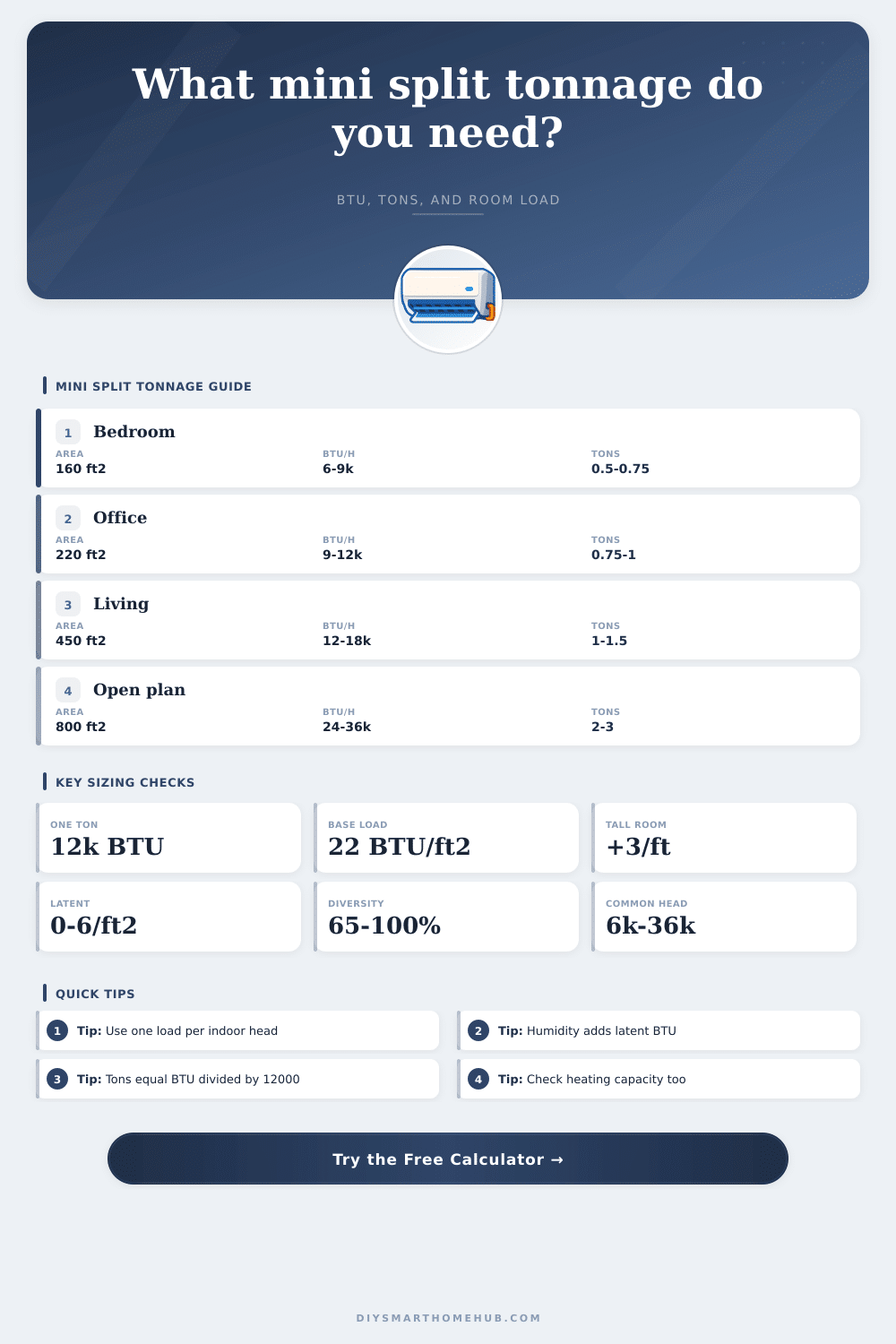
| 6,000 BTU/h | 6,000 / 12,000 = 0.50 ton | 100-250 ft² / 9-23 m² | Small bedrooms, offices, and low-load quiet spaces. |
| 9,000 BTU/h | 9,000 / 12,000 = 0.75 ton | 180-400 ft² / 17-37 m² | Bedrooms, dens, guest rooms, and compact living spaces. |
| 12,000 BTU/h | 12,000 / 12,000 = 1.00 ton | 300-550 ft² / 28-51 m² | Main rooms with average insulation and moderate internal heat. |
| 18,000 BTU/h | 18,000 / 12,000 = 1.50 tons | 500-800 ft² / 46-74 m² | Large living rooms, bonus rooms, and warm garage zones. |
| 24,000 BTU/h | 24,000 / 12,000 = 2.00 tons | 700-1,100 ft² / 65-102 m² | Open plans, workshops, and high solar or high volume rooms. |
| 36,000 BTU/h | 36,000 / 12,000 = 3.00 tons | 1,000-1,600 ft² / 93-149 m² | Large single zones or multi-zone outdoor unit comparison. |
🏠Load Factor Reference
| Factor | Formula Used | Low Value | High Value |
|---|---|---|---|
| Base sensible load | Area x 22 BTU/h per ft² | Efficient shaded rooms may be lower | Large solar or leaky rooms may be higher |
| Room volume effect | Area x height over 8 ft x 3 | No add when height is 8 ft or lower | Vaulted ceilings raise mixing load |
| Latent load | Area x selected humidity BTU/h per ft² | 0.8 BTU/h per ft² for dry rooms | 6.0 BTU/h per ft² for very humid zones |
| Internal gains | Watts x 3.412 BTU/h per watt | Small rooms with little equipment | Offices, tools, servers, and media rooms |
☀Insulation, Climate, And Latent Multipliers
| Input Setting | Model Value | What It Changes | When To Use |
|---|---|---|---|
| Excellent insulation | 0.88 envelope factor | Reduces base and height load | Tight envelope, low leakage, upgraded windows. |
| Poor insulation | 1.32 envelope factor | Raises base and height load | Older rooms, leaky shells, or weak air sealing. |
| Hot humid climate | 1.18 climate factor | Raises sensible load before latent add | Long cooling season with warm outdoor design days. |
| Very humid latent setting | 6.0 BTU/h per ft² | Adds moisture-removal BTU/h | Sunrooms, damp rooms, or high outdoor humidity. |
🔀Diversity And Room Volume Examples
| Scenario | Volume Check | Diversity Use | Tonnage Review |
|---|---|---|---|
| Single bedroom head | 168 ft² x 8 ft = 1,344 ft³ | Use 100% because one room is peaking | Usually compare 6k and 9k heads. |
| Main room plus open hall | 520 ft² x 9 ft = 4,680 ft³ | Use 85%-95% if spaces peak together | Often lands near 1.5 tons. |
| Whole-level connected zone | 1,200 ft² x 8 ft = 9,600 ft³ | Use 75%-90% if rooms differ by exposure | Check 2.5 to 3.5 ton outdoor capacity. |
| Garage or workshop | 500 ft² x 10 ft = 5,000 ft³ | Use 100% for same-time equipment heat | High internal watts can push the next size up. |
ℹTonnage Calculation Tips
Selecting the correct capacities for a mini split system is a necessary step in the installation of a mini split system. By selecting the correct capacity for a mini split system, it is ensured that the room will reach a comfortable temperature. If the mini split system that is selected have too small of a capacity to effectively cool the room, the mini split system wont be able to cool the room when its hot in the areas.
Additionally, if the mini split system that is selected has too large of a capacity to cool the area, the mini split system will continually turn on and off within the cooling cycle. By continually turning on and off, the mini split system will not be able to effectively remove moisture from the air that exists within the room, which is necessary to avoid feeling clammy within the area. Thus, it is important to ensure that the mini split system that is selected has a capacity that is appropriate for the amount of heat and moisture in the room to be cooled.
How to Choose the Right Mini Split Size
The calculator that is provided on this page is one that can calculate the correct capacity requirement for the mini split system. This mini split system capacity calculator begin with a measurement of twenty-two BTUs per square foot of area to be cooled. The capacity requirements calculator then adjusts this initial measurement based off the height of the ceilings within the area to be cooled, the insulation that is within the room, and the climate in which the area exist.
The height of the ceilings can increase the number of BTUs that is required by the mini split system. Areas with high ceilings have an increased amount of air within the area to cool. The insulation within the area can also increase or decrease the number of BTUs that is required.
Poor insulation allows for heat to enter the area, but good insulation will prevent heat from entering the area. Finally, the climate that exists within the area can increase or decrease the number of BTUs that are required of the mini split system. Areas with humid climates will require different settings different than those with dry climates.
Another factor that the mini split system capacity calculator considers is the humidity within the area. This measurement of humidity are separate from the temperature of the area. Humidity requires a certain amount of cooling capacity within the mini split system to effectively cool the amount of moisture within the air.
This humidity setting range from dry to very humid. Settings that are further from the dry setting will increase the number of BTUs that is required to cool the area. Areas with high level of humidity will require mini split systems with increased dehumidification capacity.
Areas that contain many computers, appliances, or individuals will generate heat within the area. The heat of these items is measured in BTUs, which are used in determining the total number of BTUs that will be generated within the area. The diversity setting is another that should of been considered in mini split system installations that has more than one indoor unit.
If the indoor unit that is to be connected to the outdoor mini split system will only cool one indoor room, then the diversity setting will be set to 100%. However, if there are indoor mini split systems that will cool indoor areas but that indoor areas do not reach their highest heat loads simultaneously, then the diversity setting will be used to reduce the required capacity of the outdoor mini split system unit. This setting will avoid purchasing an outdoor unit that will be too large for the needs of the indoor mini split systems.
Finally, the mini split system capacity calculator will reveal the design load of the system in BTUs per hour, the tonnage of the mini split system, and the nearest available nominal capacity of mini split system manufacturers. The figures that are calculated through these parameters can deviate from the figures that are calculated in the mini split capacity calculation. For instance, if the area to be cooled is a finished attic, there may be additional heat that the dark roof that covers the area will create.
Similarly, if the area to be cooled is a garage or workshop, there may be additional heat that is created by the tools that is within the area. Thus, while the mini split capacity calculator will provide the mini split system manufacturer with an estimated number of BTUs that will be required, the manufacturer will also utilize the information within the mini split system specifications and performance tables to ensure that the mini split system will contain enough heating capacity and air movement to cool the area that is to be cooled. The tables that are provided on this page provide information regarding the number of BTU that are contained within different sized mini split systems.
Additionally, these tables provide the relationship between BTU measurements and ton measurements of mini split systems. Other tables provide the mini split systems manufacturing use multipliers to account for the insulation of the room, the climate in which the mini split system will be used, and the humidity levels within the area. Finally, each of these tables will assist the mini split system manufacturers in understanding how each factor will impact the capacity requirement of the mini split system.
By understanding each of these factors, the mini split system manufacturers will be able to effectively and accurately utilize the calculator. The mini split system calculator will be more accurate than a simple rule of thumb calculation. A rule of thumb calculation will not account for each of the factors discussed, but the use of the mini split system manufacturer provided calculator will account for each of these factors; ensuring that the mini split system that is manufactured will have an accurate capacity according to the environment that will be cooled by the mini split system.