Smart Pet Feeder Portion Calculator
Convert a pet calorie target into feeder-ready cups, grams, rounded meal portions, hopper runout days, and calorie drift after the feeder's dispensing increment is applied.
📌Real Smart Feeder Presets
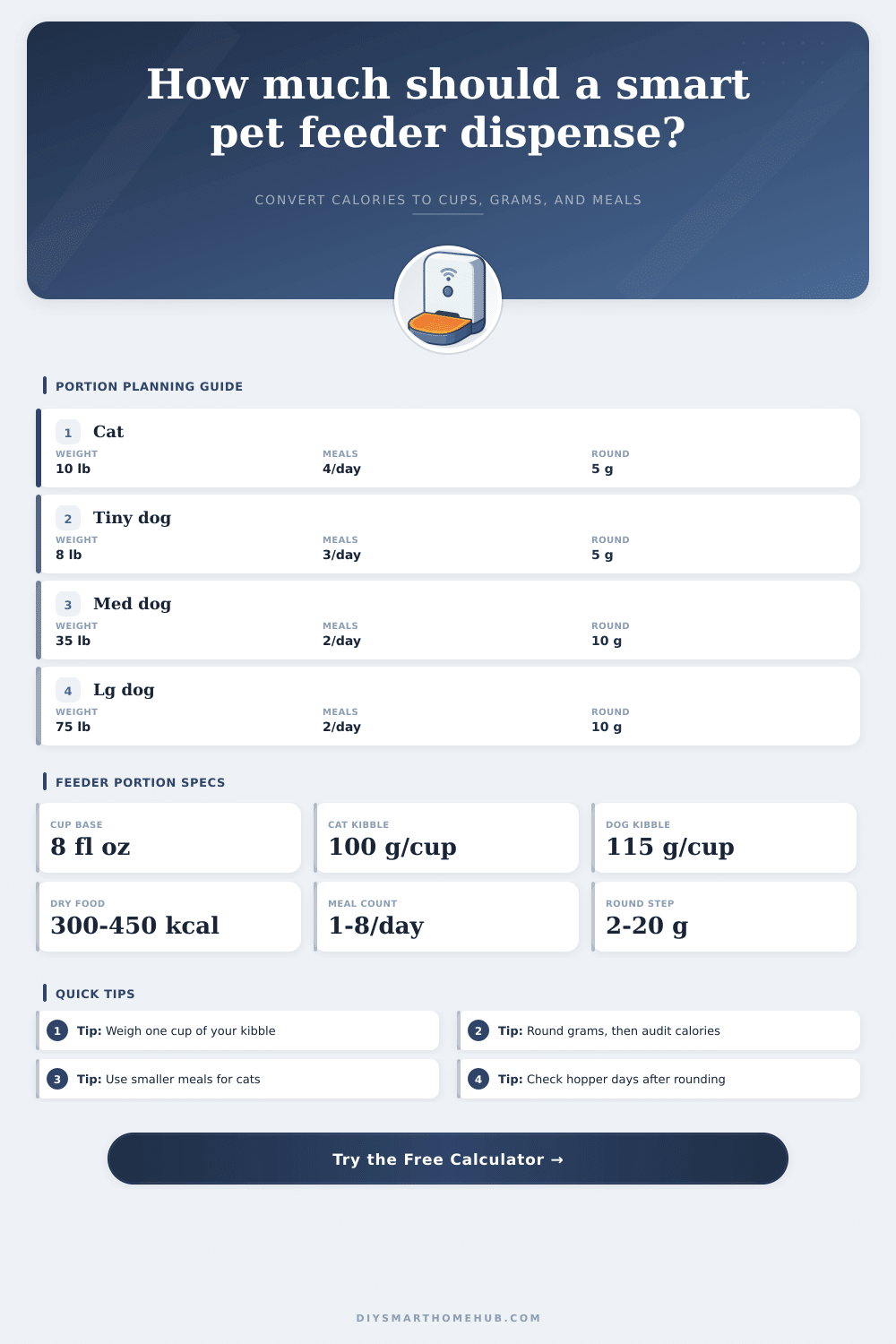
Loaded preset: Indoor Adult Cat. The feeder splits a daily calorie target into four small dry-food meals and rounds each drop to a 5 gram motor step.
⚙Feeder Portion Inputs
📊Current Feeder Spec Snapshot
📐Reference Tables
Food Density Reference
| Food type | Typical kcal/cup | Typical g/cup | Feeder note |
|---|---|---|---|
| Adult cat dry food | 350 to 450 | 85 to 115 | Small kibble usually works with 2 to 5 g steps. |
| Kitten dry food | 400 to 520 | 90 to 120 | Energy dense food makes rounding drift matter more. |
| Small breed dog dry | 340 to 430 | 95 to 125 | Small meals benefit from fine motor increments. |
| Adult dog dry food | 300 to 420 | 105 to 135 | Medium kibble often needs 5 to 10 g rounding. |
| Large breed dog dry | 300 to 390 | 115 to 150 | Large kibble may bridge in narrow chutes. |
Smart Feeder Portion Grid
| Feeder style | Best portion step | Meal range | Best fit |
|---|---|---|---|
| Scale-based feeder | 1 to 2 g | 5 to 300 g | Cats, tiny dogs, calorie-sensitive plans. |
| Small rotor feeder | 2 to 5 g | 8 to 120 g | Cat kibble and small breed kibble. |
| Standard rotor feeder | 5 to 10 g | 15 to 200 g | Most adult dog and cat dry-food plans. |
| Large hopper feeder | 10 to 20 g | 40 to 450 g | Large dogs and multi-pet dry food setups. |
| Timed gravity assist | Audit by scale | Variable | Needs calibration because kibble flow changes. |
Common Preset Outcomes
| Preset | Daily target | Meals | Modeled drop |
|---|
Rounding Drift Reference
| Step | Small meal risk | Best use | What to watch |
|---|---|---|---|
| 1 g | Very low | Scale feeders and calibration checks. | Scale tare and bowl movement. |
| 2 g | Low | Cats and toy dogs with small meals. | Dense kibble can still overshoot calories. |
| 5 g | Moderate | Most dry-food smart feeders. | Meals under 20 g can drift noticeably. |
| 10 g | High for cats | Medium and large dog portions. | Small pets may need fewer calories than one step. |
| 20 g | Very high | Large dog meals only. | Use only when each meal is comfortably large. |
🔍Feeder and Pet-Food Spec Comparison
| Scenario | Food density | Feeder step | Hopper planning | Recommendation |
|---|---|---|---|---|
| Single indoor cat | 90 to 110 g/cup | 2 to 5 g | 8 to 16 cups usable | Use more meals and smaller rounded drops. |
| Two-cat shared feeder | 90 to 115 g/cup | 5 g | 12 to 24 cups usable | Check that each pet gets the intended share. |
| Toy dog | 95 to 120 g/cup | 2 to 5 g | 8 to 18 cups usable | Keep rounding drift under the profile threshold. |
| Medium dog | 105 to 130 g/cup | 5 to 10 g | 16 to 32 cups usable | Two or three meals usually round cleanly. |
| Large dog | 115 to 150 g/cup | 10 to 20 g | 24 to 48 cups usable | Use large chute hardware for bigger kibble. |
💡Portion Calibration Tips
To calculate the portion for an automatic feeder, one must consider an amount of food that the automatic feeder will dispense into the pet’s food bowl. The amount of food that an automatic feeder dispenses can have an impact on the weight and the health of the pet. Automatic feeders is devices that will dispense a specific amount of food to an animal at a set time interval.
However, the automatic feeder may not always dispense the amount of calories that the pet require to function proper. If the amount of calories that is dispensed are incorrect, the pet may become either too overweight or too underweight, or it may develop begging behavior for food. The calculator included with the automatic feeder product will calculate the amount of food in grams or cup that the automatic feeder should dispense to provide the number of calories that the calculator determines the pet requires.
How to Calculate Food Portions for an Automatic Feeder
The calculator will also report the amount of food that the automatic feeder will dispense after it perform rounding of the amount of food that should be dispensed by the automatic feeder. The automatic feeder’s motor performs this rounding of the amount of food to provide specific increment to move the food from the automatic feeder to the pet’s food bowl. Many individuals will use the number of calories that is published by the pet’s veterinarian or the food label of the food that the automatic feeder is to dispense.
However, the calorie value from the food label does not account for the density of the food. For instance, one type of kibble may weigh more than another type of kibble, even if the volume of the kibble are the same. Thus, it is necessary to measure the food to determine how many grams of food contain one cup of food.
This measurement is critical in that if the number of calories is converted to volume of food incorrect, the automatic feeder will dispense the correct amount of food in relation to the portion settings of the automatic feeder, but it will dispense the wrong number of calories to the pet. Another factor that must be considered in the calculation of the portions of food that should be dispensed by the automatic feeder is the mechanical limit of the automatic feeder. Most automatic feeders will dispense the amount of food to the pet in increments; the motor of the automatic feeder may only be able to round the amount of food to the nearest gram.
Using five gram increments may not cause significant error in feeding a medium-sized dog, but it could lead to significant errors in feeding a cat. The calculator can be used to determine this potential drift in the amount of food that will be dispensed; based on this determination, an owner may be able to adjust the portion settings of the automatic feeder. The capacity of the hopper of the automatic feeder is another factor in determining the amount of food that will be dispensed to the pet each day.
The hopper of the automatic feeder have a limited amount of space to hold the food that will be dispensed to the pet. Thus, to determine the number of days that the food will last in the automatic feeder, the total capacity of the hopper can be divided by the amount of food that will be dispensed each day. The calculator will report the number of days the food will last in the automatic feeders hopper after rounding of the amount of food.
This will help to ensure the pet owner does not unexpectedly run out of food for there pet. The type of food that will be fed to the pet may also impact the settings of the automatic feeder. For instance, large breed dog kibble is less dense than kitten food; thus, a cup of each type of kibble will contain a different number of calories.
Additionally, some type of automatic feeders may be better than others for dispensing specific types of food to certain types of pets. For instance, automatic feeders that use scales to measure the amount of food dispensed is often recommended for cats, since these devices can measure one gram increments. Rotor-style automatic feeders are often used for dispensing food to adult dogs.
The behavior of the pet also may impact the settings of the automatic feeder. For instance, cats typically eat more frequently than dogs. Thus, the number of meals that are fed to the cat per day may need to be increased in the automatic feeder’s settings.
Conversely, the number of meals per day that are fed to dogs may need to be decreased. These settings can be attempted in the automatic feeder using the portion calculator included with the automatic feeder product. Another reason to use the portion calculator is for purpose of weight control of the pet.
The control of the weight of a pet requires precision in the amount of food that is fed to the pet. If the pet is on a reduced-calorie diet, the error in the amount of food that the automatic feeder dispenses can have a significant impact upon the pet’s health. The portion calculator will calculate the percentage of the error in the amount of food that is dispensed from the automatic feeder, as well as the actual number of calories that may be dispensed.
This information can help the owner of the automatic feeder to determine if the error in the amount of food that is dispensed is too large for the weight control requirements for the pet. Finally, another factor to consider is the effect of the environment in which the automatic feeder and the food is stored. For instance, high humidity in the environment may lead the kibble to clump together.
The ability of the food to clump may impact the amount of food that flow through the automatic feeder. Additionally, the food that is stored within the bag in which it is dispensed to the automatic feeder may settle over time. This settling of the food may impact the number of grams of food per cup of food.
The portion calculator does not account for these variables, but they can be periodically accounted for by re-weighing the food to determine if any adjustment should be made in the grams per cup measurement that is entered into the calculator. To use the portion calculator for the automatic feeder, one cup of food should be measured. The food should be weighed to determine the grams of food per cup of food.
This measurement can then be entered into the portion calculator. The portion calculator will calculate the amount of food in grams or cups that the automatic feeder should dispense to provide the number of calories that the calculator determines the pet requires. The calculator will also report the amount of food that the automatic feeder will dispense after it performs rounding of the amount of food that should be dispensed by the automatic feeder.
Based on these figures, an owner can adjust the settings of the automatic feeder to ensure that it dispenses the amount of food that are required by the pet.