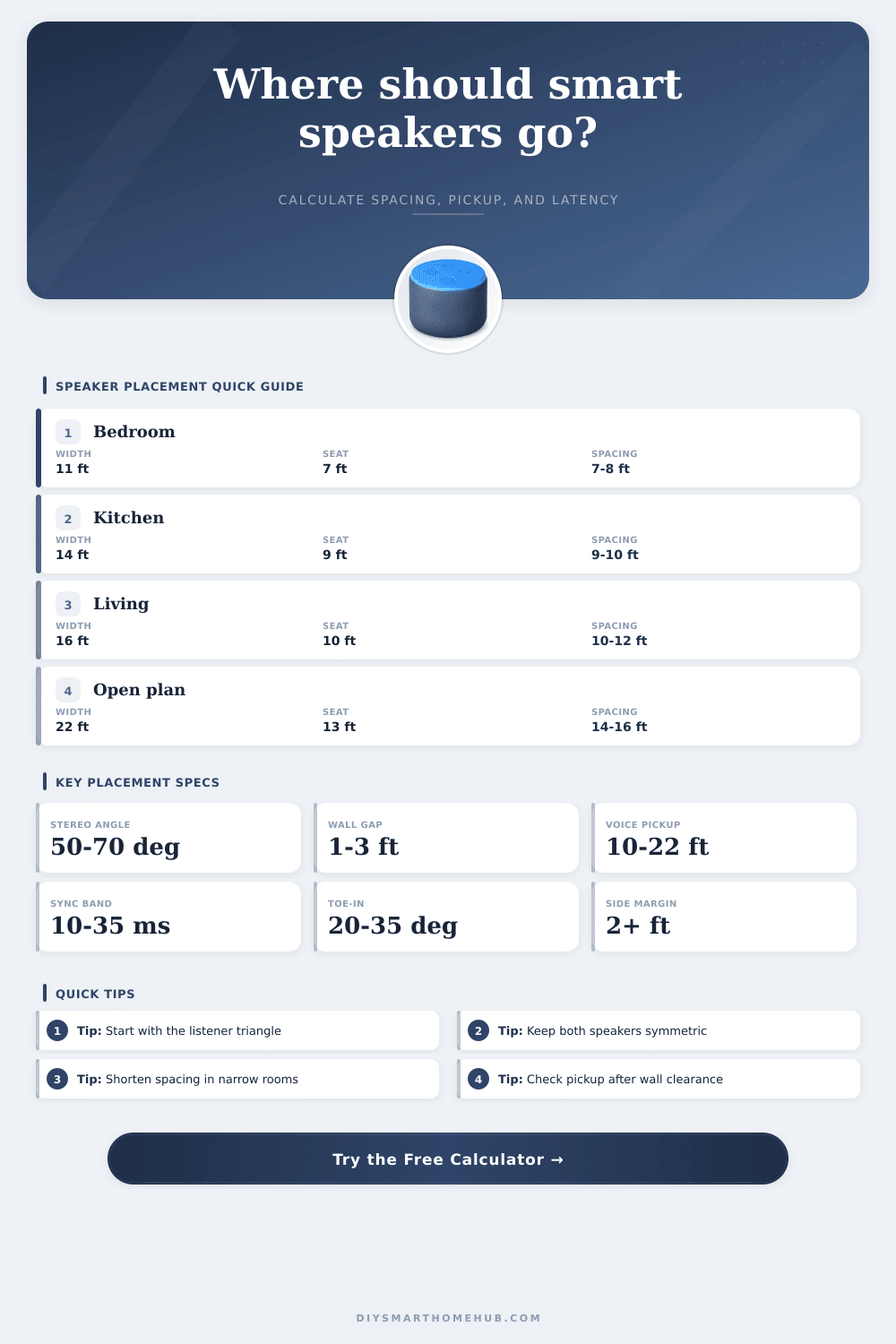
Smart Speaker Placement Distance Calculator
Plan stereo smart speaker spacing from room dimensions, listener triangle geometry, wall clearance, voice pickup reach, speaker profile limits, and latency tolerance.
Full placement breakdown
Compact voice speaker
Fits desks, nightstands, and small rooms. Use tighter spacing and shorter pickup estimates because output and mic arrays are modest.
Balanced smart speaker
Good default for kitchens, offices, and living rooms. It tolerates normal wall clearance and a standard 60° triangle well.
Premium stereo speaker
Works best when the room allows a wider triangle, more side clearance, and enough depth for the listener to sit off the front wall.
Smart display speaker
Placement must balance screen visibility with audio geometry. A display often sits closer to the listener than pure stereo speakers.
Assistant soundbar
Uses the TV wall as the front reference. Treat its virtual separation as wide, but verify voice pickup at the actual couch distance.
Weather-ready speaker
Patios and garages need shorter pickup ranges and conservative spacing because background noise weakens command reliability.
| Target angle | Separation formula | Spacing at 8 ft seat | Placement use |
|---|---|---|---|
| 50° narrow triangle | 2 x distance x tan(25°) | 7.5 ft / 2.3 m | Small rooms, desks, shared-wall apartments |
| 60° equilateral triangle | 2 x distance x tan(30°) | 9.2 ft / 2.8 m | Default music and stereo smart speaker layout |
| 70° wide triangle | 2 x distance x tan(35°) | 11.2 ft / 3.4 m | Open rooms where side-wall clearance remains healthy |
| Room-limited triangle | room width - 2 x side clearance | depends on width | Use when the desired triangle is wider than the room |
| Wall clearance | Typical distance | Formula effect | Best used for |
|---|---|---|---|
| Tight shelf placement | 0.5 to 1 ft / 0.15 to 0.3 m | Reduces available separation | Small displays, nightstands, and desks |
| Normal smart speaker gap | 1.5 to 2.5 ft / 0.46 to 0.76 m | Balances side clearance and stereo width | Most living rooms and offices |
| Premium speaker breathing room | 2.5 to 4 ft / 0.76 to 1.22 m | Limits spacing in narrow rooms | Larger speakers with stronger bass output |
| TV wall or soundbar reference | 0.5 to 1.5 ft / 0.15 to 0.46 m | Keeps front offset shallow | Soundbars, displays, media-room assistant nodes |
| Pickup or latency case | Planning value | Formula check | Placement meaning |
|---|---|---|---|
| Quiet bedroom or office | 14 to 22 ft / 4.3 to 6.7 m pickup | Adjusted pickup should exceed triangle side | Commands come from a fixed seat or bed area |
| Kitchen, garage, or patio | 8 to 16 ft / 2.4 to 4.9 m pickup | Use shorter range for noise and appliances | Place closer to the counter, bench, or door path |
| 10 ms tight sync | 11.3 ft / 3.4 m path difference | Latency band is narrowest | Use for critical music or close stereo pairs |
| 20 to 40 ms normal sync | 22.6 to 45.2 ft / 6.9 to 13.8 m path difference | Often supports a couch-width band | Good default for smart speaker stereo pairs |
| Placement project | Typical room dimensions | Starting spacing | Primary check |
|---|---|---|---|
| Bedroom smart pair | 11 x 13 ft / 3.4 x 4.0 m | 5 to 8 ft / 1.5 to 2.4 m | Nightstand symmetry and voice pickup from bed |
| Desk stereo speakers | 10 x 12 ft / 3.0 x 3.7 m | 3 to 5 ft / 0.9 to 1.5 m | Near-field triangle and front-wall clearance |
| Living room sofa pair | 14 x 18 ft / 4.3 x 5.5 m | 9 to 12 ft / 2.7 to 3.7 m | 60° triangle without side-wall crowding |
| Open-plan main floor | 20 x 28 ft / 6.1 x 8.5 m | 12 to 18 ft / 3.7 to 5.5 m | Latency band and voice pickup from work zones |
| Garage workshop zone | 20 x 20 ft / 6.1 x 6.1 m | 8 to 12 ft / 2.4 to 3.7 m | Short pickup path in a noisy space |
Smart speaker placement involve two different goals for smart speakers. Each goal is somewhat in conflict with the other goal. For music listening, the listener should arrange speakers to provide balance stereo sound.
For voice assistant control of smart home devices, the speakers must have voice command range to hear the listener’s commands. These two goals involve different geometry requirement for optimal performance. Therefore, the placement of smart speakers must balance these two requirements.
Where to Put Smart Speakers for Music and Voice
Placing smart speakers against a wall or on a shelf in the center of the shelf may seem like an easy solution for many people; however, both of these placement options has the potential to cause either a lack of balance between the left and right speaker, or to cause issues for the voice assistants ability to hear the listener. Speaker placement must take into consideration the triangle that is formed by the two smart speakers and the listener. The angle of this triangle impact both the width of the soundstage that is created by the speakers and the timing of the left and right speakers.
A sixty-degree angle is often targeted for this triangle; however, the width of the listening room may make it impossible to achieve such an angle. A calculator can help the listener determine the ideal distance between the two smart speakers in the room based off the dimensions of the room and the angle that is targeted. In addition to the calculation of the ideal distance between the smart speakers, it is also necessary to provide clearance against the wall.
The speakers need this space to effectively produce bass sound. Additionally, placing the speakers too close to the wall may cause the speakers’ microphones to pick up the reflected sound that is created when the sound waves hit the wall. The amount of space that is required for the speakers to have clearance against the wall may vary based upon the model of the smart speaker.
If the calculations indicates that the speakers need to be closer together to provide clearance against the wall, then the size of the room is the limiting factor in smart speaker placement in that room. The range in which the speakers can effectively hear the listener’s voice is different than the range in which they produce balanced stereo sound. Furthermore, the range for voice recognition is often shorter than the range that is required for the speakers to project balanced stereo sound.
Calculators determine the range that the speaker microphones can hear based upon the profile of the smart speaker. The calculator compares this range to the distance between the smart speaker and the listener. If the distance between the speakers and the listener is greater than the range that the speakers can hear the listener’s voice, the user must move the speaker closer to the listener.
Another factor to consider in speaker placement is the latency of the speakers when the listener is not located in the center of the speakers. The latency is created due to the fact that sound travels at a fixed rate. When the listener moves away from the center of the smart speakers, the distance that the sound travels from one speaker to the listener is different than the distance that the sound travels from the other speaker to the listener.
The smart speaker placement calculator may include a setting that allows the listener to enter the latency tolerance that the listener desires for the speakers sound. A tight latency tolerance may be selected if the speakers are to be use to listen to music, whereas a more lenient setting may be used if multiple listeners will mostly use the speakers to listen to music at the same time. The calculations for speaker placement are based upon the assumption that the listening room is in the shape of a rectangle.
Most real listening rooms, however, will have furnitures, windows, and doorways in the room. These elements will reflect the sound waves created by the speakers and may cause dead zone in the listening area. Therefore, the speaker placement calculator provides a starting point for speaker placement.
The speakers should be placed at the coordinates provided by the calculator. After placing the smart speakers at these calculated coordinates, the listener should listen to music and try to command the voice assistant. Small adjustments to the position of the smart speakers may fix these problems that were thought to be significant when deciding upon the placement of the speakers based upon the calculations.
It is common for people to treat the concept of balanced stereo sound as the same as the voice command range of the speakers. People may optimize the speakers for stereo sound but find that the voice command range isnt effective in recognizing the listener. Additionally, it is common for people to ignore the difference between compact versus large smart speakers.
These ignored differences may cause the listener to find that the speaker placement suggested by the smart speaker placement calculator is either too wide or too narrow for their smart speaker models. A comparison grid can help the listener to understand these differences and to select the best speaker profile for there needs. Open-plan spaces may require consideration of where the voice assistant should hear the listener in the room.
For instance, it may be necessary for the speakers to hear the listener from both the kitchen and the living room. The speaker placement calculator will indicate the outer limits of the voice command range of the speakers. Based upon this information, the listener may have to purchase and place a second smart speaker in order to effectively control all devices throughout the open-plan space.
When the speakers are placed correctly, each speaker will produce an image of the sounds that are played through the speakers, will hear the listener when speaking to the speaker, and the timing of the speakers will be consistent.