Power Bank Phone mAh Calculator
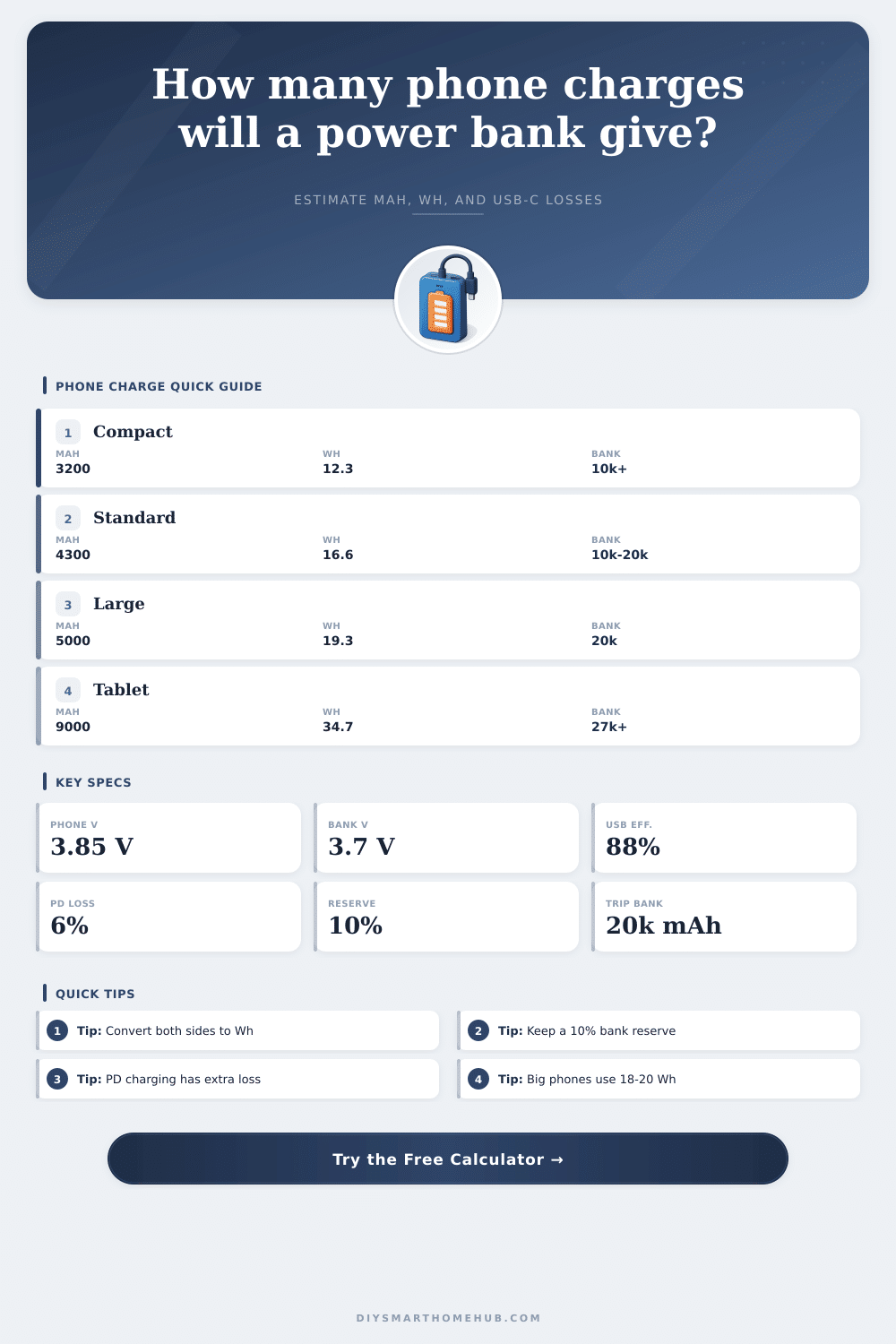
Convert phone battery mAh and power bank mAh into watt hours, usable phone-side energy, USB-C PD losses, reserve capacity, and expected full charges.
Modern Li-ion phone packs are usually labeled around 3.82 to 3.90 V nominal.
Phone Wh equals phone mAh times nominal battery volts divided by 1000.
A 10000 mAh bank at 3.7 V stores about 37 Wh before output losses.
Good power banks often deliver about 85 to 92 percent after voltage conversion.
| Phone class | Battery mAh | Nominal voltage | Approx phone Wh |
|---|---|---|---|
| Compact phone | 3000-3400 mAh | 3.82-3.87 V | 11.5-13.2 Wh |
| Standard phone | 4000-4600 mAh | 3.85 V | 15.4-17.7 Wh |
| Large flagship | 4800-5400 mAh | 3.85-3.90 V | 18.5-21.1 Wh |
| Small tablet | 8000-10000 mAh | 3.80-3.87 V | 30.4-38.7 Wh |
| Power bank rating | Cell voltage | Stored Wh | Typical phone-side Wh |
|---|---|---|---|
| 5000 mAh | 3.7 V | 18.5 Wh | 13.8-15.3 Wh |
| 10000 mAh | 3.7 V | 37.0 Wh | 27.5-30.6 Wh |
| 20000 mAh | 3.7 V | 74.0 Wh | 55.0-61.3 Wh |
| 27000 mAh | 3.7 V | 99.9 Wh | 74.3-82.7 Wh |
| Loss setting | Typical range | What it covers | Use when |
|---|---|---|---|
| Conversion efficiency | 82-94% | Boost converter and electronics | Always include it |
| USB-C PD loss | 3-10% | Fast-charge voltage changes and heat | Charging above basic 5 V |
| Cable loss | 1-5% | Cable resistance and connector heat | Longer or worn cables |
| Reserve | 5-20% | Capacity not planned for use | Travel or backup planning |
| Scenario | Phone battery | Bank size | Expected result |
|---|---|---|---|
| Short commute | 4300 mAh | 5000 mAh | About one full charge |
| Weekend travel | 5000 mAh | 20000 mAh | About three full charges |
| Camera-heavy day | 4855 mAh | 27000 mAh | About four full charges |
| Two phone share | 4500 mAh | 30000 mAh | About five full charges |
Power bank boxes don’t give you numbers; they throw numbers at you in an attempt to impress you. Ten thousand milliamp hours sounds nice, but then your phone only gets to about eighty percent when you go to charge it. That’s a disconnect, and the reason is that power bank makers measures capacity at the voltage of their cells and your phone measures it at another voltage entirely. It’s like they’re using two different currencies and you’re trying to compare them before converting from one to the other. The converter above does the math for you so you know whether that hulking brick in your bag can make it through the day.
The first set of numbers will trick you into thinking that you know something; but they don’t tell you anything about watt hours, which is where your actual battery capacity lies, no matter what the voltage might be. A typical phone battery contains four thousand three hundred milliamp hours at an average of three point eight five volts. So that’s about sixteen point six watt hours of energy in the battery. And then you have this big power bank marked as having ten thousand milliamp hours; typically powered by cells rated at a nominal three point seven volts, so thirty-seven watt hours total. In theory, that means two and a half charges from empty to full.
How to Calculate Real Power Bank Capacity
In reality, physics requires payment for moving electrons, it’s never quite as gooder. Other serious factors also cuts down how many charges you actualy get out of your power bank. A boost converter inside the power bank boosts the voltage from the lithium cell(s) up to the five or more volts needed for USB standards. That creates heat, which is wasted energy. An average of 85-92% efficiency rating is what most good banks achieve. The calculator accounts for this loss from the boost converter stepping up the voltage, plus further penalties if you’re using a fast charging protocol such as USB-C Power Delivery.
Fast charging is convenient, sure, but it also involves some extra heat loss and negotiation overhead that can eat away one or two percentage points on top of that. It does work, but it’ll cost you in terms of energy too. Most folks don’t think much about the cable used to charge their devices. However, the longer the cable and/or lower quality it is, the more electrical resistance it has, causing some of those wanted watt hours to be wasted as unnecessary heat prior to reaching the phone port. Keep the cable short and ensure it can handle current, and you’ll save on battery drain.
Also take into account a reserve capacity in your math. Save ten percent of the bank’s energy to keep it unspent. That way, when you’re truly running on fumes, you won’t find yourself stuck halfway down the road with a dead power source and only a half-charged phone. Don’t plan for zero; it’s never a good plan.
Don’t worry about getting as many milliamp hours from the shelf as you possibly can; instead get a battery with as many watt hours of storage as you actualy use each day. So if you burn sixteen watt hours in your phone a day and your bank outputs about twenty eight usable watt hours (after losses), then you’ve got a full charge plus a partial second one… Which is frequently plenty for a weekend trip. If you are heading out for a longer trip, getting a larger bank like a twenty thousand milliamp hour one will give you some extra head room, but it will also weigh much more in your pack. The chart at the bottom of the page does a good job of laying out those tradeoffs so that you can visualize how far off the starting line you’re going to be before making a commitment to a purchase.
A power bank isn’t an endless supply of energy; it’s a fuel tank. Plan accordingly for how much juice you’ll need on your trip, and then add some padding if you want to stop at any detours along the way. To do this, turn the specs for your bank and phone into watt hours. That strips out all the marketing gobbledygook and lets you see what’s really going on: What are the real-world engineering limitations? From there, you won’t undershoot and buy something that has you twitchy by mid-day or overshot and bought a giant brick that you only ever use as a doorstop. It’s really just about knowing what they’re measuring beneath their plastic bodies.
Start thinking in terms of energy instead of just current. Shopping for chargers then becomes a simple exercise in practical math, rather than a roll-of-the-dice with your battery. You should of looked at the watt hours first to avoid this mess.