Power Bank Watt Hours Calculator
Convert advertised mAh into battery watt hours, pack voltage, usable USB-C output energy, estimated phone charges, laptop charges, and carry-on airline limit status.
Calculation breakdown
| Advertised capacity | Wh at 3.7 V | Usable USB Wh at 88% | 5 V output mAh estimate |
|---|---|---|---|
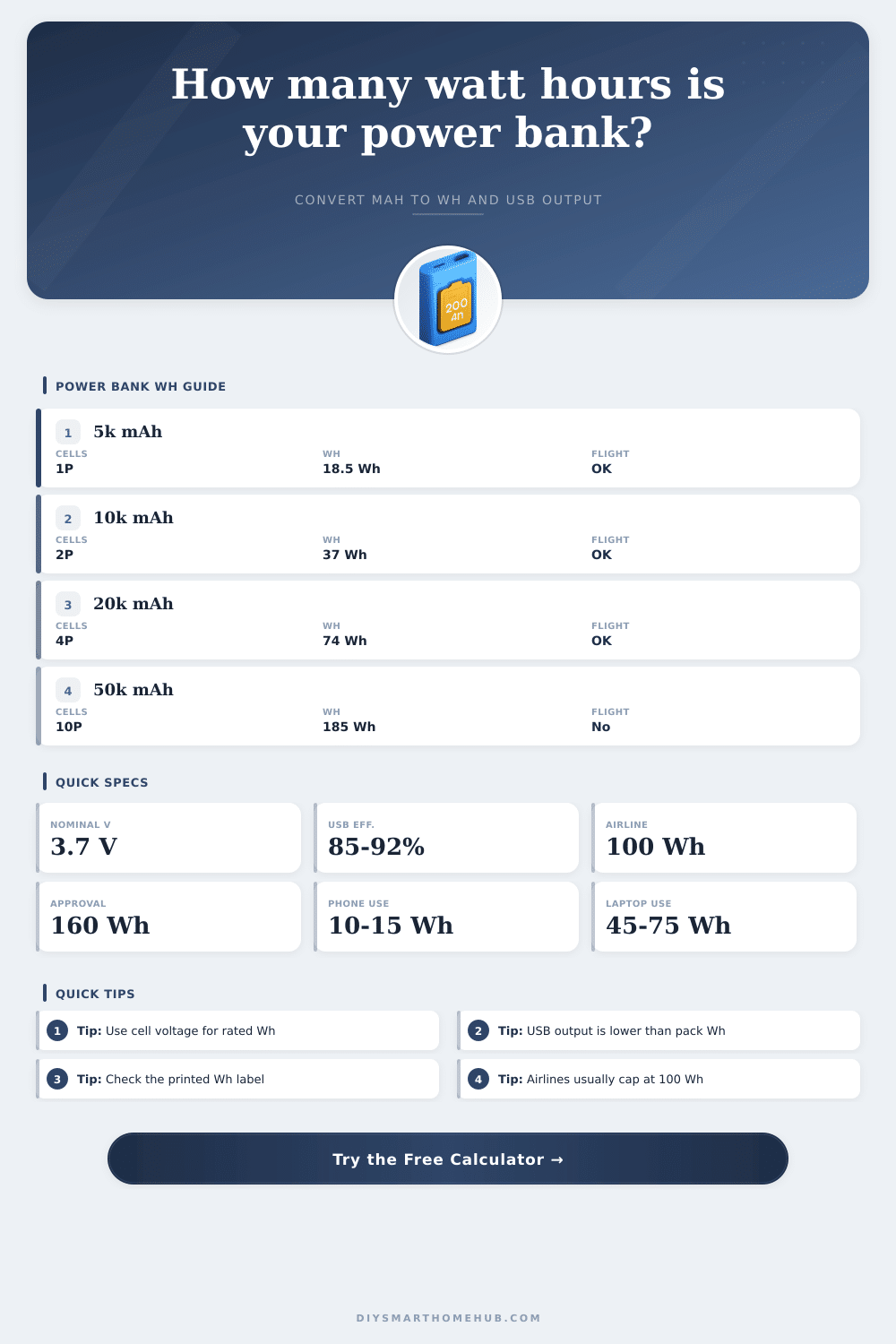
| 5,000 mAh | 18.5 Wh | 16.3 Wh | About 3,260 mAh |
| 10,000 mAh | 37.0 Wh | 32.6 Wh | About 6,510 mAh |
| 20,000 mAh | 74.0 Wh | 65.1 Wh | About 13,020 mAh |
| 26,800 mAh | 99.2 Wh | 87.3 Wh | About 17,460 mAh |
| 30,000 mAh | 111.0 Wh | 97.7 Wh | About 19,540 mAh |
| Battery energy | Common carry-on status | Checked baggage status | Calculator note |
|---|---|---|---|
| Up to 100 Wh | Usually allowed | Usually not allowed loose | Keep terminals protected and carry with you. |
| 100 to 160 Wh | Airline approval commonly required | Usually not allowed loose | Often limited to two spare batteries. |
| Above 160 Wh | Generally not allowed as spare lithium battery | Special cargo rules may apply | Do not assume a large pack can fly. |
| Missing Wh label | May be refused | May be refused | Printed Wh rating is easier for screening. |
| USB mode | Typical voltage | What changes | Best use |
|---|---|---|---|
| Basic USB-A | 5 V | Highest output mAh number, same usable Wh | Phones, earbuds, low-power devices |
| Quick-charge / PD low | 9 V to 12 V | Lower current for the same wattage | Fast phone and tablet charging |
| USB-C PD mid | 15 V | Useful bridge for tablets and small laptops | Tablets, handheld PCs, compact notebooks |
| USB-C PD laptop | 20 V | Output mAh appears smaller at higher voltage | Laptops that accept USB-C power delivery |
| Power bank type | Label capacity | Approximate Wh | Typical practical use |
|---|---|---|---|
| Slim pocket bank | 5,000 mAh at 3.7 V | 18.5 Wh | One partial to full phone charge. |
| Daily carry bank | 10,000 mAh at 3.7 V | 37 Wh | Two phone charges for many users. |
| Travel phone bank | 20,000 mAh at 3.7 V | 74 Wh | Several phone charges or tablet backup. |
| Flight-limit laptop bank | 26,800 to 27,000 mAh at 3.7 V | 99 to 100 Wh | Common upper size before approval. |
| High-capacity PD bank | 30,000 to 40,000 mAh at 3.7 V | 111 to 148 Wh | Laptop-focused pack, airline approval zone. |
A 20,000 mAh bank at 3.7 V stores about 74 Wh, not 100 Wh. The voltage attached to the mAh rating decides the energy.
USB output mAh changes at 5 V, 9 V, or 20 V. Watt hours stay consistent and show the real usable energy after conversion loss.
There’s this large power brick in your palm at a TSA checkpoint, and you’re wondering whether you’ll make it through without it being confiscated, or worse, without the charger. It has 20,000 milliamp hours, you read on label, which is a heckuva lot of juice for your laptop and phone, right? Wrong.
To the airline agent, who isn’t measuring capacity in either milliamps or amp hours but rather watt hours, you’re advertising a number in one unit that no one needs, while they’re looking for a completely different unit. That’s why most travel angst over portable chargers comes from this disconnect between what regulators demand and what manufacturers claim.
Why Watt Hours Are More Important Than Milliamp Hours for Travel
How do you turn that impressive-sounding number into a number that matches your gadgets’ capacities, as well as the capacities that flight attendant is expecting? When most consumers think about milliamp hours, they thinks it is simply a way to describe units of energy; it’s not. Consider milliamp hours to be the tank (size) and voltage to be the pressure behind the water. You could have a small tank full of pressure or a large tank with little pressure. Both would contain equal amounts of energy.
Typically lithium ion cells is operated around three point seven volts. If you have 10,000 mAh at that voltage, you have approximately 37 Wh of usable energy in your bank. After plugging in your exact rating into the calculator above, it do all the work for you, which helps avoid any guesswork on how those internal ratings convert to real world use cases. It also factors out inefficiencies involved with transferring power from your battery cells to your USB port.
A big source of dissapointment with battery packs is efficiency. To charge your phone, your power bank has to take the lower voltage inside its cells and ramp it up to five volts or more. That requires a conversion process which also produces heat, Heat equals waste. Waste means lost energy. It vanishes into thin air. An average boost converter will only keep about eighty five percent of existing battery’s energy as usable output.
If you’re looking at a spec sheet claiming X number of charges, make sure that it includes losses from realistic usage, or if it claims perfect efficiency. Adjust the reserve percentage to reflect the way older batteries don’t hold charge like they used to. Watt hours are more important since it’s the international measure for energy content (not just capacity) which, not surprisingly, have strict airline ties.
Batteries with less than one hundred watt hours don’t need prior authorization to go in your carry on. Most airlines requires some kind of prior authorization for devices from one hundred to one hundred sixty watt hours. Anything greater is frequently prohibited as a spare battery. That’s pretty clear if you look at the reference table on the page and know exactly where your device falls in the hierarchy of the law. It keeps you from having an embarrassing moment trying to explain what the heck you have to the security guard after they remove a giant brick from your bag.
The output voltage doesn’t make a difference in terms of overall charging capacity, if you want to charge your laptop with 20 volts or your smartphone with five volts, you’ll use the same amount of energy off the battery as before. Only the current that flows down the cable changes (with higher voltage = lower current). This is great for managing heat and also prolonging the life of the cable itself. It’s less stress on those fancy connectors inside your device.
You can switch between them and tool will calculate how much of a charge you’d realistically be able to get per cycle depending on size of your laptop/phone battery. If you use older power banks: Repeatedly depleting them entirely (or letting them sit charged to 100% continuously for weeks) make them age prematurely. Lithium ion chemistry prefer partial cycles; moderate charge levels are best.
By including a reserve percentage in the calculator, you are also planning for the unavoidable wear-and-tear of use. This also accounts for colder temperatures reducing the battery’s effectiveness. You should of been better safe than sorry at the airport with your phone totally dead.
The bottom line is that milliamp hours are marketing and watt hours is reality. Knowing this helps you select gear based off your travel needs, not only because it will run long enough, but because it won’t surprise you with rules or disappoint you with runtime. Maybe you need that big brick anyway. But at least now you know why the numbers mean something and can confirm ’em on your own.
Next time you purchase a charger, skip over the flashy capacity claims and glance down to read the fine print… the one about the actual energy rating. It is a little thing that makes all the difference when you are away from an outlet.