Power Bank mAh Calculator
Convert power-bank capacity between mAh and watt-hours at cell, pack, and USB output voltages, with series and parallel cell math, efficiency loss, reserve, and airline threshold checks.
🔋Pack voltage presets
📏Conversion inputs
⚙Cell and pack spec grid
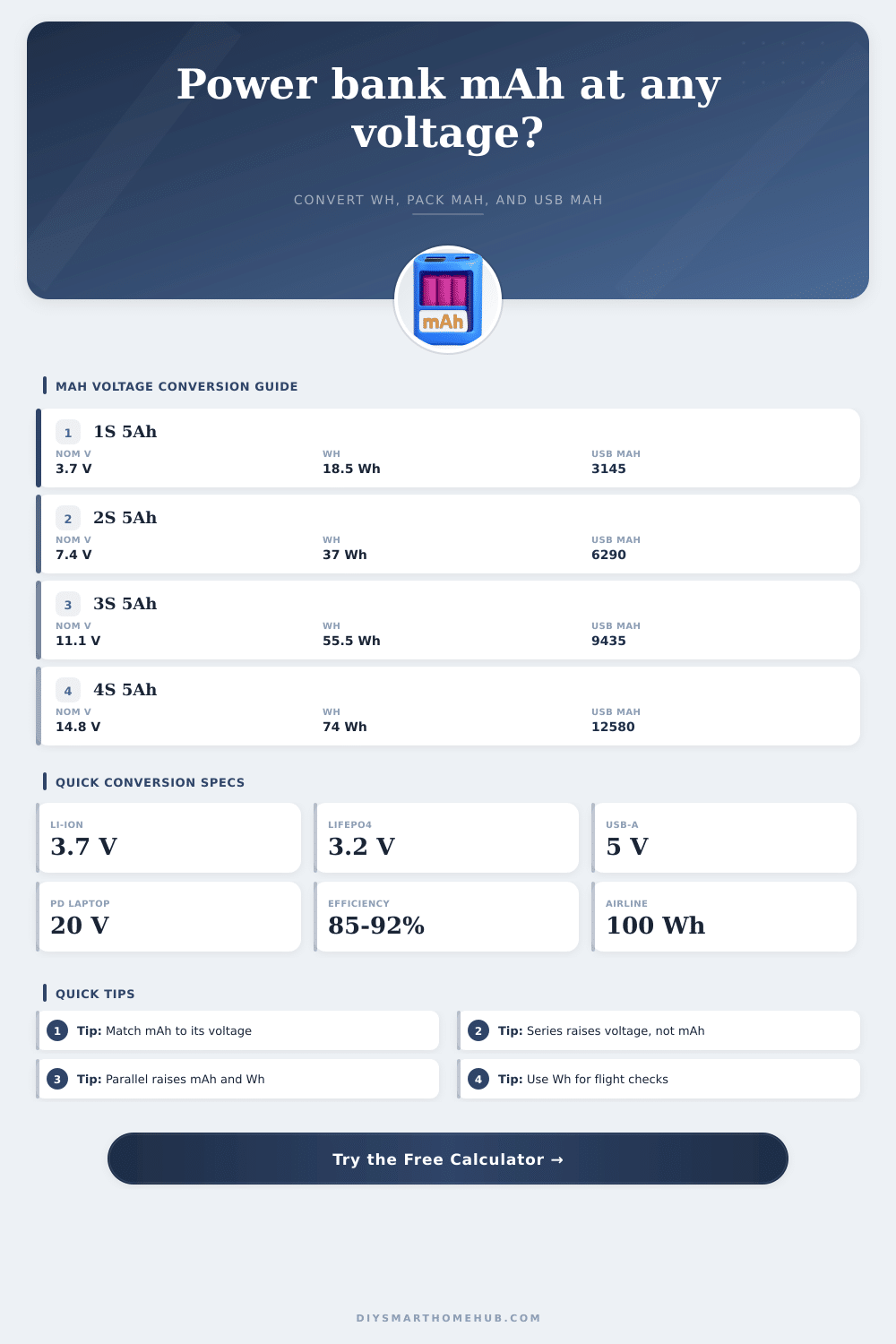
📊Voltage preset reference
| Pack preset | Cell model | Nominal voltage | Where it appears |
|---|---|---|---|
| 1S Li-ion | 1 x 3.7 V | 3.7 V | Common USB power banks |
| 2S Li-ion | 2 x 3.7 V | 7.4 V | Compact DC packs and small UPS banks |
| 3S Li-ion | 3 x 3.7 V | 11.1 V | 12 V-class electronics before regulation |
| 4S Li-ion | 4 x 3.7 V | 14.8 V | High-power USB-C and DC output packs |
| 10S Li-ion | 10 x 3.6 V | 36 V | E-bike and high-voltage tool-style banks |
🧮Conversion formulas
| Need | Formula | Example | Meaning |
|---|---|---|---|
| mAh to Wh | mAh x V / 1000 | 10000 x 3.7 / 1000 | Energy at that voltage |
| Wh to mAh | Wh x 1000 / V | 37 x 1000 / 5 | Ideal mAh at a new voltage |
| Nominal pack V | Cell V x series | 3.7 x 4 = 14.8 | Series cells raise voltage |
| Pack mAh | Cell mAh x parallel | 5000 x 2 | Parallel cells raise capacity |
| Usable output mAh | Wh x eff x reserve x 1000 / output V | 37 x 0.85 x 0.95 x 1000 / 5 | After conversion losses |
🔌Cell chemistry reference
| Chemistry | Nominal cell V | Typical use | mAh conversion note |
|---|---|---|---|
| Li-ion / Li-poly | 3.6 V to 3.7 V | Most slim power banks | Printed mAh is often cell-side |
| LiFePO4 | 3.2 V | Long-life DC packs | Lower cell voltage changes Wh |
| NiMH | 1.2 V | AA-style rechargeable packs | Many cells needed for USB boosting |
| Lead acid cell | 2.0 V nominal | Sealed backup packs | Use Wh for fair comparison |
✈Airline and output examples
| Stored energy | Cell-side mAh at 3.7 V | Usable 5 V mAh at 85% | Flight planning signal |
|---|---|---|---|
| 18.5 Wh | 5000 mAh | 3145 mAh | Well below 100 Wh |
| 37 Wh | 10000 mAh | 6290 mAh | Common carry-on size |
| 74 Wh | 20000 mAh | 12580 mAh | Near large-bank range |
| 100 Wh | 27027 mAh | 17000 mAh | Typical no-approval limit |
| 160 Wh | 43243 mAh | 27200 mAh | Often approval-limited |
💡Practical tips
You’re about to take a long plane trip, so you purchase this power bank that says it has twenty-thousand milliamp hours. This means you’ll have enough juice to give yourself a full charge twice over. So you go home, plug it in, and what do you find? It had just enough to give you a single charge, and maybe a half-charge at best.
It didn’t lie; it’s just that the number lacked its partner. Milliamp-hours don’t mean anything on their own. It’s a function of time and current, specifically, voltage multiplied by current and then multiplied by time. In other words, milliamp hours without voltage are an incomplete picture. You’ve got some idea of how far you traveled, but you don’t know where you ended up.
Why mAh Numbers Can Be Misleading
Once you enter your own efficiency assumptions and particular cell layout, the calculator does math for you rather than leaving you guessing about all sorts of conversions and coefficients. Most battery packs is made from off-the-shelf lithium ion cells. These cells has their capacity printed at 3.7V, which is also the nominal voltage of a single cell. If you then use that bank to charge something over USB, the circuitry inside will boost that voltage back out to five volts or more. As voltage rises, however, available current have to fall. That’s basic physics; energy can’t be made from nothing.
The tool takes this into account by allowing you to set your output voltage and see what effect that has on effective capacity. This also explains the huge difference in battery life caused by inefficiency. Whenever you put your energy through a boost chip or a step up converter, some of that gets converted into heat. That means you’re losing anywhere from ten to fifteen percent of your stored energy when going from your power bank to your device. You’ll always overestimate how long your power bank lasts if you don’t account for this loss. You can input whatever efficiency percentage you want here. This is useful when comparing cheaper generic banks to more expensive premium ones with better thermal management.
It goes beyond what is listed on the box. Most folks don’t think much about cell chemistry, but it really does matter. Lithium iron phosphate runs lower (3.2 volts) than the standard 3.7 volt rating for lithium ion. Even though the milliamp hour rating may be equal on the box, the watt hour total will differ. When purchasing from an off-the-shelf manufacturer who doesn’t list chemistry, or building a customized pack, using incorrect voltage assumption can throw your whole energy calculation significantly off.
The reference table on the page lays it out clearly and shows the final numbers for both series and parallel configuration. Parallel increases capacity at constant voltage. Series increases voltage at constant capacity. Knowing what kind of connection your power pack has will tell you how to expect it to behave when charged. For example, if your pack is higher-voltage, it could possibly just charge your laptop. No need for any aggressive boosting. That means better efficiency. If your pack’s lower-voltage, it’ll have to do more work in its internal chips, resulting in increased loss and warmer components during fast charges.
The other complication is bringing big batteries. No, airlines don’t worry about milliamp hours. What they are concerned with is watt hours. Watt hours represent real energy storage capacity. Power banks less than one-hundred watt hours should of been fine for most airlines without prior approval; those between one-hundred and one-hundred sixty usually require permission; anything more is generally not allowed in carry on baggage. Get yourself a calculator or converter app that will convert whatever printed mAh value you have into Wh so that you don’t find yourself at the security checkpoint handing over your high dollar equipment.
In conclusion: a power bank is nothing more than a mobile warehouse of electrons. The voltage indicates how hard those electrons can be made to work; the number on the box indicates how many electrons are waiting. Combine the two numbers while accounting for how much is lost during conversion. This moves you from vague expectations to solid planning. You will no longer have to guess if your gear will last until dark, because you will know exactly when it will fail. The number on the box is merely the beginning.