📷 Lux to EV Calculator
Convert between lux and exposure value (EV) for smart home security cameras and photography automation.
| EV | Lux (C=2.5) | Scene Description | Camera Setting Context |
|---|---|---|---|
| -4 | 0.16 | Deep night, no moon | Requires IR illuminator |
| -2 | 0.63 | Candlelight, very dim | Long exposure / night vision |
| 0 | 2.5 | Full moon, clear sky | High ISO, wide aperture |
| 1 | 5 | Night outdoor (lit street) | ISO 3200, f/2, 1s |
| 3 | 20 | Twilight / dusk | ISO 1600, f/2, 1/4s |
| 5 | 80 | Indoor dim | ISO 800, f/2.8, 1/15s |
| 6 | 160 | Indoor (corridor) | ISO 800, f/2.8, 1/30s |
| 7 | 320 | Indoor average | ISO 400, f/2.8, 1/30s |
| 8 | 640 | Indoor bright (office) | ISO 400, f/4, 1/60s |
| 10 | 2560 | Overcast bright | ISO 100, f/8, 1/125s |
| 11 | 5120 | Light cloud | ISO 100, f/8, 1/250s |
| 12 | 10240 | Overcast outdoor | ISO 100, f/8, 1/500s |
| 13 | 20480 | Hazy sunshine | ISO 100, f/11, 1/500s |
| 14 | 40960 | Hazy sun | ISO 100, f/11, 1/1000s |
| 15 | 81920 | Direct sunlight | ISO 100, f/16, 1/1000s |
| 16 | 163840 | Bright snow / sand | ISO 100, f/16, 1/2000s |
| EV | Aperture (f/) | Shutter Speed | ISO | Smart Camera Use |
|---|---|---|---|---|
| 0 | f/1.4 | 1s | 100 | Full moon outdoor |
| 3 | f/2 | 1/4s | 100 | Dusk / twilight |
| 5 | f/2 | 1/15s | 100 | Dim indoor |
| 7 | f/2.8 | 1/30s | 100 | Indoor average |
| 8 | f/4 | 1/60s | 100 | Indoor bright |
| 10 | f/5.6 | 1/125s | 100 | Overcast outdoor |
| 12 | f/8 | 1/500s | 100 | Cloudy outdoor |
| 15 | f/16 | 1/1000s | 100 | Full sunlight |
Converting lux to EV is a theme that commonly appears in photography. A light meter occasionally gives value in lux, which is the illuminance of the scene, but to use it with a camera, you must convert that to EV100. Commercial meters are much cheaper than those for photography, but they measure only in lux.
So, knowing how to go between those two values is quite useful
How to convert lux to EV
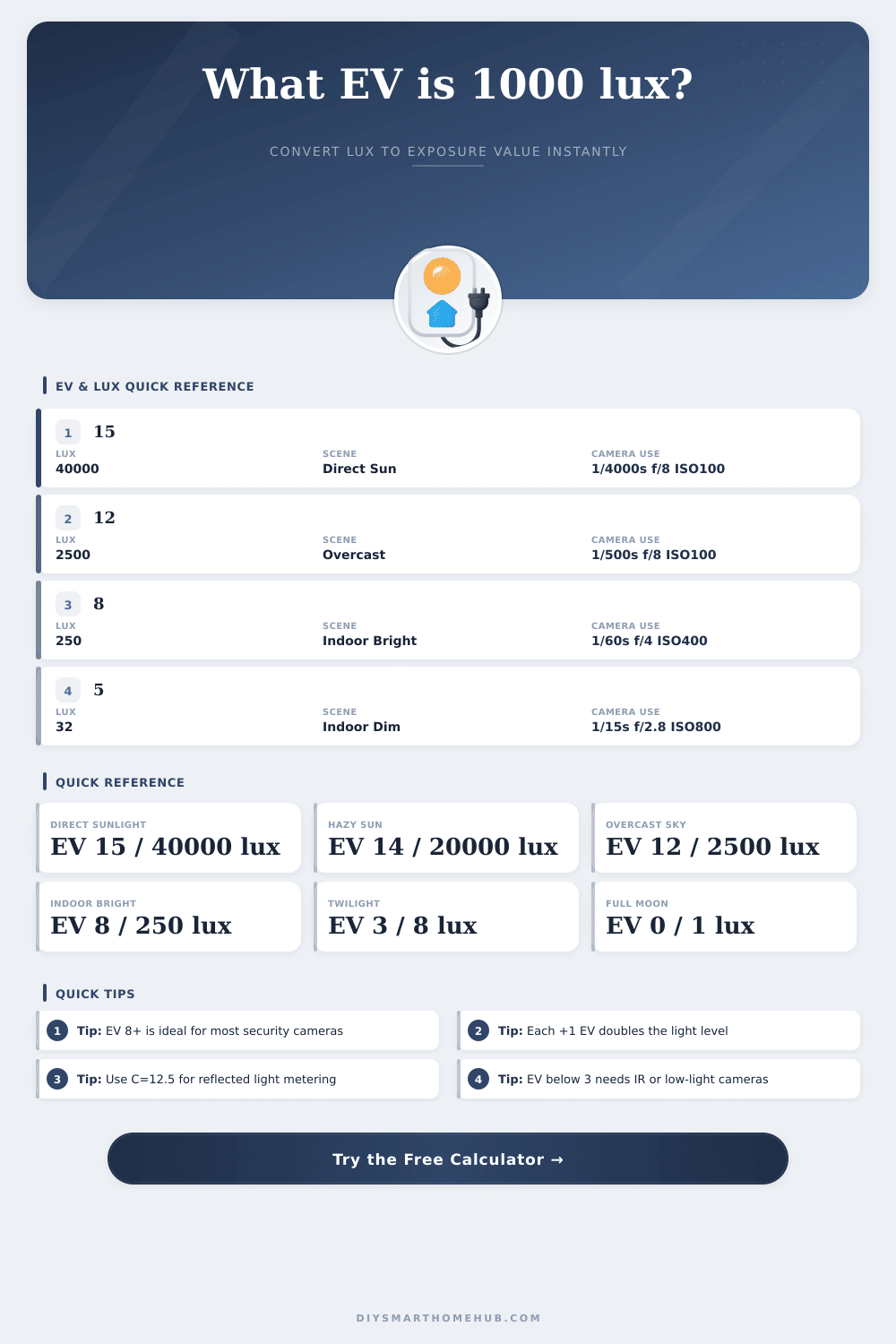
The main formula that binds those values is: lux equals 2 power of EV, multiplied by 2.5. This equation converts EV to lux. Even so, commonly we require the reverse: convert lux to EV.
For help with that, exist various online calculators. One such tool asks you enter the lux value measured by your meter (between 1.25 and 926,819 lux) and it gives the corresponding EV value, rounded down.
To better understand the scale, notice that 1 EV is 5 lux, 2 EV is 10 lux, and 3 EV is 20 lux. It works logrithmic. Remember that EV depends on the ISO or film speed.
The mentioned values count only for ISO 100. For instance, EV 0 at ISO 100 means 2.5 lux.
Canon, Nikon and Sekonic use a calibration value of 12.5. Because that is exactly one-eighth and the math bases itself on powers of two, it equals negative three. Like this the formula becomes: L equals 2 power of (EV minus 3).
Maybe it seems that the differences between makers are too big, but that only happens because of various calibration standards that each company uses.
As a sample, EV 0 at ISO 100 corresponds to opening f/1 and shutter speed of 1 second. The famous “sunny f/16 rule” suggests that the shutter speed be about the same as the ISO value. At ISO 100 and shutter speed of 1/125 second, the EV is around 14 and two-thirds at f/16. That matches to about 65,000 lux or 6,000 footcandles.
Because the f/16 rule is only a guess, those values are enough.
There is also a concept called Light Value or LV. That which some sources call EV100 or what light meters call EV should actually be called LV. Light Value measures the illuminance in lux, which is the light coming directly from the object.
Converting lux to EV is only the first step; later you add the ISO and shutter speed to find the right f-stop. Illuminance is measured by a flat sensor, and the typical value C is 250 when youuse lux.