Chiller Tonnage Calculator
Calculate chilled water system capacity in tons of refrigeration from flow rate and temperature differential
Calculator
Please enter valid positive values. Check that return temp > supply temp.
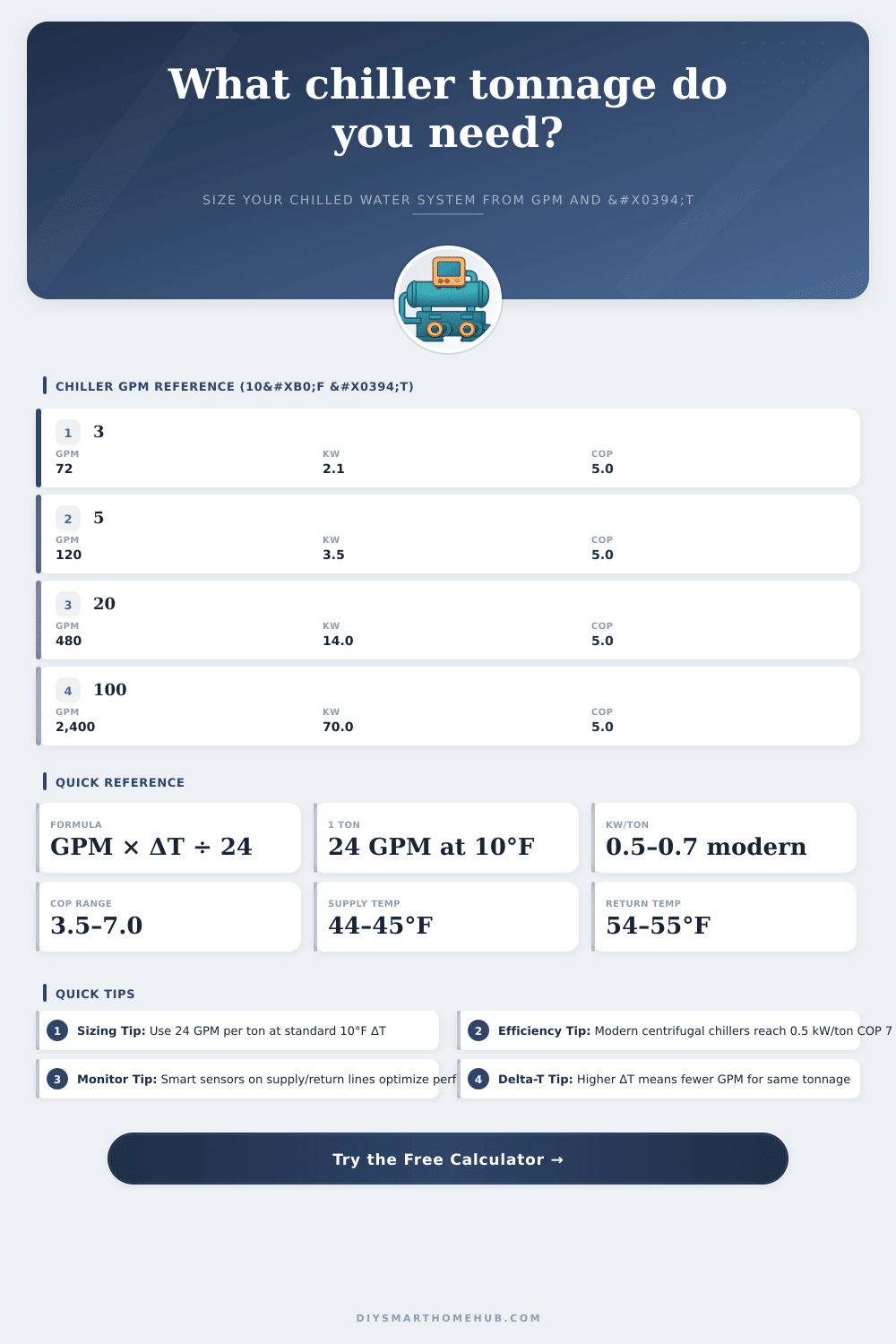
Chiller GPM Spec Grid (10°F ΔT Standard)
Chiller Sizing Reference Table
| Capacity (Tons) | GPM at 10°F ΔT | kW (0.6 kW/T) | COP | BTU/hr | Typical Application |
|---|
Chiller Efficiency Comparison Table
| Chiller Type | kW/Ton | COP | EER | Technology / Era |
|---|---|---|---|---|
| Magnetic Bearing Centrifugal | 0.35–0.50 | 7.0–10.0 | 24–34 | Current high-efficiency |
| Variable Speed Centrifugal | 0.45–0.55 | 6.4–7.8 | 22–27 | Modern premium |
| Fixed Speed Centrifugal | 0.55–0.65 | 5.4–6.4 | 18–22 | Current standard |
| Screw Chiller (VFD) | 0.55–0.70 | 5.0–6.4 | 17–22 | Current commercial |
| Scroll Chiller | 0.70–0.90 | 3.9–5.0 | 13–17 | Small/medium systems |
| Reciprocating Chiller | 0.90–1.10 | 3.2–3.9 | 11–13 | Older / legacy |
| Aging Centrifugal | 1.00–1.20 | 2.9–3.5 | 10–12 | Pre-1990 units |
| Absorption Chiller (single) | 0.80–1.00 | 0.7 (COP thermal) | — | Waste heat / steam driven |
❄ Smart Chiller Monitoring
Install flow meters and temperature sensors on both the supply and return chilled water lines. A smart controller can calculate real-time tons of refrigeration and kW continuously, flagging efficiency drops that indicate fouled heat exchangers, refrigerant loss, or pump degradation. Target a stable ΔT of 10°F; a collapsing ΔT signals low flow or a distribution problem.
❄ Optimizing Chilled Water ΔT
Raising chilled water ΔT from 10°F to 14°F reduces required pump flow by 30% for the same tonnage, cutting pump energy significantly. Smart variable-speed pumps combined with automated setpoint control can hold an optimal ΔT across all load conditions, reducing chiller plant energy use by 15–25% compared to constant-flow systems.
Chiller sizes are measured in tons, and that goes back to old methods Before electronic systems existed, you harvested ice blocks from cold lakes and rivers in North America to cool houses during the summer. Because of that history, the term “tons” is still used.
One chiller ton equals 12,000 BTU each hour, or 288,000 BTU during 24 hours. This is the basic unit to measure how much heat a chiller can remove. The goal of an industrial chiller is to move heat from one place to another.
What a Chiller Ton Is and How to Count It
You commonly use water or a water glycol solution to move the heat, which requires the device to have a reservoir and pump system.
You commonly think that nominal tons base on ambient temperature of 95°F. Even so, in reality, there is no industrial standard or fixed rule for those values. In practical conditios, the actual capacity of a “10-ton” chiller can range between four and 12 tons, depending on the design. That is a very big difference.
To count the tonnage, the formula is tons equals GPM multiplied by the delta T and divided by 24. Another way is to use the formula 500 times GPM times delta T, which gives BTU each hour. Then, you divide that by 12,000 to get the tons.
The number 500 comes from the conversion of water weight to gallons, 8.3 pounds of water times 60 equals almost 500.
In the plastic industry, calculations for tonnage base on a coolant temperature of 50°F, with capacity to handle a temperature rise of 10°F because of the process load. For injection molding, about 30 pounds each hour of high-density polyethylene equals one ton, and around 35 pounds each hour of low-density polyethylene also equals one ton.
It is good practice to choose a chiller 20 percent bigger than required. So, the ideal size is the calculated tons multiplied by 1.2. If the cooling load is 91 tons, a 90-ton chiller will not suffice.
It is better to choose the next available size, for instance a 100-ton chiller.
To count kW each ton, you divide the power input in kW by the chiller capacity in tons. You cannot simply convert tons to kW, because a chiller does not convert electricity to tons, it pumps heat. With modular chillers, the capacities can pass 1,000 tons, and technically you could build a chiller without limit.
The main factor here is the economy.
Here, at the cooling tower, the equivalent ton indeed removes about 15,000 BTU each hour, because you must consider the heat produced by the compressor of the chiller.
The coolingtower removes heat.