EER Calculator
Calculate Energy Efficiency Ratio — find EER, COP, SEER estimate & annual energy use
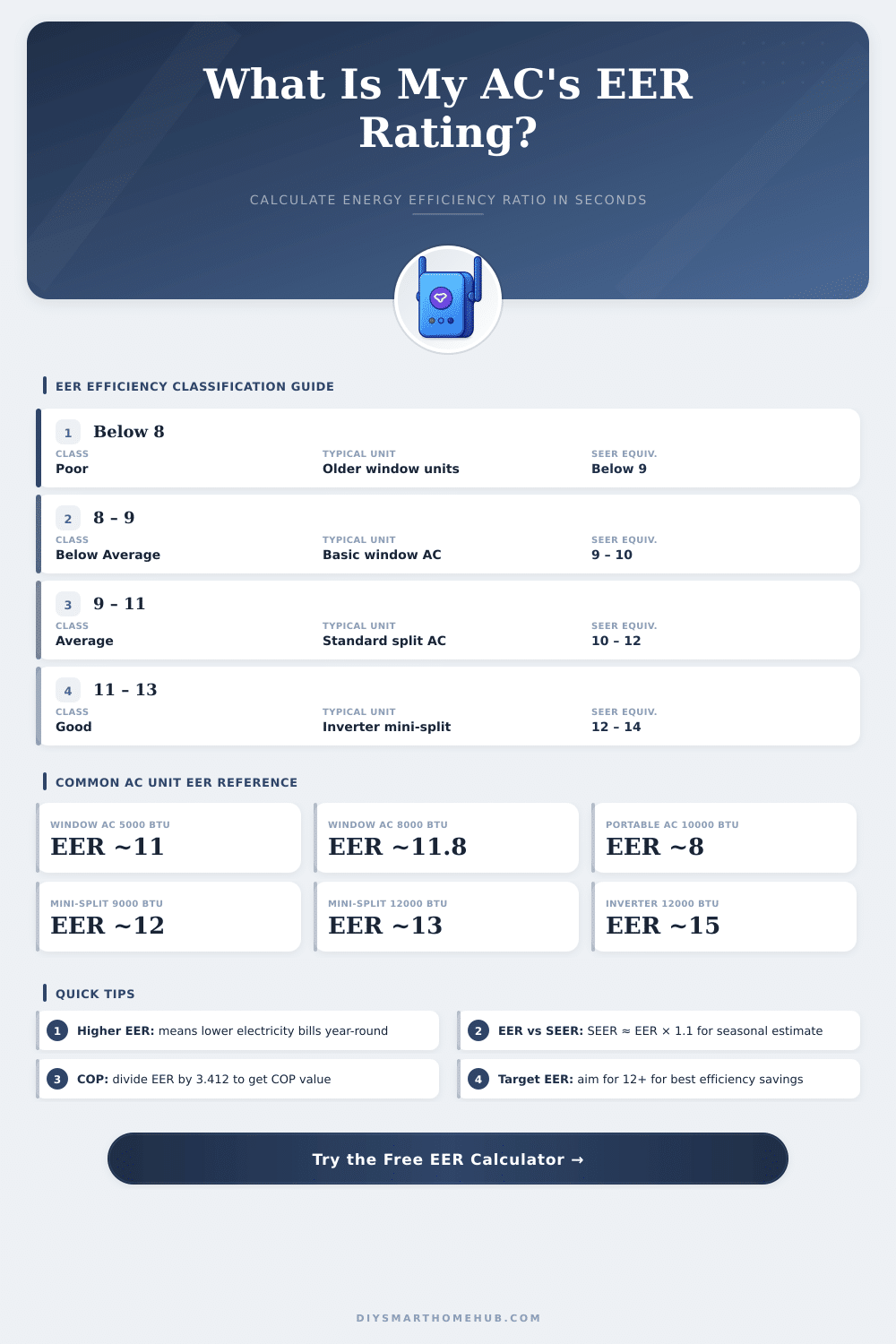
| EER Range | Efficiency Class | Typical Unit Type | SEER Equivalent |
|---|---|---|---|
| Below 8 | Poor | Older window units | Below 9 |
| 8 – 9 | Below Average | Basic window AC | 9 – 10 |
| 9 – 10 | Average | Standard room AC | 10 – 11 |
| 10 – 11 | Average+ | Mid-range split | 11 – 12 |
| 11 – 13 | Good | Inverter mini-split | 12 – 14 |
| 13 – 15 | Excellent | High-efficiency split | 14 – 17 |
| Above 15 | Superior | Premium inverter unit | Above 17 |
| Metric | What It Measures | Test Condition | Formula |
|---|---|---|---|
| EER | Efficiency at peak load | 95°F outdoor / 80°F indoor | BTU ÷ Watts |
| SEER | Seasonal efficiency | Varied temperature range | BTU/season ÷ Wh |
| SEER2 | Updated seasonal metric | Higher static pressure test | Updated SEER |
| COP | Unitless efficiency ratio | Same as EER conditions | EER ÷ 3.412 |
| HSPF | Heating efficiency | Heating season total | BTU heat ÷ Wh |
| Unit Type | BTU/hr | Typical Watts | Typical EER |
|---|---|---|---|
| Window AC (small) | 5,000 | 450 | ~11.1 |
| Window AC (medium) | 8,000 | 680 | ~11.8 |
| Portable AC | 10,000 | 1,250 | ~8.0 |
| Mini-Split 9k | 9,000 | 750 | ~12.0 |
| Mini-Split 12k | 12,000 | 920 | ~13.0 |
| Inverter Mini-Split 12k | 12,000 | 800 | ~15.0 |
| Central AC 18k | 18,000 | 1,600 | ~11.3 |
| Central AC 24k | 24,000 | 2,200 | ~10.9 |
An EER calculator gives you a rough figure for how many calories your body needs daily to stay in energy balance. EER is short for Estimated Energy Requirement and it is the best guess at your daily calorie needs. To find that number, the calculation considers your age, sex, height, weight and your level of activity.
Using an EER calculator is quite simple. You only enter your age, sex, height, weight and activity, and some versions even allow you to set a target weight. The tool then counts how many calories you should eat to keep your current weight.
How an EER calculator works
In the background, it uses equations from the Institute of Medicine to find those energy demands.
Even so, there is a probelm: you can choose only from four categories of activity. That simplicity is both an advantage and disadvantage. First, it eases the process.
On the other hand, it does not consider everything you do during the day… For example lifting weights, sports, running or other activities. Even so, for most healthy folks, the result gives a solid rating of your basic EER.
The math behind that becomes a bit hard. Calculations for women use one formula, it subtracts 6.91 times your age from 354, then adds your weight in kilos multiplied by 9.36 and an activity factor, and finally adds 726 times your height in meters. Men have their own version.
One common formula for men starts at 160.3, subtracts 30.8 times the age, then adds 10 times the weight multiplied by the activity factor, and 934 times the height. That activity multiplier adjusts depending on whether you are sedentary, a bit active, active or very active.
Despite that, there is a whole set of different formulas to find a rough result. Some tools use the Mifflin-St. Jeor Equation to count BMR instead.
When you use that method, you commonly receive results that match better with other calculators. The standard EER method can give very different figures compared with a regular TDEE calculator. Dietary guidelines suggest that a 21-year-old guy who is 5’10” and weighs 154 pounds would require around 2400 calories daily.
But a TDEE calculator could suggest closer to 2046 calories. That is a signifaunt difference.
Nobody can claim that those methods are perfect. If you want accuracy, DEXA scans can measure your actual metabolism. Even so, an EER calculator stays a very useful nutrition tool when you only need a fast rating without too much complexity.