💡 Lux Distance Calculator
Calculate how light intensity changes with distance using the inverse square law — essential for smart home lighting placement.
| Distance Ratio (d2/d1) | Lux Multiplier | Effect on Light Level | Example |
|---|---|---|---|
| 0.25x (quarter distance) | 16x more | 16 times brighter | 1m → 0.25m |
| 0.5x (half distance) | 4x more | 4 times brighter | 2m → 1m |
| 0.71x (÷√2) | 2x more | Twice as bright | 1.41m → 1m |
| 1x (same distance) | 1x | No change | 2m → 2m |
| 1.41x (x√2) | 0.5x less | Half as bright | 1m → 1.41m |
| 2x (double distance) | 0.25x less | One quarter | 1m → 2m |
| 3x (triple distance) | 0.11x less | One ninth | 1m → 3m |
| 4x (quadruple) | 0.0625x less | One sixteenth | 1m → 4m |
| 5x | 0.04x less | One twenty-fifth | 1m → 5m |
| 10x | 0.01x less | One hundredth | 1m → 10m |
| Device Type | Typical Candela (cd) | Lux at 1 m | Lux at 3 m | Lux at 5 m |
|---|---|---|---|---|
| Recessed Downlight | 300–600 cd | 300–600 lx | 33–67 lx | 12–24 lx |
| LED Spotlight | 500–1200 cd | 500–1200 lx | 56–133 lx | 20–48 lx |
| Security Floodlight | 2000–5000 cd | 2000–5000 lx | 222–556 lx | 80–200 lx |
| Pendant Lamp | 200–500 cd | 200–500 lx | 22–56 lx | 8–20 lx |
| Desk Lamp | 100–300 cd | 100–300 lx | 11–33 lx | 4–12 lx |
| LED Strip (per 10cm) | 5–20 cd | 5–20 lx | 0.6–2.2 lx | 0.2–0.8 lx |
| Outdoor Path Light | 50–150 cd | 50–150 lx | 6–17 lx | 2–6 lx |
| Grow Light (full spectrum) | 400–1000 cd | 400–1000 lx | 44–111 lx | 16–40 lx |
| Smart Bulb (E27) | 250–800 cd | 250–800 lx | 28–89 lx | 10–32 lx |
| Motion Sensor Light | 300–700 cd | 300–700 lx | 33–78 lx | 12–28 lx |
To understand lux distance, you must know that light spreads when it goes from its source. The lux (symbol lx) is the unit of illuminance or luminous flux per unit area in the International System of Units. It equals one lumen per square metre.
In photometry, you use it to measure the irradiance as seen by the human eye
How Light Gets Dimmer with Distance
When light leaves the emitter, it spreads over an area. The further the light must travel, the more it spreads. So the amount of lux on a surface can change depending on the distance of the light and the angle it hits the surfcae.
Because one lux equals one lumen per square metre, to count lux you must know the size of the illuminated area. When you count that area at a certain distance, you use the same distance for the whole light beam, because lux depends on distance. The intensity of the lighting on a surface is opposite to the square of the distance from the light source.
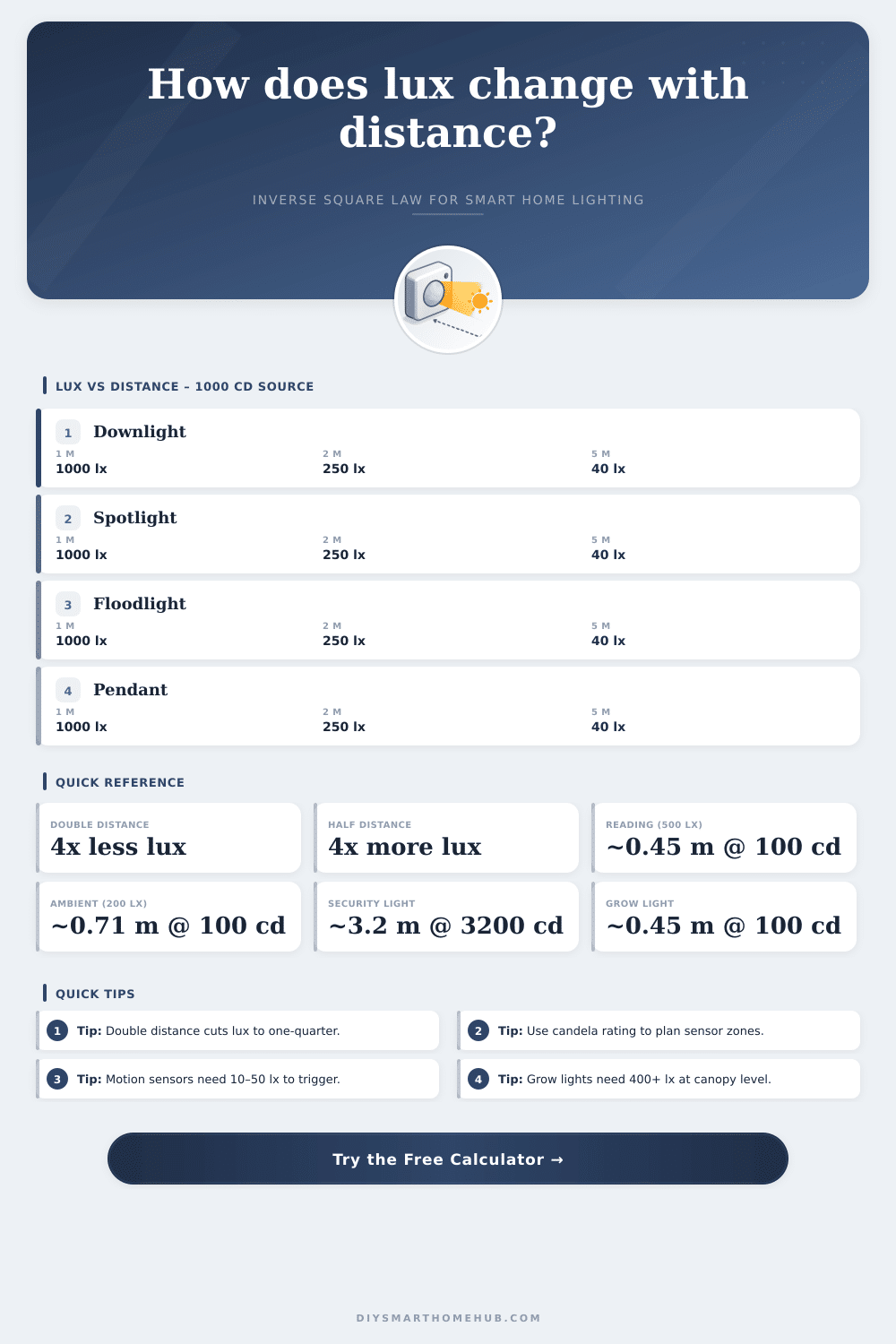
Here is where it becomes interesting. Lux drops quadratically when the distance grows. If light has intensity of 10,000 lux at 1 metre, it falls to 2,500 lux at 2 metres, only 400 lux at 5 metres and only 100 lux at 10 metres.
With the distance, the area that the light illuminates grows quickly. The area covered at one foot would quadruple at two feet. At four feet, the covered area would be sixteen times bigger than at one foot.
Light that puts out 100 lumens with a beam covering one square metre at one metre distance measures 100 lux. But at ten metres, if the beam covers 100 square metres, that gives only 1 lux. For fast reference, a simple incandescent bulb (around 1,300 to 1,600 lumens) at 2 metre distance gives roughly 52 to 65 lux, assuming half-spherical distribution and ignoring reflectors or the room.
Because of reflectors, you cannot always use the inverse square law to count the intensity of the lighting. That law applies only to point sources. Candlepower measures the concentration of light at a certain distance, but it is not the same as lux.
Candela equals lux at 1 metre, and the maximum distance is counted when the lux on the target is 0.25. Although the formula says that illuminance at 1 metre equals the candelas of the source, candela usually makes more sense at distances above 5 metres because of focal points and mistakes.
Recommended light levels for normal activities usually are between 100 and 300 lux. Currently the standard is more common between 500 and 1,000 lux, depending on the activity. To reach 10,000 lux, you should be around 10 cm away, which is very impractical.
At distances bigger than 30 cm, the result falls under 5,000lux.