Wind Power Density Calculator
Estimate wind power density, hub-height wind speed, rotor disk power, Betz-limit power, and usable daily energy for small turbines, smart sheds, sensors, and home battery systems.
⚙Real wind density presets
📏Wind and rotor inputs
🧮Current density spec grid
🌬Wind power density reference
| Hub wind speed | Power density at 1.225 kg/m³ | Resource reading | Typical small-system meaning |
|---|---|---|---|
| 3 m/s / 6.7 mph | 17 W/m² | Very low | Usually below useful turbine production except tiny sensor charging. |
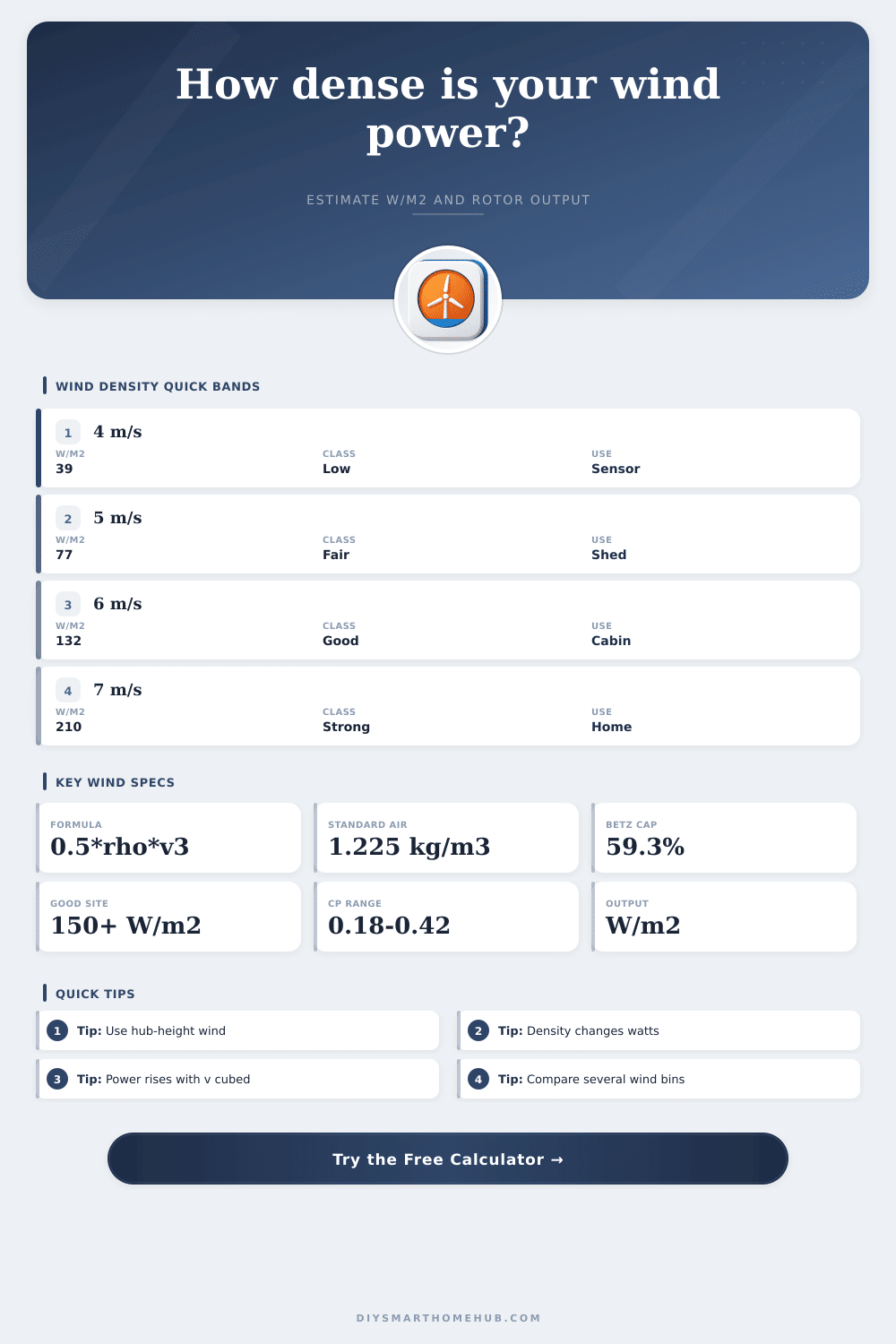
| 4 m/s / 8.9 mph | 39 W/m² | Low | Micro systems may trickle charge, but rotor watts stay modest. |
| 5 m/s / 11.2 mph | 77 W/m² | Fair | Useful for sheds, weather stations, or small hybrid battery sites. |
| 6 m/s / 13.4 mph | 132 W/m² | Good | Small wind begins to provide meaningful daily energy. |
| 7 m/s / 15.7 mph | 210 W/m² | Strong | Rotor sizing, controller limits, and tower rating matter more. |
| 9 m/s / 20.1 mph | 447 W/m² | Very strong | Check furling, braking, and whether output is capped. |
🌡Air density and altitude table
| Condition | Density used | Power versus standard | When to use it |
|---|---|---|---|
| Cold sea-level winter air | 1.292 kg/m³ | 105% | Cold coastal sites or winter logging near sea level. |
| Standard sea-level air | 1.225 kg/m³ | 100% | Default comparison condition for most turbine power curves. |
| Warm lowland air | 1.184 kg/m³ | 97% | Warm-weather readings near sea level or lower valleys. |
| Highland site | 1.112 kg/m³ | 91% | Approximate 1000 m elevation planning and testing. |
| Mountain site | 1.007 kg/m³ | 82% | High-elevation sites where thin air reduces rotor watts. |
🔋Turbine profile assumptions
| Profile | Cp used | System efficiency | Availability meaning |
|---|---|---|---|
| Sensor trickle turbine | 0.18 | 70% | Small rotor, simple electronics, many low-power hours. |
| Roof micro turbine | 0.16 | 62% | Accounts for rough roof airflow and compact hardware. |
| Smart shed small HAWT | 0.28 | 76% | Reasonable small horizontal-axis turbine on a clean mast. |
| Battery mast turbine | 0.32 | 78% | Good matching into a controller and battery bank. |
| Clean tower turbine | 0.40 | 82% | Optimized rotor in smoother hub-height wind. |
| Vertical-axis rotor | 0.22 | 68% | Lower Cp but simpler directional behavior. |
📌Common density check scenarios
| Scenario | Main inputs to trust | Primary result | Secondary check |
|---|---|---|---|
| Weather-station sensor mast | Long average wind and measured height | W/m² tells whether trickle charging is realistic. | Daily usable Wh checks battery balance. |
| Smart shed hybrid system | Hub height, rotor diameter, and Cp profile | Rotor disk watts show wind contribution potential. | Net W/m² compares sites independent of rotor size. |
| Rural tower pre-check | Exposure class and reference-height wind | Hub wind correction reveals the tower-height value. | Betz power catches unrealistic output expectations. |
| Roof-mounted trial | Real roof wind, not nearby airport wind | Low density can explain disappointing watts. | Compare roof profile against open-field profile. |
✅Density calculation tips
Wind power density are a measurement of the amount of kinetic energy that passes through each square meter at a specific site. Wind power density is important to determine whether a small wind turbine is a good idea for installation at a specific site. By knowing the wind power density at a site, a person can determine the size of the turbine, how high to place the turbine, and the amount of energy that can be harvested.
Wind speed isnt the only measurement of the wind power density at a site. The wind speed will change with the height above the ground. For instance, a location that experience a wind speed of 6 meters per second at 10 meters above the ground may experience a different speed at 30 meters.
Wind Power Density for Small Wind Turbines
The terrain can also alter the wind speed measurements. Open pastures will have different wind speeds than areas that contain many houses and tree. To account for these changing variables, the calculator will use height and terrain exposure to find the correct measurement of the wind power density at a site.
The calculator determine this by using the power law to find the wind speed at different heights over different terrains. The density of the air at a site can also have an impact upon the wind power density at that site. Air density will change based upon the temperature and the altitude of the site.
For instance, air that is cold and near the sea has a higher density within each square meter of air than warm air or air at high altitudes in the mountains. Because wind power density is in part the result of air density multiplied by the cube of the wind speed, changes to air density will have a large impact upon the amount of watt that can be produced at that site. It is possible to use the standard conditions for air density within the calculator in cases where the site is a coastal area or a highland ridge.
The amount of area that the turbine blades will sweep will play a critical role in calculating the amount of available watts at a site. Multiplying the wind power density by the area that the turbine blades will sweep will provide an understanding of the amount of available watts at that site. The calculation will also display the Betz limit.
The Betz limit is a theoretical maximum of 59.3 percent for the amount of energy a turbine can harvest from the wind; no turbine will ever reach this amount. Because no small turbine will reach the Betz limit, it provides a method of ensuring that the calculated power coefficient for the small turbine is realistic and within the limits of the available energy from the wind. Small wind turbines can come in a variety of profiles and designs that are appropriate for different terrains and uses.
Each turbine will have a different design with its own efficiency and availability factor. For instance, a turbine located on a roof will experience more turbulence from air movement than a turbine that is located on a mast in open terrain. This turbulence will lower the availability factor for the turbine.
The calculations incorporate the availability factor as a way of showing how these various factor interact with one another at a site. Many individuals may focus upon the wattage that can be created by the wind at a site. However, the availability factor is another measurement provided in the calculation that allows individuals to understand how much energy will be created at that site over the course of a year.
Two sites may experience the same wind speeds but have different availability factors, leading to a difference in the amount of energy that will be created at each site. The terrain where the installer will install the turbine will impact the wind power density at the site. For instance, terrain impact the wind shear exponent and the wind speed multiplier.
An open shoreline is likely to have a different wind speed than a suburban yard. The same is true of ridges that can force the wind to increase in speed as they move over those features. These changes in terrain will impact the amount of power that is produced by the wind at a site, especially since the power is more proportional to the cube of the speed of the wind.
Reference tables can provide individuals with an understanding of the relationship between wind speed and wind power density. These tables can help individuals to understand if the wind speed that is projected at the site is within a fair, good, or strong wind speed. Using these tables, individuals can decide whether the calculation is worth performing at sites with low wind speed.
One of the common mistake that individuals may make when calculating wind power density is selecting the wrong height or ignoring the local obstructions to the movement of the wind. For instance, using the available wind speed at the airport, which is measured at 10 meters above the ground, may result in underestimations of the wind power density at a site with a turbine that is located at 25 meters. Similarly, place the turbine too close to local trees or the edge of the roof will underestimate the available energy because it will overestimate the wind power density.
The calculator for wind power density cannot see the trees or the location of the roofline at a site; the exposure factor is only as accurate as the individual understands the area. Therefore, installers may recommend performing a short measurement campaign to determine the actual available wind power density at the site prior to purchasing the hardware for the installation. The daily energy that is calculated through the use of the wind power density calculator should not be guaranteed.
The availability factor is based upon the average wind speeds at a site, but the actual amount of available wind may vary from year to year. Additionally, it may vary from month to month within the same year. Therefore, this figure should only be used as an estimate for the amount of energy that will be created by the turbine at a site.
By using the calculator for different sites at the same time, it is possible to compare the energy output of different location. By using the same assumptions for each site, the calculator will provide an accurate ranking of each site according to its net power density. This value is independent of the square meter size of the turbine; the ranking will remain the same even if the size of the rotors at each site were to change.
Knowing which site has the highest net power density allows individuals to decide other factors related to the installation, such as the cost and length of the wire run to the location of the turbine. Wind power density allows individuals to easily translate the different characteristics of a site into a common language that all individuals involved in the installation can understand. The result of the calculation allows those working with small wind turbines to determine if small turbines will be appropriate for use in locations with fair or good wind speeds.
In locations with low wind speeds, the hardware may function as a trickle charger for sensors. Therefore, this calculation allows individuals to make these determinations more rapid than they could otherwise. The figure for the wind power density at a site is the first that individuals should consider when installing a small wind turbine.
After determining the wind power density at a site, individuals can better form an understanding of other aspects of the installation of the turbine, such as the size of the rotor, the limits of the controller that the installer will use for the turbine, and the seasonal variation of the available energy. By performing this calculation as the first step in determining the installation of a small wind turbine, the installer avoids the error of purchasing the hardware for the small turbine before determining the available wind resource at the site.