Wind Power Calculator
Estimate available wind watts, net turbine output, daily energy, and capacity factor from rotor diameter, measured wind speed, hub height, air density, and system losses.
Wind Power Summary
Results will appear after calculation.
| Wind speed | Site meaning | Power effect | Planning note |
|---|
| Turbine profile | Typical rotor | Cp used | Best fit |
|---|
| Exposure | Shear alpha | Height response | Common site |
|---|
| Preset scenario | Rotor | Hub wind | Daily energy |
|---|
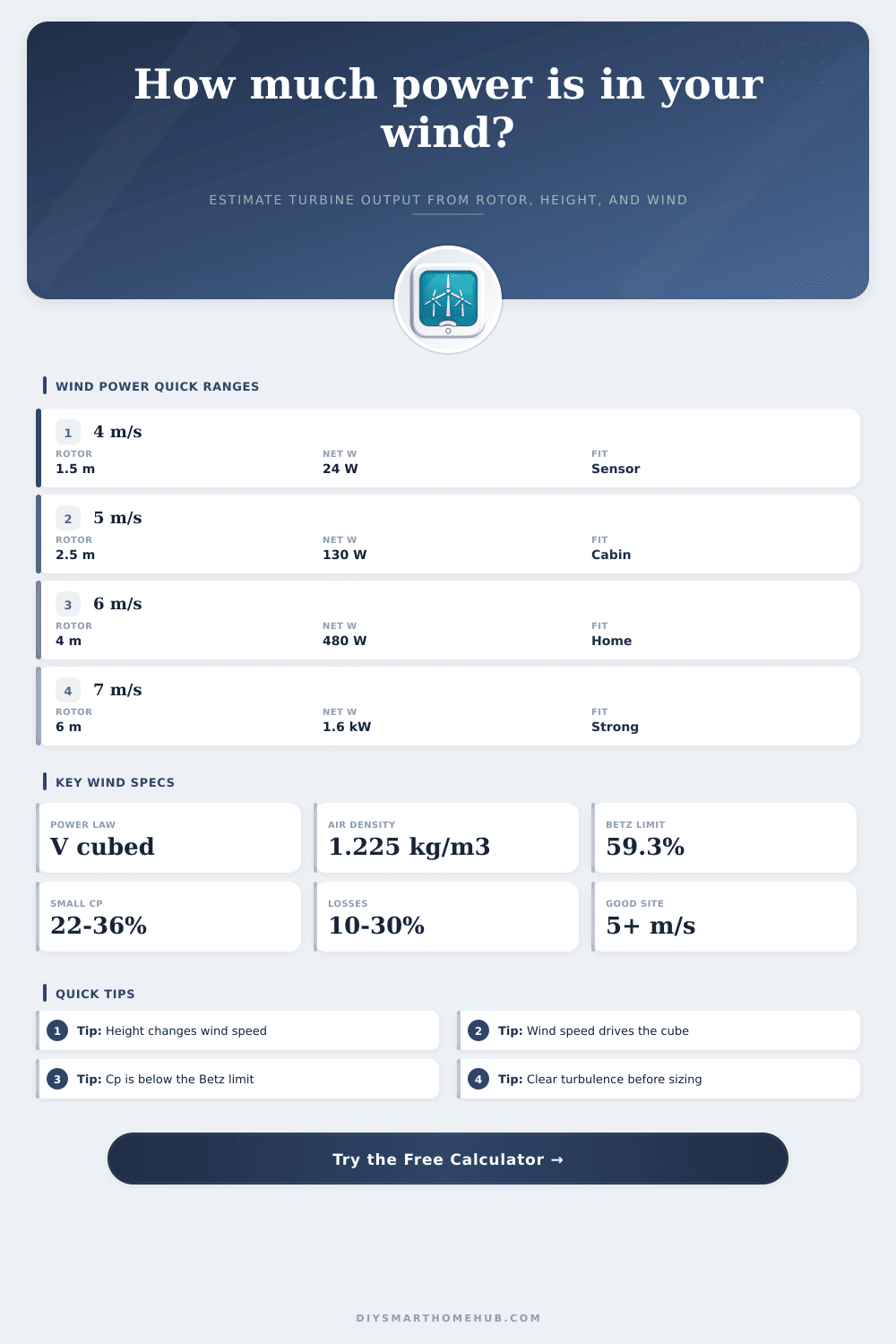
Roof-level guesses can be far below or above a clean mast reading. The cube law means a 20% wind-speed error can become a much larger power error.
Available rotor power shows what is in the moving air. Net turbine power is the practical estimate after aerodynamic capture, rated caps, and system losses.
Wind power is one of the methods of generating energy. Wind power use the movement of air to produce electricity. Many people think that wind power is a simple form of energy, but there is alot of different variables involved in the process of creating wind power.
The variables include the height of the turbine blade, the weight of the air, and the amount of energy that the rotor of the turbine can produce. A wind power calculator is used to determine the amount of electricity that a wind turbine will produce based off the information regarding the location where the turbine will be established. The first of the variables to consider in the development of a wind turbine is the size of the rotor of the turbine.
How Wind Power Is Calculated
The rotor of the turbine are the component of the turbine that captures the wind energy. The diameter of that rotor is the variable that is entered into the calculator. If an individual double the diameter of the rotor, the area that the rotor sweeps will quadruple.
Thus, changes to the diameter of the rotor have a significant impact upon the amount of energy that the turbine will produce. The wind power calculator will determine the swept area of the turbine so that individuals does not have to perform these calculations themselves. The swept area of the turbine is important in that it sets the limit for the amount of power that can be produced by the wind turbine.
Another of the variables that impacts the amount of energy that a wind turbine creates is the speed at which the wind blow. The faster that the wind moves, the more energy that the turbine can produce. This relationship between wind speed and energy is not linear, but based upon the cubed value of the wind speed.
For instance, a location with five meter per second of wind will produce more energy then a location with four meters per second of wind. The wind power calculator allows individuals to adjust for the height of the turbine hub; wind speeds at the ground are not the same as the wind speeds at the hub of a turbine. The wind power calculator will determine the shearing exponent of the wind at different heights for the specific terrain that the individual enters into the calculator.
For instance, an open field will have a different exponent then a wooded area. The third of the variables to consider is air density. Air density is another of the variables that individuals that wish to produce energy from the wind often overlook.
Air density is affected by the elevation at which the turbine will be established, as well as the temperature of the air. Higher elevations have less air and, therefore, less air density than areas at sea level. If an individual enter the air density into the wind power calculator, it will account for the different densities and how they impact the amount of energy that will be produced by the established turbine.
The fourth of the variables to consider is the power coefficient of the turbine, as well. No amount of energy from the wind can be captured by the turbine. The blades of the turbine will never capture all of the energy from the wind due to the limitations of the Betz limit (fifty-nine percent).
Small turbines produce less energy than this percentage due to the efficiency of the blades. Additionally, some of the energy is lost in the rectifier, the battery bank, the charge controller, and in the wiring of the system. Each of these features produce a loss of the energy that was produced by the turbine.
The individual can enter these energy loss into the calculator; the calculator does not account for the fact that no system is perfect and energy is lost to these features. When completed, a wind power calculator will produce four different number. The first number will be the available rotor power.
This is a value that represents the total energy that is contained within the wind at the established location. The second number will be the net turbine power. This is the amount of energy that the turbine will produce after accounting for the limitations that were discussed.
The third number will be the daily energy. This value will account for how much energy is produced each day at that location. Finally, the last number is the capacity factor of the turbine.
This is the amount of time that the turbine is run at its maximum capabilities. A low capacity factor does not indicate that the wind turbine is failing; instead, it may simply indicate that the wind is variable at that location. Another of the variables for the creation of a wind power project is the height at which the turbine is established.
If the turbine is raised in height, more energy can be created by the turbine. If the height of the turbine hub is increased by as little as ten or fifteen feet, the amount of energy that the turbine produces each day can increase by a large percentage. Individuals should not base the sizing of the turbine upon the wind speeds at low height; the amount of wind at a short pole will differ from that of a high tower.
Individuals can perform the calculations with the wind power calculator a variety of times. For instance, individuals can adjust the height of the turbine to see the impact of height upon the energy that is created. Additionally, individuals can adjust the loss profile of the energy to determine how different types of batteries will impact the performance of the energy.
The more that the results of the calculator change with small adjustments to the variables, the more riskily the project will be. The more similar the results of the calculator are to one another with altered variables, the more stable the project will be. Thus, the calculator does not help to predict the behavior of the wind at any given location.
However, it does allow individuals to make decisions regarding the construction of their projects based upon the physics of the concept of wind power.