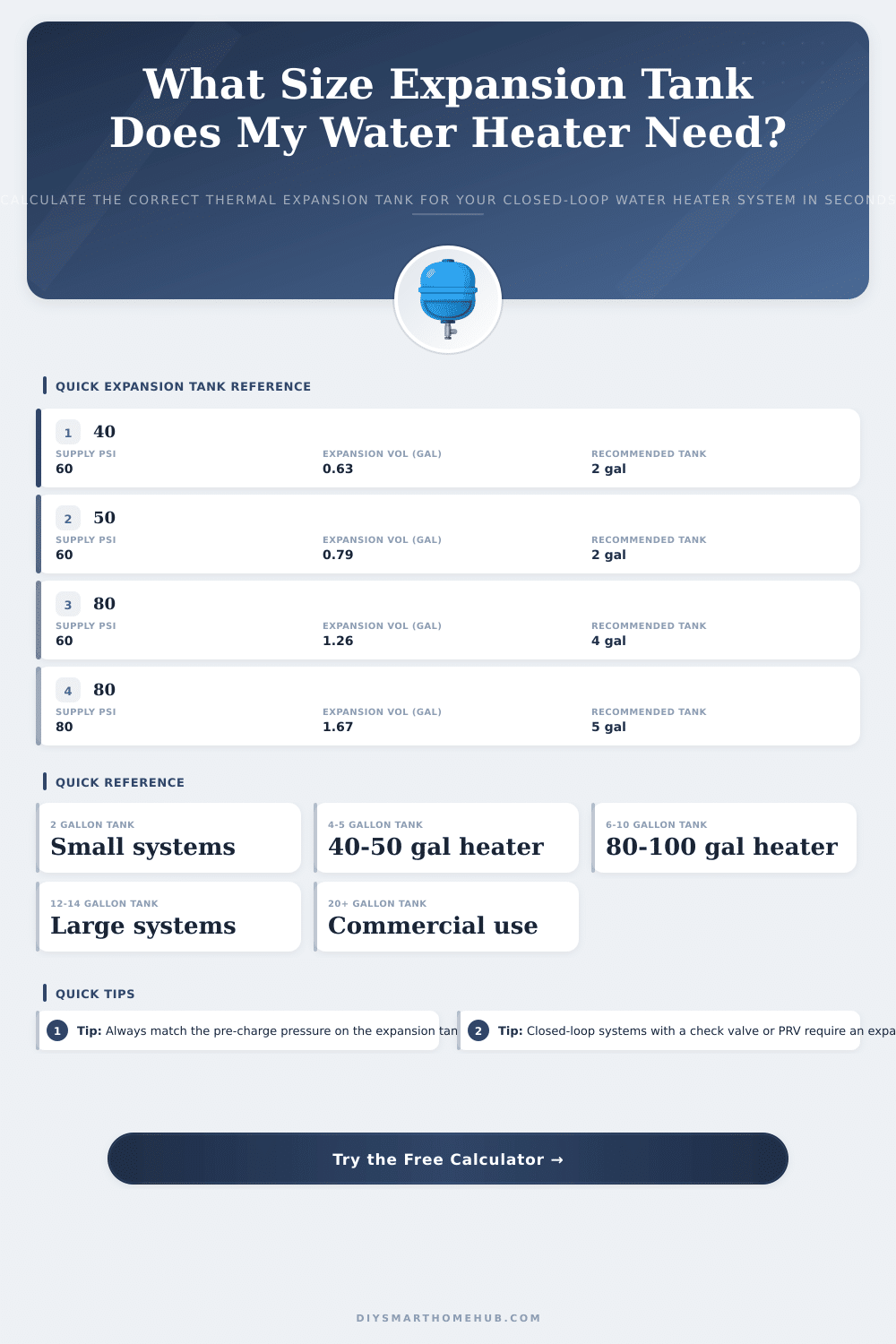
Water Heater Expansion Tank Size Calculator
Find the correct thermal expansion tank volume for your closed-loop water heater system
| Heater Size (gal) | 40 PSI Supply | 60 PSI Supply | 80 PSI Supply | 100 PSI Supply |
|---|---|---|---|---|
| 30 gal | 2 gal | 2 gal | 2 gal | 2 gal |
| 40 gal | 2 gal | 2 gal | 2 gal | 4 gal |
| 50 gal | 2 gal | 2 gal | 4 gal | 4 gal |
| 60 gal | 2 gal | 2 gal | 4 gal | 5 gal |
| 80 gal | 2 gal | 4 gal | 5 gal | 6 gal |
| 100 gal | 4 gal | 4 gal | 5 gal | 10 gal |
| 120 gal | 4 gal | 5 gal | 6 gal | 10 gal |
| 150 gal | 5 gal | 6 gal | 10 gal | 12 gal |
| Tank Volume (gal) | Acceptance at 40 PSI pre-charge | Acceptance at 60 PSI pre-charge | Acceptance at 80 PSI pre-charge | Max Pressure |
|---|---|---|---|---|
| 2 gal | 0.71 gal | 0.53 gal | 0.36 gal | 150 PSI |
| 4 gal | 1.42 gal | 1.06 gal | 0.72 gal | 150 PSI |
| 5 gal | 1.77 gal | 1.32 gal | 0.90 gal | 150 PSI |
| 6 gal | 2.13 gal | 1.59 gal | 1.08 gal | 150 PSI |
| 10 gal | 3.55 gal | 2.65 gal | 1.80 gal | 150 PSI |
| 12 gal | 4.26 gal | 3.18 gal | 2.16 gal | 150 PSI |
| 14 gal | 4.97 gal | 3.71 gal | 2.52 gal | 150 PSI |
| 20 gal | 7.10 gal | 5.30 gal | 3.60 gal | 150 PSI |
| 32 gal | 11.36 gal | 8.48 gal | 5.76 gal | 150 PSI |
| 44 gal | 15.62 gal | 11.66 gal | 7.92 gal | 150 PSI |
A water heater expansion tank, also known as a thermal expansion tank, is a small second tank that connects to the water supply pipe that goes to the water heater. It is basically a tiny container that keeps pressurized air to accept the expansion of warm water. When the temperature of the water rises the water expands.
If there is no way to unload the pressure, the water heater must absorb that expansion and contraction.
What Is a Water Heater Expansion Tank?
In a closed plumbing system the expansion tank gives a place where the expanding water can go, like this reducing the pressure and protecting the whole system. Closed water systems commonly use check valves, backflow prevention devices, pressure-reducing valves or other devices on the supply line to stop water from being sucked back in the municipal water supply. If the water source has a backflow prevention valve, a expansion tank is necessary.
It simply gives the water a place to expand while it warms up.
Expansion tanks are quite small compared with water heaters. In residential systems they usually hold around two gallons, although the size ranges according to the water volume of the hot water supply system they serve. The size of a expansion tank depends on the size of the water heater, so a six-gallon heater normally would requier only a small tank.
Higher thermostat settings and common heating cycles cause more expansion, and the expansion tank helps to reduce that stress. If no tap operates, the water has nowhere to go, because it stays in the pipes and in the tank. A thermal expansion tank absorbs the extra pressure that creates thermal expansion.
Without it, the increasing pressure over time could cause stress to pipes, damage to valves or even bursting pipes.
Expansion tanks became a rule during about the last ten years, so getting one helps ensure that you follow the newest code. They are recommended for homes built in 1985 or newer. They are quite cheap and easy to install during the installation of the water heater.
There is really no big reason not to install one with every water heater, even if there is currently no known backflow preventer.
A tankless water heater does not require an expansion tank, because the water does not warm until a tap is opened and the flow triggers the heating. Even so, when you doubt, putting one in is commonly the simplest solution. The only occasion when it is not required is if the water already has a place to go while it expands, for instance if the municipal supply does not have a regulator or check valve.
To remove one, turn off the water heater and later close the cold water supply to the water heater. Drain around a gallon from the water heater, and later unscrew the expansion tank from the threaded adapter. Professional installation and regular care are worth considering to keep everything workingright.