AC Tonnage Calculator
Manual J-style heat load estimation for smart home HVAC sizing — enter your room or home details for accurate AC tonnage
Calculator
Please enter a valid floor area greater than zero.
AC Tonnage Spec Grid
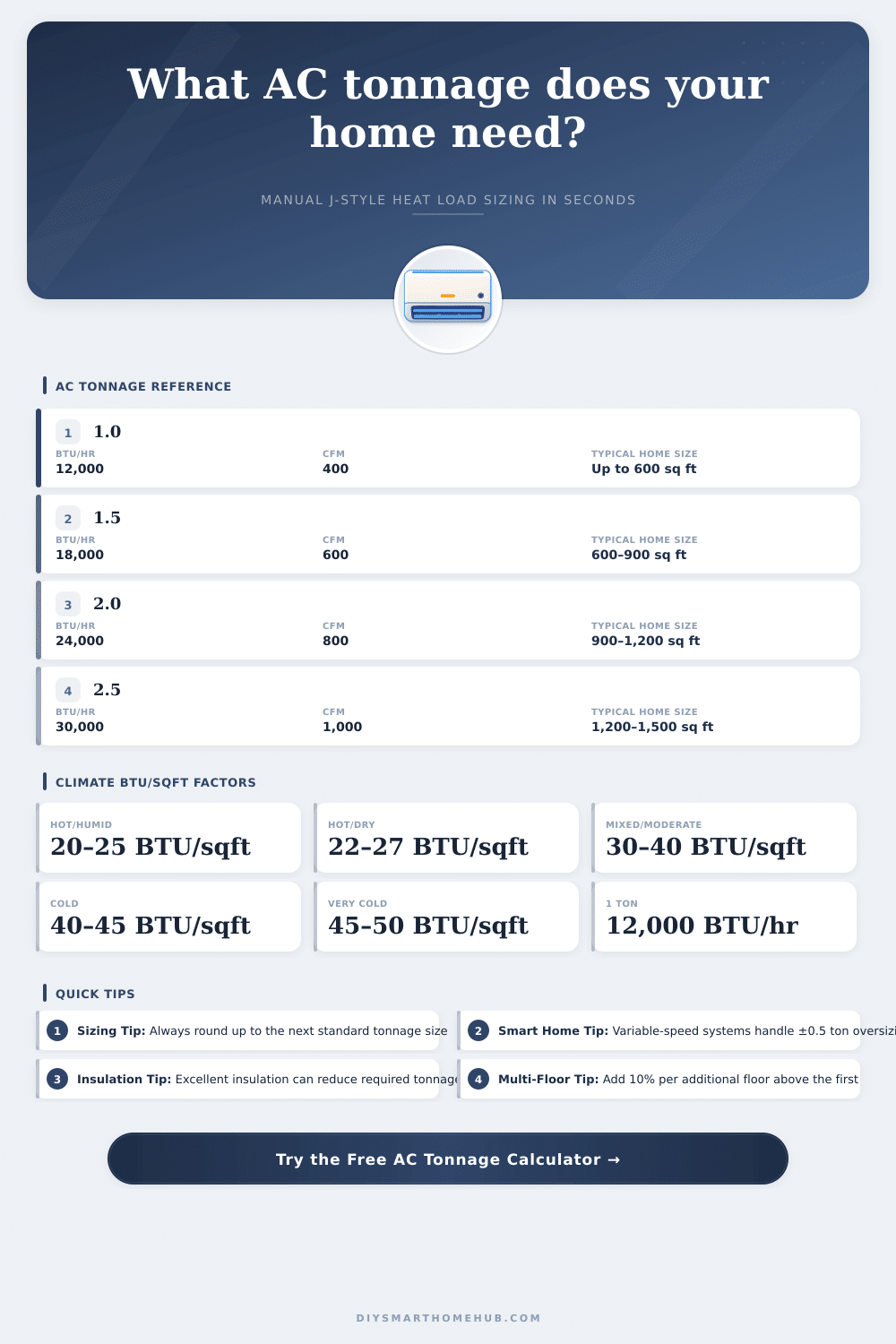
Climate Zone BTU/sqft Reference
| Climate Zone | BTU/sqft Factor | Example Cities | Notes |
|---|---|---|---|
| Hot / Humid | 20–25 BTU/sqft | Miami, Houston, New Orleans | High humidity increases latent load |
| Hot / Dry | 22–27 BTU/sqft | Phoenix, Las Vegas, El Paso | Low humidity, but extreme peak temps |
| Mixed / Moderate | 30–40 BTU/sqft | Atlanta, Dallas, Los Angeles | Balanced sensible and latent loads |
| Cold | 40–45 BTU/sqft | Chicago, Denver, Minneapolis | Heating dominates; AC still required |
| Very Cold | 45–50 BTU/sqft | Anchorage, Duluth, Fargo | Minimal AC load; focus on heating |
Adjustment Factor Reference
| Condition | BTU Adjustment | When to Apply |
|---|---|---|
| Each additional floor | +10% per floor | Multi-story homes above 1 floor |
| Sunny / south-facing exposure | +10% | Large south-facing windows or walls |
| Western exposure | +10% | Main glazing or wall faces west |
| Mostly shaded | −10% | Heavy tree cover or north-facing |
| Poor insulation | +10% | Older homes, uninsulated walls/attic |
| Excellent insulation | −10% | Modern high-performance envelope |
| High ceilings (>9 ft) | +15% | Vaulted, cathedral, or loft ceilings |
| Each person over 2 occupants | +600 BTU | Additional residents beyond 2 |
| Kitchen present | +1,000 BTU | Any home with a cooking kitchen |
| Each large window | +200 BTU | Windows >15 sq ft area |
Smart Home AC Sizing Strategy
For smart home HVAC, accurate tonnage is critical: an undersized unit runs constantly and cannot maintain setpoint during peak heat, while an oversized unit short-cycles, causing humidity swings and premature wear. Use the next standard size up from your calculated result. Variable-speed inverter systems handle a half-ton of oversizing well and recover efficiency through modulation, making them ideal for smart thermostat integration.
Manual J and Smart Zoning
This calculator uses a simplified Manual J approach suitable for residential pre-sizing. For multi-zone smart home systems, calculate each zone individually and sum for total tonnage. Smart thermostats paired with variable-air-volume (VAV) or mini-split multi-head systems var each zone operate independently, reducing total runtime and improving comfort. Always account for duct losses (typically 10–15% additional BTU) in ducted central systems.
The tonnage of an AC unit has nothing to do with weight. In the HVAC field, “ton” is a term to describe how much heat an AC unit can remove from a house in one hour One measures that heat using British Thermal Units, or BTU. One BTU equals the heat of one candle, or the amount needed to raise the temperature of one pound of water by one degree.
When folks talk about the tonnage of AC, they really mention the cooling capacity.
What AC Tonnage Means and How to Find It
People call that capacity also “tonnage”. In the HVAC industry, tonnage describes the cooling capacity of the air conditioner. Simply said, tonnage is the cooling power.
For instance, a 1.5-ton unit removes 18,000 BTUs of heat each hour, while a 5-ton unit moves 60,000 BTUs. Imagine the BTUs as little packets of heat energy. The more packets the AC can throw outside each hour, the srtonger it is.
The tonnage depends on the size of the compressor, the power of the fan and the area of the coil.
A tonnage calculator is basically a formula that HVAC specialists use to decide which system fits a particular home. You think about the size of the house when you choose an AC unit, but using a simple rule of tonnage for square foot is a bad idea. Such a method does not consider the climate or the building style of the house.
The number of square feet for one ton can range between 325 and 900, depending on the building. Things like the height of the ceiling, windows that look at the sun and the thickness of the insulation each play a role.
AC systems are made to cover 95% of the days. If you would choose a system too big for rare occasions when there are many guests, it would be too big for almost all other time. Two-stage models only exist in full tonnages, as 2, 3, 4 or 5, without half sizes.
How to check the tonnage of your AC? Most makers allow you to identify the tonnage using the model number. Search the outdoor unit and find a glue label or metal plate on the side.
When you find the model number, search for a two-digit number as 18, 24, 36 or 60. For home units, that number usually goes from 18 until 60. Divide that number by 12 (because 12,000 BTU per hour equals one ton), and you will get the tonnage of your AC.
For instance, 18,000 BTU AC is 1.5 tons, and a unit with 24 in the modelnumber is two tons. Any company that replaces your system should insist on a right load calculation, instead of only following the size of the old unit.