Smart Underfloor Heating Schedule Calculator
Estimate underfloor heating start time, warm-up duration, effective W/m², occupied-window kWh, preheat kWh, and daily kWh from heated floor area, floor build-up, thermal mass, and schedule windows.
📌Real underfloor heating presets
🌡Schedule inputs
⚙Selected heating profile
Electric tile mat
Fast electric heating under tile, useful for short bathroom and ensuite comfort windows.
The model uses heat density, active area, floor finish factor, thermal mass, temperature lift, and schedule hours. It stays focused on timing and kWh.
Calculated Heating Schedule
📊Underfloor heating spec comparison grid
📘Reference tables
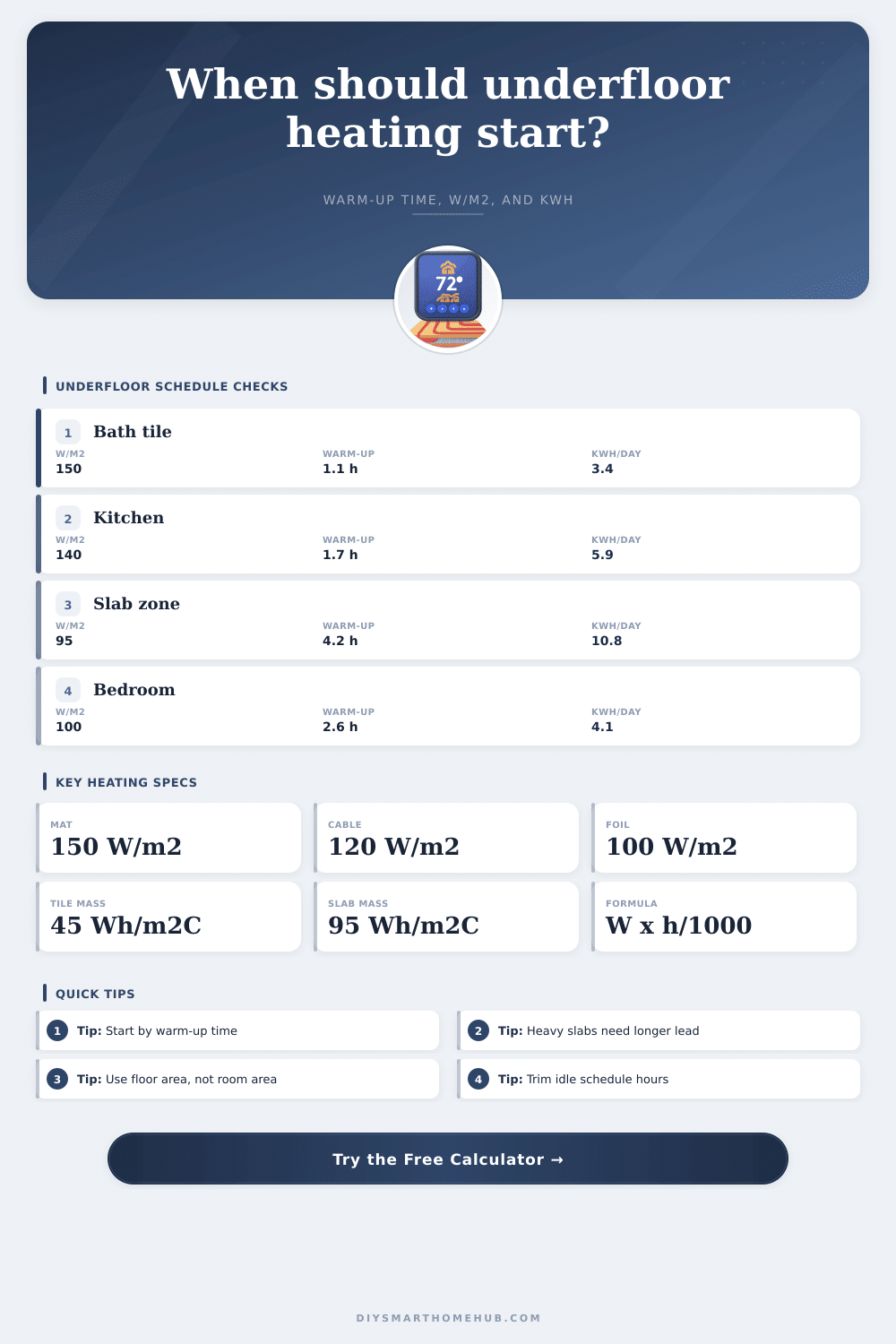
Preset schedule examples
These rows use the same formulas as the calculator, so they are useful checks before fine-tuning your own area, W/m², mass, and schedule window.
| Preset | Floor model | Warm-up result | Schedule kWh |
|---|
System W/m² comparison
Installed heat density sets the available watts before the floor finish and thermostat cycling are considered.
| System type | Typical W/m² | Warm-up behavior | Schedule fit |
|---|
Thermal mass and warm-up table
Thermal mass is modeled as Wh/m²C, then multiplied by heated area and temperature lift to estimate preheat kWh.
| Floor build-up | Mass value | Warm-up cue | Best schedule pattern |
|---|---|---|---|
| Thin tile over backer board | 30 to 45 Wh/m²C | Short lead time | Morning bathroom, ensuite, utility zone |
| Tile on medium screed | 45 to 65 Wh/m²C | Moderate lead time | Kitchen, entry, sunroom, dining area |
| Thick screed heat spreader | 65 to 85 Wh/m²C | Slow but stable | Longer occupied windows and predictable routines |
| Concrete slab hydronic zone | 85 to 120 Wh/m²C | Long lead time | All-day or early-start schedules |
Floor finish factor table
The finish factor reduces delivered heat output for schedule planning, which lengthens warm-up when the same W/m² system sits below a more resistant finish.
| Floor finish | Factor used | Output effect | Schedule note |
|---|---|---|---|
| Tile or stone | 1.00x | Full modeled output | Best fit for short comfort windows |
| Thin vinyl | 0.92x | Small output reduction | Add a little warm-up margin |
| Engineered wood | 0.85x | Moderate reduction | Use steadier schedules and modest temperature lift |
| Laminate underlay | 0.78x | Slower delivered heat | Start earlier for morning windows |
| Low-tog carpet | 0.68x | Largest listed reduction | Prefer longer windows and lower lift |
✅Schedule calculation tips
You must understand that the timing of when your underfloor heating start will determine whether the room is comfortable and whether the underfloor heating is efficient. Many people has set their underfloor heating system to a fixed hour. However, it is likely that setting the underfloor heating system to that fixed hour will result in the floor not becoming warm to the individual who needs the warmth from that floor.
Instead, you can begin to work backwards from the time at which you would like the comfort from the floor to occur. By considering the characteristics of the floor, you can more accurately determine at what time the underfloor heating system should begin cycle to provide for the comfort desired from the floor. Furthermore, this consideration will impact the energy bill for the underfloor heating system as well as the comfort that the individuals from that room will experience throughout the day.
When to Start Your Underfloor Heating
To calculate the start time of the underfloor heating system, the individual setting up the underfloor heating system will require additional information. Specifically, the calculator will require the area of the floor that will be heated, the output of the underfloor heating system installed per square metre of the floor, the build-up of the floor, and the length of the comfort window that is desire for that particular floor. From these inputs, the calculator can mathematically determine the time that the underfloor heating system will need to start circulating heat to reach the desired comfort in the floor.
Additionally, the daily energy cost can be divided into two different components. The energy costs for the underfloor heating system can be divided into the energy required to preheat the floor to the desired temperature, and the energy required to hold that heat during the comfort window. One of the variables that must be taken into consideration in the calculation of the energy costs for the underfloor heating system is that of the thermal mass of the floor itself.
The thermal mass of the floor will impact the length of time that the underfloor heating system will take to warm the floor to the desired temperature. For instance, thin tiles laid upon a subfloor of timber will have a low thermal mass, indicating that the floor will warm to the desired temperature relatively quick. In contrast, a floor of concrete will have a high thermal mass, indicating that the concrete will require a longer lead time before it becomes warmed to a comfortable temperature for human.
The energy costs for the underfloor heating system will factor in the mass of the floor in watt-hours per square metre per degree. By changing the mass of the floor, the start time of the underfloor heating system will change; the underfloor heating system for the bathroom’s tiled floor may start twenty minutes prior to the start of the comfort window, yet the underfloor heating system for the living room’s concrete floor may need to start four or five hour earlier prior to the comfort window to warm the large area of the living room. The type of finish for the floor can also impact the underfloor heating system.
For instance, if the floor is tiled, the heating system will effectively transmit all of its installed watts into the room. Yet, if the floor features engineered wood planks or carpeting, those material will act as a form of resistance to the heat from the underfloor heating system. Therefore, the installed watts will be reduced in the engineered wood or carpet area, leading to the lengthening of the preheat period for which the underfloor heating system will be operating, and leading to the reduction of the underfloor heating system’s hold cycle once the desired temperature is reached within the room.
Thus, the floor finish that creates a resistance to the heat will lead to the lengthening of the preheat period for the underfloor heating system, and create a schedule for the underfloor heating system that is gentler than if tiled floor were used within the house. The length of the comfort window will also have an impact upon the energy costs for the underfloorfloor heating system. For instance, a short comfort window may be used for a bathroom in which the individual desire warmth for only thirty or forty percent of the hours in that comfort window.
Yet, the comfort window may be six hour in length for the living area of the home. Within the underfloor heating system calculations, this different length will impact the amount of energy required to run the underfloor heating system within the comfort window. The underfloor heating system will calculate the energy that is required for the preheat phase of the underfloor heating system, and then add to that energy the hold-duty percentage for the living area of the home that features the longer comfort window.
Finally, the weekly total energy cost for the underfloor heating system will be calculated based upon the daily costs. The underfloor heating system will calculate the weekly total by multiplying the daily energy costs by the number of day upon which the underfloor heating system will be required to provide heat for the home. This number can help the individuals within the home to decide whether the underfloor heating system should be left on throughout the entire seven-day period, or whether it should be turned off completely.
The underfloor heating system can be used in any room of the home. To begin with, the individual can begin with just one room in which they wish to establish the required comfort from the underfloor heating system. The individual will need to input the area of the room that will be heated by the underfloor heating system, the type of underfloor heating system that is installed, the mass of the floor within the room, the comfort time that is to be provided, and the length of the comfort window.
By entering these variable into the underfloor heating system cost calculator, the underfloor heating system will calculate the start time for the underfloor heating system, and the energy costs for each portion (preheat and hold) of the underfloor heating system. Additionally, each of these variables can be altered to determine how the underfloor heating system will change. For instance, changing the lift temperature will change the length of each phase of the underfloor heating system.
The value of the underfloor heating system cost calculator may become apparent to the owner of the underfloor heating system when applying the same calculations to each of the rooms within the home. Each room will differ from each other in terms of the length and number of comfort window that are to be provided, the mass of the floors within those rooms, the type of floor finish, and even the size of each room. By determining how each of these factor will impact the underfloor heating system costs for each room, the owner will be able to understand how to best control the underfloor heating system to ensure that it behaves as a deliberate part of the daily rhythm of the individuals who live within the home.