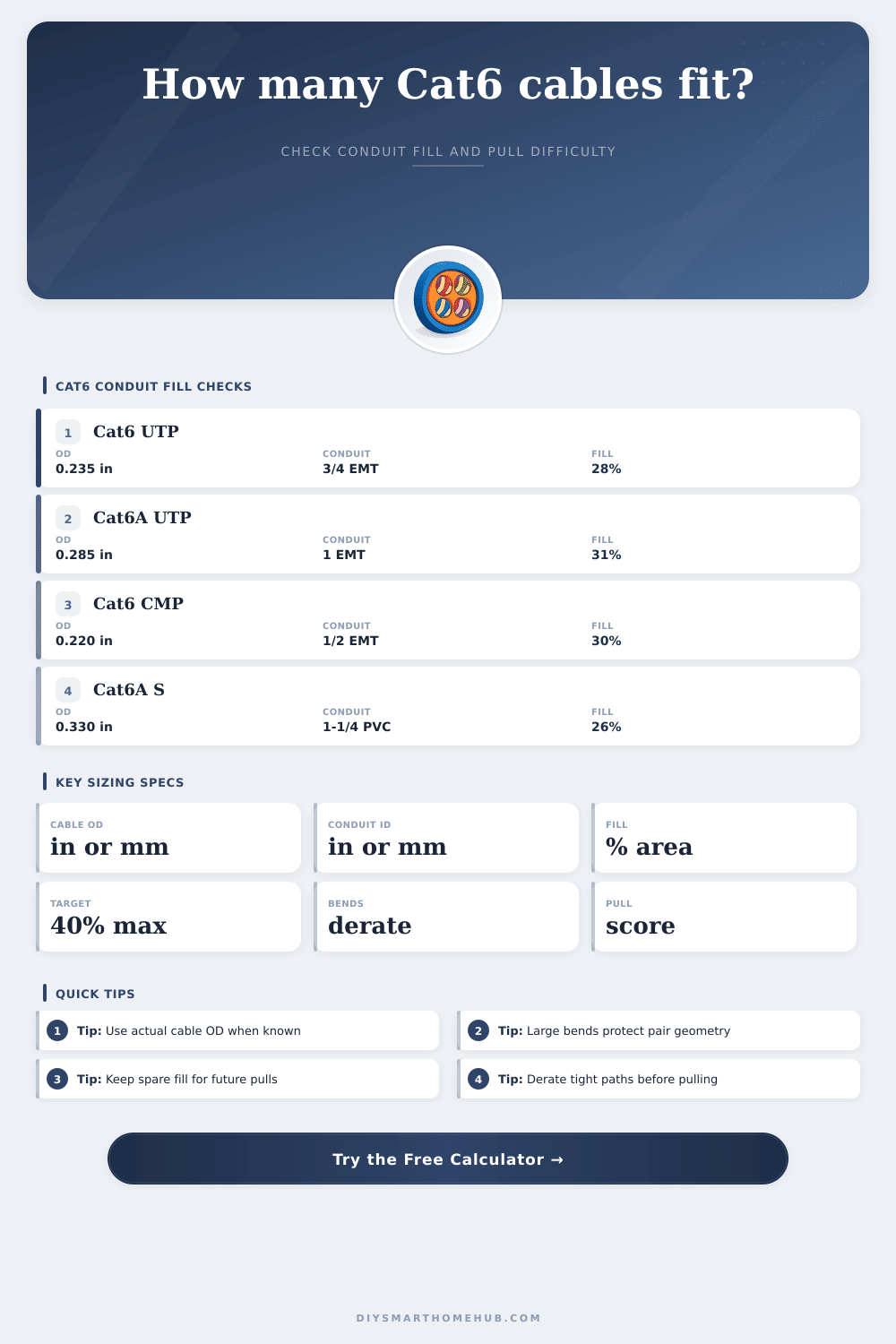
Cat6 Conduit Fill Calculator
Size conduit for Cat6 and Cat6A low-voltage cable bundles using actual cable outside diameter, conduit inside diameter, circular area fill, bend-count derating, and a pull difficulty score for smart-home network runs.
📌Cat6 conduit presets
⚙Conduit fill inputs
🔍Live sizing cues
📊Conduit and cable spec comparison
📏Reference tables
| Cable type | Formula OD basis | Typical OD | Cable area | Planning note |
|---|---|---|---|---|
| Cat6 slim | 0.235 in x 0.80 | 0.188 in / 4.78 mm | 0.0278 in² | Small OD helps dense short patch-rated bundles. |
| Cat6 UTP | 0.235 in base OD | 0.235 in / 5.97 mm | 0.0434 in² | Common residential horizontal cable estimate. |
| Cat6 CMP | 0.235 in x 0.94 | 0.221 in / 5.61 mm | 0.0384 in² | Some plenum designs are slightly smaller. |
| Cat6 outdoor | 0.235 in x 1.13 | 0.266 in / 6.75 mm | 0.0555 in² | Outdoor jackets can fill conduit quickly. |
| Cat6A UTP | 0.285 in base OD | 0.285 in / 7.24 mm | 0.0638 in² | Larger diameter improves alien crosstalk spacing. |
| Cat6A shielded | 0.285 in x 1.16 | 0.331 in / 8.40 mm | 0.0859 in² | Shield and separator raise OD and pull stiffness. |
| Conduit | Typical ID | Area | 40% fill area | Approx Cat6 UTP count |
|---|---|---|---|---|
| 1/2 EMT | 0.622 in / 15.80 mm | 0.304 in² | 0.122 in² | 2 cables before bend derate |
| 3/4 EMT | 0.824 in / 20.93 mm | 0.533 in² | 0.213 in² | 4 cables before bend derate |
| 1 EMT | 1.049 in / 26.64 mm | 0.864 in² | 0.346 in² | 7 cables before bend derate |
| 1-1/4 EMT | 1.380 in / 35.05 mm | 1.495 in² | 0.598 in² | 13 cables before bend derate |
| 1 PVC Sch 40 | 1.029 in / 26.14 mm | 0.831 in² | 0.332 in² | 7 cables before bend derate |
| 1 ENT | 1.000 in / 25.40 mm | 0.785 in² | 0.314 in² | 7 cables before bend derate |
| Bend count | Capacity factor | Adjusted 40% target | Pull cue |
|---|---|---|---|
| 0 bends | 1.00 | 40.0% | Straight pull geometry governs. |
| 1 bend | 0.96 | 38.4% | Low derate for one broad turn. |
| 2 bends | 0.92 | 36.8% | Typical room-to-closet planning path. |
| 3 bends | 0.88 | 35.2% | Leave extra spare area for cable jacket drag. |
| 4 bends | 0.84 | 33.6% | Consider larger conduit or pull access. |
| Smart-home run | Bundle | Conduit | Fill result | Best use |
|---|---|---|---|---|
| Single room drop | 4 Cat6 UTP | 1/2 EMT | 57.1% before derate | Use larger conduit if future pulls matter. |
| Media wall chase | 6 Cat6 UTP | 3/4 ENT | 37.9% before derate | Good for short accessible chases. |
| Camera trunk | 16 slim Cat6 | 1 EMT | 51.4% before derate | Better split into two pathways. |
| Rack backbone | 12 Cat6A | 1-1/4 EMT | 51.2% before derate | Upsize to maintain pull margin. |
| Future path | 18 Cat6A | 1-1/2 EMT | 44.1% before derate | Low bend count is important. |
💡Calculation tips
Proper conduit sizing for Cat6 or Cat6A cables are an important part of the network planning process. Proper conduit sizing will ensure that you are able to pull the cables through the conduit raceway without damaging teh cables. If the conduit is too narrow for the bundle of cables, you will experience difficulty pulling the cables through the conduit.
Additionally, the conduit may cause damage to the cables if the conduit is too narrow. Therefore, you must ensure that there is enough space within the conduit to allow for the pulling of the cables without applying too much force to those cables. The conduit sizing calculator allow you to determine the size of the conduit that you will need for your network installation.
How to Size Conduit for Cat6 and Cat6A Cables
In order to calculate the size of the conduit, you will need to enter the outside diameter of the cable, the inside diameter of the conduit, the total number of the cables that will be installed, and the target fill limit for the conduit. The conduit sizing calculator will automatically incorporate a bend derating factor into the calculation. The bend derating factor accounts for the fact that any bends within the conduit will cause an increase in the friction of the cables as they are being pulled through the conduit.
Thus, the calculator will shrink the target fill limit according to the number of bends in the conduit. The calculator will provide you with the result of the conduit size calculation, the number of spare cables that can be installed in the conduit, and the pull difficulty score for the conduit installation project. The outside diameter of the cable is a critical measurement in the conduit sizing calculation.
However, the outside diameter of the cable may change depending off the type of jacket and shielding that is used in the cable. The area of a circle is dependent upon the square of the radius of the circle, so even small changes in the outside diameter of the cable will lead to major changes in the total area of the cables. The inside diameter of the conduit is another critical measurement.
However, the inside diameter of the conduit may differ between different manufacturers of the conduit. You can use the nominal trade sizes for the conduit or enter a custom measured value if you have the conduit in your possession. The pull difficulty score is a number that represents the difficulty in pulling the installed cables through the conduit.
The higher the pull difficulty score for the conduit, the more difficult it will be to pull the cables through the conduit. Factors that will lead to an increase in the pull difficulty score include the length of the cable run, the number of bends within the conduit, the roughness of the conduit walls, and the stiffness of the installed cables. For instance, because shielded Cat6A cables are stiffer than unshielded Cat6A cables, the installation of shielded Cat6A cables will result in a more higher pull difficulty score.
This pull difficulty score is a warning tool for the installer but will not replace the need to employ proper pulling techniques when installing the Cat6 or Cat6A cables. One of the many mistakes that many people make with conduit sizing is using the 40 percent target for the fill of the conduit. However, the target percentage will decrease as the number of bends within the conduit increases.
A bundle of Cat6 or Cat6A cables may be acceptable for installation within a conduit if that conduit does not contain any bends. However, the same bundle of cables may be too large for a conduit that has numerous bends. Another mistake that people often make is using the published outside diameter of the cable rather than measuring the outside diameter of the cable.
Due to manufacturing tolerances, the actual outside diameter of the cable may be slightly differently than the published outside diameter of the cable. The reference tables on the page display typical outside diameters of Cat6 and Cat6A cables and the typical areas of conduits. These tables allow you to compare the different types of cables and conduits that is available.
The reference tables also display the impact that the number of bends within the conduit will have on the target percentage of the conduit fill. This information will allow you to decide if you must install a pull box within the network or if the installation of a larger conduit is required. Additionally, if you are interested in future-proofing your network installation, you should pay attention to the spare capacity number for the conduit.
This number will tell you how many additional cables can be installed in that conduit in the future. The final and last test of the conduit sizing is actualy pulling the cables through the conduit. If the cables experience any binding within the conduit or if the cable jacket scuffs against the conduit walls during installation, it is a sign that the conduit was too small for the bundle of installed Cat6 or Cat6A cables.
You should always aim to ensure that the total area of the installed cables is below the calculated target area for the conduit fill. By leaving some spare capacity within the conduit for the installed cables, you create a safety margin for the installation of the cables.