Swamp Cooler Temperature Calculator
Estimate wet-bulb temperature, wet-bulb depression, relative humidity, evaporative saturation effectiveness, leaving air temperature, room temperature drop, and climate suitability for an evaporative cooler.
🏜Climate presets
⚙Temperature and cooler inputs
Enter outdoor dry-bulb conditions and cooler details. The calculator estimates wet-bulb with the Stull approximation, backs into vapor pressure and relative humidity, then applies saturation effectiveness to predict supply air.
Calculation breakdown
📊Evaporative cooler spec grid
📋Reference tables
| Climate band | Outdoor RH | Typical wet-bulb depression | Cooling outlook |
|---|---|---|---|
| Excellent desert | 10% to 25% | 25°F to 38°F | Strong leaving-air drop |
| Good dry inland | 25% to 35% | 18°F to 28°F | Useful whole-room cooling |
| Borderline plains | 35% to 45% | 12°F to 20°F | Works best during driest hours |
| Weak humid heat | 45% to 55% | 7°F to 14°F | Small comfort benefit |
| Poor humid climate | Above 55% | Under 10°F | Often not suitable indoors |
| Cooler type | Typical effectiveness | Airflow range | Temperature use case |
|---|---|---|---|
| Portable direct unit | 55% to 68% | 250 to 1200 CFM | Spot cooling in dry rooms |
| Window side-discharge | 68% to 78% | 1800 to 4500 CFM | Room or small-home cooling |
| Rooftop whole-house | 72% to 85% | 3500 to 7500 CFM | Dry-climate whole-home cooling |
| Ducted direct cooler | 65% to 80% | 3000 to 8000 CFM | Distributed supply with duct losses |
| Indirect/direct two-stage | 85% to 95% | 1200 to 6000 CFM | Lower supply temp with less moisture |
| Greenhouse pad wall | 70% to 88% | Large fan bank | High airflow through wetted media |
| Input or formula | Calculator role | Core equation | Result meaning |
|---|---|---|---|
| Dry-bulb temperature | Outdoor heat input | Measured shade air | Upper limit before evaporation |
| Wet-bulb temperature | Evaporation limit | Stull RH approximation | Lowest direct evaporative target |
| Wet-bulb depression | Cooling potential | Dry bulb minus wet bulb | Maximum direct cooling gap |
| Saturation effectiveness | Cooler performance | Supply = dry - depression x effectiveness | Predicted leaving air |
| Suitability score | Climate fit | RH, drop, vent, airflow, target blend | Quick practical rating |
| Preset example | Dry bulb and RH | Supply estimate | Suitability |
|---|---|---|---|
| Phoenix Afternoon | 100°F, 18% | 73°F | Excellent |
💡Swamp cooler temperature tips
Dry air creates a large gap between dry-bulb and wet-bulb temperature. The cooler can only use a percentage of that gap, so pad condition and airflow matter.
Direct evaporative coolers need relief air. If windows or vents are too tight, airflow falls and indoor humidity rises faster than the temperature drops.
In humid conditions, your swamp cooler is going to work or not based off how much moisture the air can actualy absorb before it gets saturated. If you know the right numbers, you can see what’s happening, it’s predictable physics. Before fully saturated, what does the air do with water? What happens when it won’t take any more? No matter how thick a pad or powerful a fan, there is no forcing evaporation.
After plugging in your humidity and local temperature into the calculator above, it’ll do all that psychrometric work for you. No more guesswork on what’s too much or not enough humidity on a hot day. It calculates something called wet-bulb depression, how far below your current air temp you can get the air by evaporative cooling. That is your comfort potential. The closer the number gets to zero (meaning lots of moisture in the air), the less your supply air will be able to cool down. This is a little math fact with a huge impact on your summer strategy.
How Humidity Changes Your Swamp Cooler’s Power
The effectiveness of saturation is another bit of tech-speak that most homeowners gloss over. This section of inputs shouldn’t be skipped though. In reality, no real-world evaporative cooler operate at peak efficiency. If your pads are dirty they restrict air flow and won’t allow for even evaporation across the pad surface. An unused cooler could barely manage 60% effectiveness whereas a brand-new one might get up to 80%. This variable change the calculator’s predicted leaving air temp so you can see how things will shake out given your current conditions versus a perfect standard. It sets you up for a realistic expectation, not a best case.
Airflow is another thing that trips up users’ intuitions. More air = cooler room, right? Not so fast. Trapped heat is a fact of life. Direct evaporative coolers relies on relief vents or open windows to expel humid air while drawing in drier supply air. Pressure rises within your house if there’s no place for the displaced volume to go, stalling all airflow. The tool calculates how many times the air in your room should be replaced each hour by looking at both floor area and ceiling height.
Is the relief opening too small compared to size of your fan? What you’ll feel isn’t cooling, it’s humidity. That’s what most people miss when they seal every window shut, figuring they’re preserving the cool air. In reality, they’re choking the system.
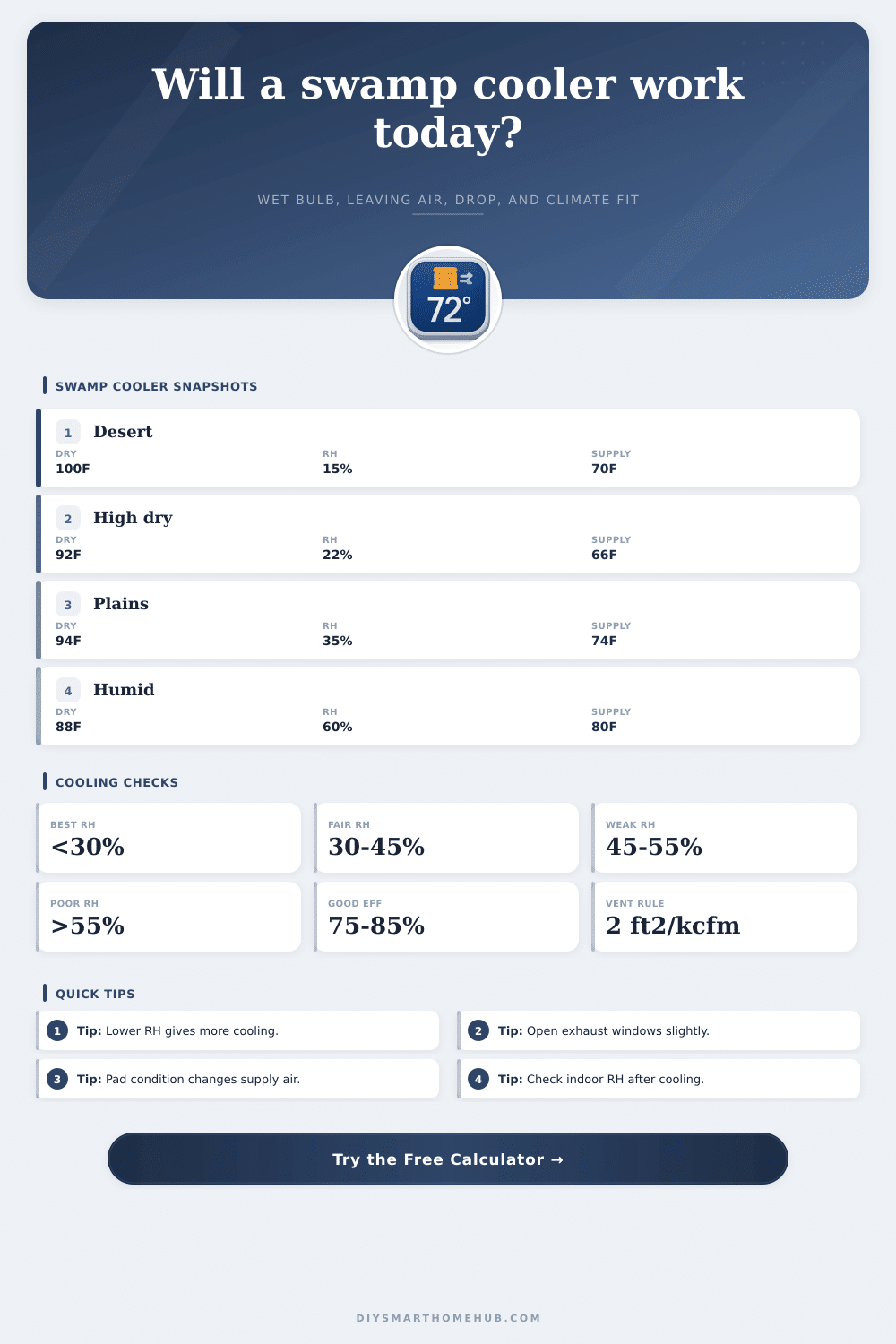
That said, even within very short distances, regional climate ranges is quite different. In desert climates, starting humidity levels are low and there’s plenty of space for cool-down by evaporation. In humid plains climates, while the outside temps may be high, the margin is much narrower and evaporative cooling won’t do much for your comfort level. The page’s reference table maps out those bands neatly so you can locate yours. This helps you understand why it makes sense (or not) to go big with your roof unit. Or, you might just have to face it: sometimes you need an air conditioner after all.
While size matter initially, longer term maintenance is more important. Scale build-up restricts water flow and creates dry areas on the pads which receive no cooling whatsoever. Before maximum heat arrives, flush the system so you’re still effective at getting them good and wet when needed most. Early season checks of exhaust ventilation paths are also helpful as dust clogged screens or sticky doors will kill your airflow rate without even hinting at what’s going wrong.
Ultimately, it’s all about working within the atmospheric conditions. On a sweltering, sunny and dry day, an evaporative cooling system cools the air and creates a nice, refreshing breeze that feels much cooler then what the thermometer registers. During humid days, it just circulates moist air, which isn’t going to help. So understanding the capabilities of your equipment and your environment will help you manage realistic expectations during those hot summer months. Instead of trying to figure out why the temperature isn’t falling as low as you’d like, you can learn how to dial in the right setting. This helps you get the best results possible given current conditions.