Specific Humidity Calculator
Convert temperature, relative humidity, and barometric pressure into specific humidity, mixing ratio, vapor pressure, and room moisture mass for HVAC sensors and smart home humidity checks.
| Condition | Temperature | RH | Specific humidity | Mixing ratio |
|---|---|---|---|---|
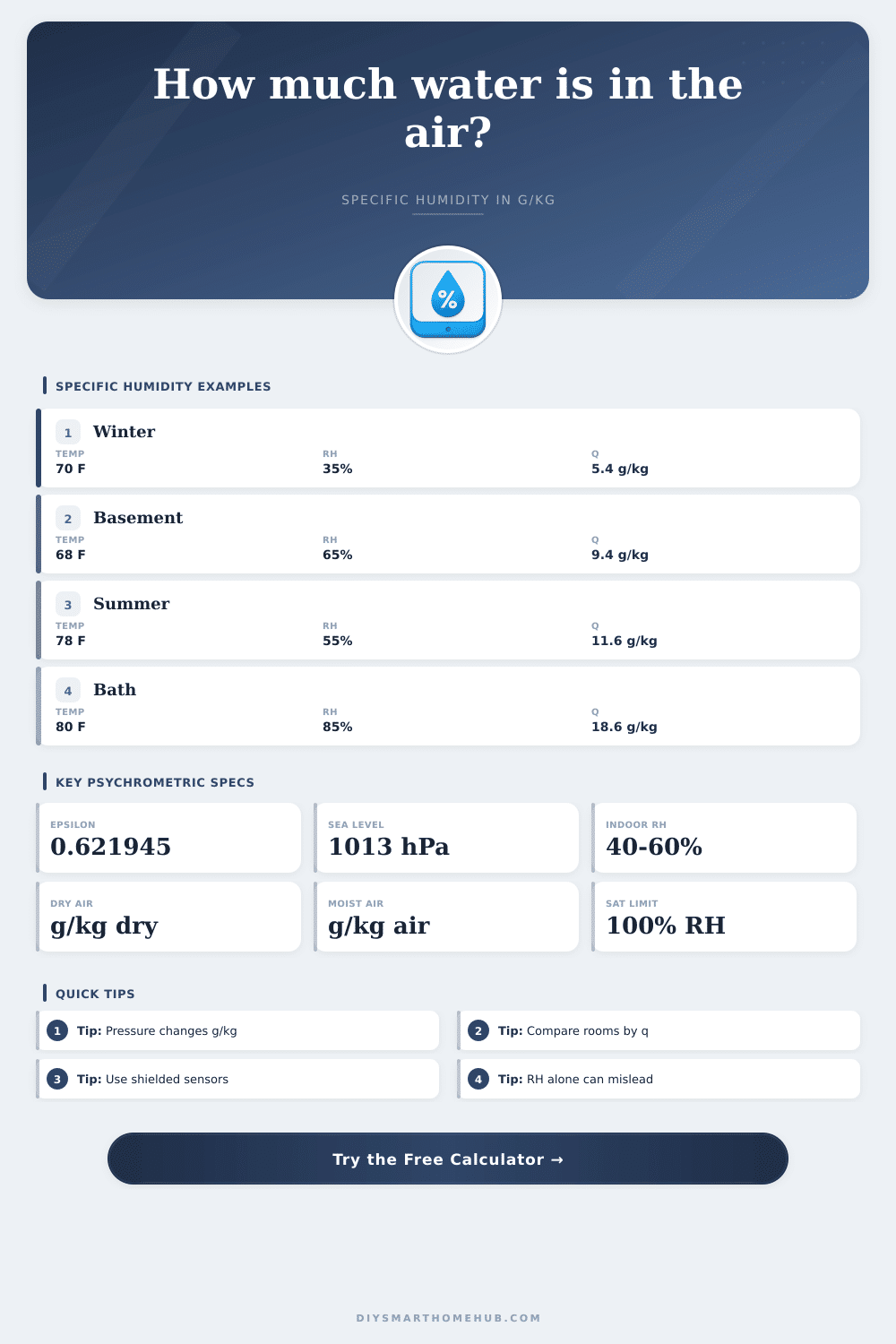
| Cold winter indoor | 68 F / 20 C | 30% | 4.3 g/kg moist air | 4.3 g/kg dry air |
| Comfortable indoor | 72 F / 22.2 C | 45% | 7.4 g/kg moist air | 7.5 g/kg dry air |
| Humid basement | 68 F / 20 C | 65% | 9.4 g/kg moist air | 9.5 g/kg dry air |
| Summer indoor | 78 F / 25.6 C | 55% | 11.4 g/kg moist air | 11.5 g/kg dry air |
| Bathroom spike | 80 F / 26.7 C | 85% | 18.4 g/kg moist air | 18.7 g/kg dry air |
| Location pressure | Example altitude | 72 F / 50% RH q | 72 F / 50% RH w | Why it matters |
|---|---|---|---|---|
| 1013 hPa | Sea level | 8.2 g/kg | 8.3 g/kg | Baseline indoor calculation |
| 950 hPa | About 1800 ft | 8.8 g/kg | 8.9 g/kg | Same RH means more g/kg |
| 850 hPa | About 4800 ft | 9.8 g/kg | 9.9 g/kg | Altitude raises humidity ratio |
| 800 hPa | About 6400 ft | 10.4 g/kg | 10.5 g/kg | Use station pressure for sensors |
| Sensor class | Typical RH accuracy | Temp accuracy | Best use | g/kg caution |
|---|---|---|---|---|
| Basic smart sensor | +/-3% RH | +/-0.5 C | Room trend checks | Expect a visible uncertainty band |
| Calibrated home sensor | +/-2% RH | +/-0.3 C | Automation thresholds | Good for comparing rooms |
| Reference probe | +/-1% RH | +/-0.2 C | Commissioning and validation | Best for target humidity ratio |
| Unverified sensor | +/-5% RH | +/-1.0 C | Rough alerting only | Calibrate before tuning HVAC |
| Use case | Typical target | Helpful metric | Watch point | Automation note |
|---|---|---|---|---|
| Living room comfort | 40-55% RH | 6-10 g/kg q | Seasonal drift | Compare q between rooms |
| Basement control | 45-60% RH | 8-11 g/kg q | Cool surfaces | Use dew point and q together |
| Bathroom exhaust | Return below 60% RH | Falling q | Short humidity spikes | Stop fan after q recovers |
| Crawlspace monitor | Below 65% RH | Stable q trend | Outdoor air mixing | Vent decisions need pressure data |
| Equipment closet | 35-55% RH | Lower vapor pressure | Heat hides RH risk | Track absolute moisture, not RH only |
Relative humidity and specific humidity is two different ways to measure the amounts of water that is in the air. Understanding the differences between these two type of humidity is important for those who wish manage the humidity in there indoor environments. Relative humidity is a value that indicate how close the air is to become saturated with water vapor.
However, relative humidity will change when the temperatures of the air change. Specific humidity, on the other hand, is a measurement of the actual mass of water vapor in the air, and is expressed in gram of water per kilogram of moist air. Because specific humidity is a measurement of the mass of water in the air, specific humidity will remain the same regardless of changes in the temperature within a given room.
Difference Between Relative Humidity and Specific Humidity
Therefore, specific humidity is a useful value in the consideration of whether or not a dehumidifier is need in a given area. The calculator require that you enter three specific measurements in order to calculate the specific humidity of an area: the temperature of the air, the relative humidity of the air, and the station pressure within that area. Each of these measurements is necessary in order to calculate the specific humidity of the area due to the influence that each of these measurement has upon the humidity of the air.
For instance, specific humidity and air temperature are related to the saturation vapor pressure of the air through the Magnus formula. Additionally, the relative humidity of the air is a measurement of the fraction of the saturation vapor pressure that is present in the air. Finally, the station pressure is used in determining the relationship between the vapor pressure of the water and the specific humidity of the air in that area.
There is a small difference between the mixing ratio of the air and the specific humidity of the air. However, understanding the difference between these two measurement is important for those who may be performing calculations of the moisture load that enter a structure through the ventilation system. The mixing ratio is calculated by dividing the mass of the water vapor in the air by the mass of the dry air in the air sample.
In contrast, the user calculates specific humidity by dividing the mass of the water vapor by the total mass of the moist air in the sample. Both of these measurements is provided by the calculator as some control systems will require one or the other measurement. While the two measurements will be essentially the same under normal condition in an indoor environment, the difference between the two measurements becomes more important in environments that are exchanging a significant amount of moisture with the remainder of the indoor environment.
Beyond the calculation of specific humidity of an area, it is also useful to consider the volume of the area as well as the air-change rate within that area. For instance, a specific humidity of 8 g/kg of air may be considered comfortable for a bedroom with a small volume. However, the same specific humidity in a basement with a large volume of air contain a much larger amount of water vapor in the air.
Additionally, the air-change rate can allow for the estimation of how much moisture is entering or leaving a space within an hour. Thus, the air-change rate is another parameter that can help to indicate whether or not dehumidifiers is needed, or whether exhaust fans should be operated for longer period of time. Because sensors can be inaccurate, especially inexpensive humidity sensors, it is important to consider the accuracy of the sensors when using the calculator.
If the relative humidity measurements from a sensor contain an error, that error will increase when converted to specific humidity measurements. Thus, the uncertainty band around each specific humidity measurement can help individuals to understand how reliable that measurement is. Additionally, specific humidity measurements from different areas within a given structure may appear to have different problems with humidity, but those differences may be caused by inaccuracies of the sensors that is measuring the humidity in those specific rooms.
The reference table included with the calculator provides examples of the specific humidity measurements in various type of indoor environments. For instance, specific humidity in a living room during the winter may be 4 g/kg of moist air while specific humidity in a bathroom after a hot shower may be 18 g/kg. Furthermore, these examples also help to reveal how relative humidity targets may be misleading.
For instance, a basement that has a relative humidity of 65% may contain more water vapor than a living room that have a relative humidity target of 45%. Thus, specific humidity do not change with changes in air temperature, so specific humidity measurements from different parts of a structure can help to reveal moisture problems in those area. In addition to specific humidity, it is also useful to consider the dew point of the air in the environment.
For instance, if the calculator displays the specific humidity and the dew point, high specific humidity and a high dew point will indicate the potential for condensation of water out of the air in the structure. High specific humidity and high dew point measurements are often found in basement areas of a structure. Air within indoor environments will always be in movement due to air leaks in the structure, ventilation system, and the stack effect.
Thus, the specific humidity within each area will change over time as air exchange with the outdoors. Therefore, the calculator provide specific humidity measurements for a structure at a given time. Furthermore, the calculator can help to indicate where sensors should be placed within a structure, or where individual area of a structure may need to be assessed for issue related to moisture levels.
Finally, by utilizing specific humidity measurements over time, automation rule can be programmed to control devices like dehumidifiers according to absolute moisture levels in the air. Thus, specific humidity can help to compare different part of a structure with one another without becoming confused by the varying temperatures in those area.