Attic Fan CFM Calculator
Estimate powered attic fan CFM from attic volume, air changes, roof pitch, intake net free area, static pressure derate, and allowable temperature rise.
1.Pick a realistic attic preset
Presets load different attic shapes, roof pitches, vent balances, and pressure penalties. You can tune every value after choosing one.
2.Enter attic geometry and airflow limits
Attic fan CFM results
3.Attic airflow model checkpoints
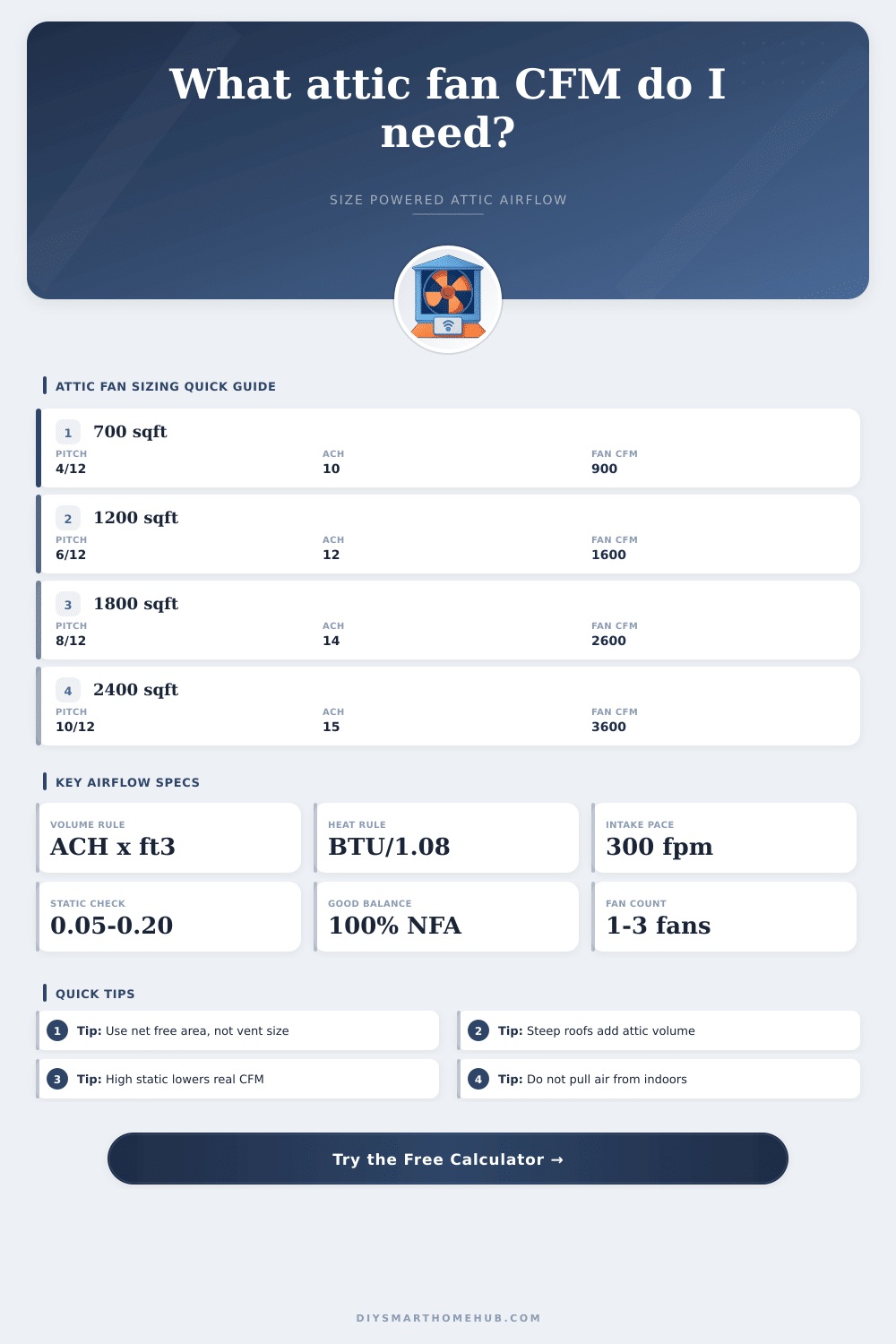
CFM equals attic cubic feet times selected air changes per hour, divided by 60 minutes.
Heat-control airflow uses sensible heat load divided by 1.08 times allowed Fahrenheit rise.
Available NFA is converted to a practical intake airflow limit using square feet times 300 fpm.
The fan rating is raised when louvers, screens, tight soffits, or ducted exhaust reduce delivered CFM.
4.Air change and volume reference
| Attic condition | Typical ACH screen | Use when | Calculator effect |
|---|---|---|---|
| Balanced vented attic | 8 to 10 ACH | Good soffit intake, light roof color, moderate climate. | Usually volume method and heat method land close together. |
| Warm mixed-climate attic | 10 to 12 ACH | Typical asphalt roof with some radiant gain and standard eave intake. | Often needs one mid-size gable fan or roof fan. |
| Hot roof deck or garage | 12 to 18 ACH | Dark shingles, west sun, unconditioned garage, or low allowed temperature rise. | Temperature-rise CFM can exceed the volume-only CFM. |
| Tight retrofit attic | 10 to 14 ACH | Limited soffit slots, insect screen buildup, or restrictive gable louvers. | Static derate increases required rated fan CFM. |
5.Intake vent area and static pressure table
| Available intake NFA | Intake-limited CFM at 300 fpm | Static pressure clue | Sizing note |
|---|---|---|---|
| 288 sq in | 600 CFM | Usually low only with open soffits. | Small fan or add intake before using a large powered fan. |
| 480 sq in | 1,000 CFM | Moderate if screens or baffles are dusty. | Good for compact attics and short roof spans. |
| 720 sq in | 1,500 CFM | Stable range for many single-fan retrofits. | Matches common gable fan and roof fan classes. |
| 1,200 sq in | 2,500 CFM | Best when intake is continuous and unobstructed. | Supports larger or paired fans without starving intake air. |
6.Attic fan and spec comparison grid
| Fan style | Common rated CFM | Static tolerance | Best calculator match |
|---|---|---|---|
| Solar roof fan | 500 to 1,200 CFM | Low; output changes with sun and panel angle. | Small attic, low static pressure, and strong passive intake. |
| Gable-mounted powered fan | 1,000 to 2,000 CFM | Moderate; louver and screen losses matter. | Retrofit attic with a clear gable path and enough soffit NFA. |
| Roof-mounted powered fan | 1,200 to 2,800 CFM | Moderate; roof cap and bird screen add pressure. | Central exhaust point on broad attics with balanced intake. |
| ECM or variable-speed attic fan | 800 to 3,000 CFM | Better; many hold flow under higher resistance. | Tight retrofit, noise-sensitive attic, or multi-speed control plan. |
7.Common attic size benchmarks
| Scenario | Geometry sample | Likely airflow driver | Planning result |
|---|---|---|---|
| Small garage attic | 24 ft by 24 ft, 4/12 roof | Temperature rise on hot days. | Often one compact powered fan if intake is open. |
| Single-story ranch | 50 ft by 28 ft, 5/12 roof | Air changes and intake balance. | Usually one larger gable or roof fan class. |
| Steep cape attic | 36 ft by 30 ft, 10/12 roof | Pitch-driven volume increase. | May need higher rated CFM than floor area suggests. |
| Large two-story attic | 60 ft by 40 ft, 7/12 roof | Volume, roof area, and static pressure together. | Often paired fans or a high-capacity variable-speed unit. |
8.Practical sizing tips
A larger powered attic fan can underperform if soffit or gable intake NFA is too small. The calculator flags this by comparing required CFM to intake-limited CFM.
A steep roof can hold much more air than the floor area implies. This calculator uses pitch to estimate peak height, attic volume, roof area, and heat-rise airflow.
To select a powered attic fan, you must understand the air movement requirement of the attic. Attics collects heat from the roof deck and that heat radiate into the living spaces of the structure unless moved out of the attic. Many people calculates the required size of a powered attic fan using only the floor area of the attic.
However, sizing a powered attic fan according to the floor area of the attic alone are often insufficient. The roof pitch, the intake capacity of the attic, and the temperature of the attic all play a role in the sizing of the fan. The calculator included with this article can help determine if the attic volume, heat load, or intake capacity of the attic are the limiting factor of the powered attic fan that must be sized.
How to Pick the Right Attic Fan
The roof pitch of the house is one of the significant factor in the calculation of the attic fan size. The pitch of the roof affect the volume of air that is within the attic. Steeper roof pitches create more cubic feet of air located under the roof than a more shallowly pitched roof.
Additionally, the steeper the roof pitch, the more surface area of the roof that collect heat from the sun. The attic fan calculator accounts for the roof pitch by adjusting both the height and the area of the roof at the same time. Houses with very shallowly pitched roofs may seem simple and easy to calculate.
However, the shallow pitch of the roof lead to the attic heating very quickly because there is less air mass within the attic to absorb the heat radiating from the roof. The intake area of the attic is another critical factor in sizing the attic fan. A powered attic fan will not be able to move as much air as the fan is rated to move if the attic dont have enough intake area.
If the powered attic fan moves more air than the intakes of the attic can supply, the attic fan will pull air from the conditioned spaces of the house. The attic fan calculator compares the net free area of the intakes to the airflow that the attic fan will deliver. If the intake area is too small for the attic, the airflow rating of the attic fan are irrelevant.
Often you can fix the intake by adding soffit slots or cleaning the attic intake screens. These fixes are often more effective than purchasing a powered attic fan with a higher airflow rating. Static pressure within the attic can reduce the airflow of the powered attic fan.
Any item within the attic such as screens, louvers, and duct runs can create static pressure within the attic. The static pressure of the attic can reduce the airflow of the powered attic fan. The attic fan calculator feature a derate for the static pressure within the attic.
Using the static pressure within the attic will ensure that the selected powered attic fan does not fail to deliver on its advertised airflow specifications. The higher the static pressure within the attic, the higher the airflow rating of the powered attic fan that will be required to move the air within the attic. The temperature limits of the attic rise can impact the sizing of the powered attic fan.
The temperature rise are the difference between the attic temperature and the outside air temperature. Many people allow the attic temperature to be as much as fifteen degrees higher than the outside air temperature. Others want the attic space to be as close to the outside air temperature.
If the temperature limits of the attic is lower, then the attic will require more airflow to allow for adequate temperature control. The attic fan calculator allow people to test the impact that the temperature limits will have on the airflow of the powered attic fan so that they dont have to guess at the airflow mathematics for the attic. The air changes per hour is another measurement that is used for attics where the heat load and the intake area have been balanced.
For attics with asphalt roofing and sufficient soffit intakes, ten to twelve air changes per hour is the standard requirement for attics. However, dark roofs will require more air changes per hour than a lighter-colored roof. West-facing roof slopes will require more air changes per hour than those that face other points of the compass.
Garages often require more air changes per hour than the rest of the roof area of the house because they often have poor ventilation. The air changes per hour output of the calculator will be compared to the temperature-rise calculation of the attic. The larger of the two values will be used to size the powered attic fan.
The conditions of the attic may not be as calculated in the textbook. The attic may have insulation that covers the soffit vents or the gable louvers may be clogged. In these case, it is best to use conservative numbers in the intake area and static pressure inputs of the attic fan calculator.
This will provide a margin for error for any unknown conditions within the attic. It may be easier to install a second powered attic fan at a later date than it will be to replace the existing attic fan. The goal is not to purchase the largest powered attic fan that can be afford.
Instead, the goal is to purchase the smallest powered attic fan that can meet the air movement requirement of the attic. Those air movement requirements will take into account the intake area, static pressure, and the temperature limits of the attic. If these three variables are correctly balance, then the powered attic fan will have to run less often, will use less power, and will keep the attic drier because it will remove the moisture that is present within the attic along with the heat.