Absolute Humidity Calculator
Convert temperature and relative humidity into absolute humidity in g/m³, actual vapor pressure, humidity ratio, room moisture mass, and air-change moisture throughput for smart home sensors.
🎯Smart Home Moisture Presets
⚙Absolute Humidity Inputs
📊Current Moisture Snapshot
📘Absolute Humidity Reference Tables
| Indoor condition | Air temperature | Relative humidity | Absolute humidity | Smart home use |
|---|---|---|---|---|
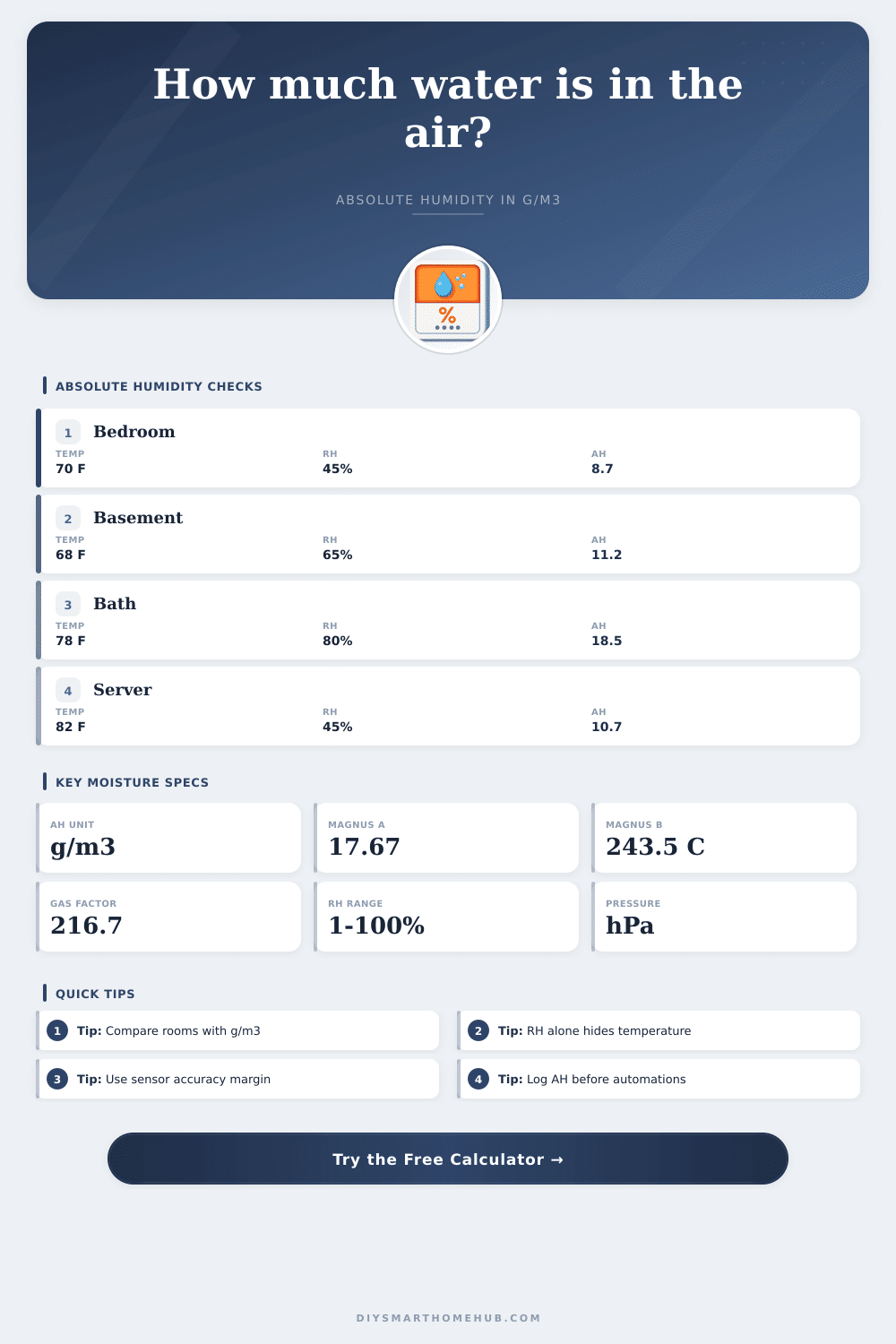
| Dry winter bedroom | 68 F / 20 C | 30% | 5.2 g/m³ | Compare against comfort and static complaints |
| Comfortable living room | 72 F / 22.2 C | 45% | 8.8 g/m³ | Good baseline for normal room sensors |
| Humid basement | 68 F / 20 C | 65% | 11.2 g/m³ | Moisture load may exceed upstairs air |
| Bathroom after shower | 78 F / 25.6 C | 80% | 18.8 g/m³ | High moisture spike for fan verification |
| Indoor greenhouse | 80 F / 26.7 C | 75% | 19.3 g/m³ | Useful for plant-room trend logs |
| Server closet | 82 F / 27.8 C | 45% | 11.8 g/m³ | Warm air can carry more water at same RH |
| Temperature | AH at 30% RH | AH at 50% RH | AH at 70% RH | Why RH alone misleads |
|---|---|---|---|---|
| 50 F / 10 C | 2.8 g/m³ | 4.7 g/m³ | 6.6 g/m³ | Cold air holds little vapor |
| 60 F / 15.6 C | 4.1 g/m³ | 6.8 g/m³ | 9.5 g/m³ | Same RH means more water |
| 70 F / 21.1 C | 5.5 g/m³ | 9.2 g/m³ | 12.8 g/m³ | Common indoor comparison point |
| 80 F / 26.7 C | 7.7 g/m³ | 12.8 g/m³ | 17.9 g/m³ | Warm rooms can look moderate by RH |
| 90 F / 32.2 C | 10.2 g/m³ | 17.0 g/m³ | 23.8 g/m³ | Attics and ducts can carry heavy vapor |
| Absolute humidity band | Typical reading | Indoor interpretation | Automation signal | Common location |
|---|---|---|---|---|
| Very dry | Below 5 g/m³ | Dry winter air or cold outdoor air | Humidity deficit alert | Bedroom, office |
| Moderate | 5 to 10 g/m³ | Normal conditioned room air | Baseline trend zone | Living area |
| Moist | 10 to 14 g/m³ | Basement, mild summer, warm closet | Compare with other zones | Basement, garage |
| Humid | 14 to 18 g/m³ | Ventilation or dehumidifying may matter | Fan or dehumidifier trigger | Laundry, bath |
| Very humid | Above 18 g/m³ | Large water vapor load | High-priority moisture event | Shower, plant room |
| Sensor / spec profile | Typical RH accuracy | Typical temp accuracy | Response behavior | Best absolute humidity use |
|---|---|---|---|---|
| Basic smart sensor | +/-3% RH | +/-0.5 C | Medium | Room-level trends after averaging |
| Calibrated room sensor | +/-2% RH | +/-0.3 C | Medium | Main zone comparison and dashboards |
| Remote probe sensor | +/-1.5% RH | +/-0.2 C | Fast | Crawlspace, duct, cabinet, slab edge |
| Battery corner puck | +/-4% RH | +/-0.7 C | Slow | Broad warning only; avoid tight triggers |
| Duct rated probe | +/-2.5% RH | +/-0.4 C | Medium fast | Supply, return, ERV, or bath exhaust air |
| Industrial transmitter | +/-1% RH | +/-0.15 C | Fast | Close control and room-to-room deltas |
💡Absolute Humidity Tips
Absolute humidity are the measurement of the actual mass of water vapor that is present in an air. While many focus on the measurement of relative humidity, which is represented as a percentage, the relative humidity only reflects how close the air is to saturation at a specific temperatures. The capacity of the air to hold water vapor change with changes in temperature, therefore making relative humidity a potentially misleading measurement.
If the temperature of the air increase, the air’s capacity to hold water vapor increases, even without adding more water vapor to the air. Consequently, absolute humidity is the measurement that must be used to understand the amount of moisture in a given room. The calculator included on this page will allow you to input the temperature of a space and the relative humidity of that space to determine the absolute humidity of that space.
What Is Absolute Humidity and How to Use the Calculator
You can use this measurement to compare the absolute humidity of different room in a building. For instance, it is possible for the relative humidity to be the same in both a basement and an upstairs bedroom within a building. However, the basement is likely to be cooler than the bedroom.
Cool air can hold less water vapor than warm air, so the basement contains a higher absolute humidity than the bedroom. By entering each of the temperature and relative humidity values into the calculator, the calculator will display the absolute humidity for you. Absolute humidity is a value that can help you make decisions about your building.
For instance, you can use the absolute humidity measurement to determine if a space need to be dehumidified or if an exhaust fan is needed in that area. Furthermore, you can compare the absolute humidity within a building to the absolute humidity outside the building to determine if the rooms need to be vented to lose moisture, or if they are gaining moisture from outside the building. The calculator performs these calculations for you so that you dont have to perform the formulas yourself.
Sensors have inherent degrees of accuracy to which they can measure relative humidity and temperature. Each sensor has a margin of error; for instance, a sensor may have a relative humidity tolerance of 3%. The calculator provides for the error of these sensors by incorporating both the relative humidity tolerance of that sensor and the relative humidity tolerance of the temperature sensor into its calculations.
The range of humidity percentages provided within the calculator will allow you to account for sensor drift; if the humidity is outside of the range provided by the sensor, the sensor may turn on and off too frequent for your comfort. Ventilation is a method of removing moisture from a space. Air changes per hour is a measurement of the ventilation of a space.
The air changes per hour can be entered into the calculator; the absolute humidity measurement and the air changes per hour allow for the calculation of the number of pounds of moisture that is exhausted from a space each hour. This number can help you determine if a bath fan is changing enough air in the bathroom, for instance, or if a crawlspace exhaust fans is exchanging enough air with the outside environment. Barometric pressure is another parameter that is required to calculate humidity.
The humidity ratio is the mass of water vapor in the air divided by the mass of the air that are dry. This value is helpful for comparing the amount of moisture in the air that emerges from a duct system to that which is already within the room. While many individuals do not require the humidity ratio on a regular basis, the value is important for those who track the impact that an energy recovery ventilator (ERV) or heat recovery ventilator (HRV) has upon the moisture in the building.
The tables located on this page include reference examples of the relationship between absolute humidity, relative humidity, and the temperature of the air. For instance, you can see that absolute humidity increases with increasing temperature even if the relative humidity remain the same. These tables can provide a basis for understanding if your absolute humidity measurement is normal for your area during the current season.
However, items in the space, like furniture, carpets, and drywall, can retain moisture over time. Consequently, the absolute humidity may not change immediately if you start to fan across a room that contains such item. The formulas that the calculator uses to calculate the absolute humidity are based off the relationship between the temperature and the vapor pressure of the water.
The Magnus coefficients are used to approximate the vapor pressure within the range of indoor temperature. These approximations are accurate enough for the average homeowner to use in making decisions within the household. Because humidity can be monitored over time, it is possible to determine the trends of the humidity within the space.
Instead of trying to maintain the relative humidity at a certain percentage, it is often easier to observe the absolute humidity over time to determine if there are any changes to that percentage. For instance, if the absolute humidity in a bedroom increases over time it may indicate a source of moisture within that bedroom. Furthermore, if the absolute humidity within the home drop after the ERV (energy recovery ventilator) begins to run, it indicates that the ERV is effectively removing moisture from the home.
By converting the relative humidity and the temperature of the space into absolute humidity, you can observe the trends within those values. Finally, by treating humidity as a physical quantity of water, you can make decisions regarding the moisture in your home.