Solar Panel Voltage Calculator
Calculate cold-weather PV string Voc, hot-weather Vmp, MPPT operating fit, array watts, input current, and charge-controller output current from real solar module data.
☀Real PV String Presets
⚙PV Voltage Inputs
📊Voltage Planning Snapshot
📘Solar Module Data Reference
| Module class | Pmax | Voc / Vmp at STC | Imp / Isc | Voltage temp coefficients |
|---|---|---|---|---|
| 100W 12V mono | 100 W | 22.6 V / 18.6 V | 5.38 A / 5.75 A | Voc -0.29%/°C, Vmp -0.35%/°C |
| 175W compact mono | 175 W | 23.9 V / 19.8 V | 8.84 A / 9.35 A | Voc -0.28%/°C, Vmp -0.34%/°C |
| 200W 12V mono | 200 W | 24.3 V / 20.4 V | 9.80 A / 10.4 A | Voc -0.28%/°C, Vmp -0.34%/°C |
| 370W 120 half-cell | 370 W | 41.1 V / 34.5 V | 10.73 A / 11.35 A | Voc -0.27%/°C, Vmp -0.31%/°C |
| 400W residential mono | 400 W | 49.8 V / 41.0 V | 9.76 A / 10.35 A | Voc -0.27%/°C, Vmp -0.31%/°C |
| 450W half-cell mono | 450 W | 49.3 V / 41.5 V | 10.84 A / 11.42 A | Voc -0.26%/°C, Vmp -0.30%/°C |
| 550W utility mono | 550 W | 49.9 V / 41.9 V | 13.13 A / 13.94 A | Voc -0.27%/°C, Vmp -0.30%/°C |
🔌Charge Controller Voltage Reference
| Controller profile | Absolute PV max | MPPT operating window | Best battery fit | Voltage planning note |
|---|---|---|---|---|
| PWM 50 V input | 50 V | Battery-coupled | 12 V or 24 V | Panel nominal voltage should closely match battery voltage |
| MPPT 75 V class | 75 V | 15 V to 70 V | 12 V or 24 V | Good for one or two small modules in series |
| MPPT 100 V class | 100 V | 15 V to 95 V | 12 V, 24 V, 48 V | Common compact off-grid controller class |
| MPPT 150 V class | 150 V | 30 V to 145 V | 24 V or 48 V | Often fits two or three residential modules |
| MPPT 250 V class | 250 V | 60 V to 245 V | 48 V | Allows longer strings and lower PV wire current |
| Hybrid inverter 500 V | 500 V | 120 V to 450 V | 48 V | Requires enough series modules for startup voltage |
| String inverter 600 V | 600 V | 120 V to 550 V | Grid-tie PV | Designed for long high-voltage strings |
🌡Temperature Correction Reference
| Module temperature | Voc effect with -0.28%/°C | Vmp effect with -0.32%/°C | Design use |
|---|---|---|---|
| -20°C cold module | Voc rises about 12.6% | Not a hot Vmp case | Controller absolute max check |
| 0°C cold module | Voc rises about 7.0% | Not a hot Vmp case | Mild-winter Voc check |
| 25°C STC module | Nameplate Voc | Nameplate Vmp | Datasheet reference point |
| 65°C hot cell | Voc falls about 11.2% | Vmp falls about 12.8% | MPPT low-voltage check |
| 75°C hot cell | Voc falls about 14.0% | Vmp falls about 16.0% | Extreme roof heat check |
🧮Common String Design Reference
| System style | Common battery or input | Useful Vmp target | Typical series count | Watch point |
|---|---|---|---|---|
| 12 V PWM small panel | 12 V battery | 17 V to 22 V | 1 small 12V module | Extra series voltage is usually wasted on PWM |
| 12 V MPPT portable | 12 V battery | 20 V to 70 V | 1 to 2 compact modules | Check cold Voc before using two in series |
| 24 V off-grid MPPT | 24 V battery | 45 V to 120 V | 2 to 3 small modules | Hot Vmp should stay above battery charge voltage |
| 48 V off-grid MPPT | 48 V battery | 90 V to 220 V | 2 to 5 home modules | Controller max PV voltage sets the series ceiling |
| Hybrid inverter PV | High-voltage MPPT | 150 V to 450 V | 4 to 10 home modules | Startup voltage is often the limiting low-end check |
| Grid-tie string inverter | High-voltage MPPT | 180 V to 550 V | 5 to 12 home modules | Cold Voc must remain below inverter maximum |
🗄Device And Spec Comparison Grid
PWM controller
Uses battery voltage as the operating point, so matching nominal panel voltage to the battery matters more than building a high-Vmp string.
Low-voltage MPPT
Tracks panel Vmp and converts down to battery voltage, but the cold Voc ceiling can be tight with two residential modules.
150 V MPPT
A common off-grid class for 24 V and 48 V systems where two or three home-size modules often fit well.
250 V MPPT
Longer strings reduce PV-side current and wire drop, while controller output amps still depend on array watts and battery voltage.
Hybrid inverter
Often needs higher startup voltage, so the hot Vmp check can matter as much as the cold Voc maximum.
Grid-tie string input
Handles high-voltage strings, but long winter Voc and local code limits still define the safe maximum series count.
✅PV Voltage Sizing Tips
When you plan a solar array you must consider the voltage of the solar array because the voltage of the solar array will determine if the system will functions. The voltage of the solar array changes according to the temperature of the solar module. Cold temperatures will increase the voltage of the solar module, but hot temperatures will decreases the voltage of the solar module.
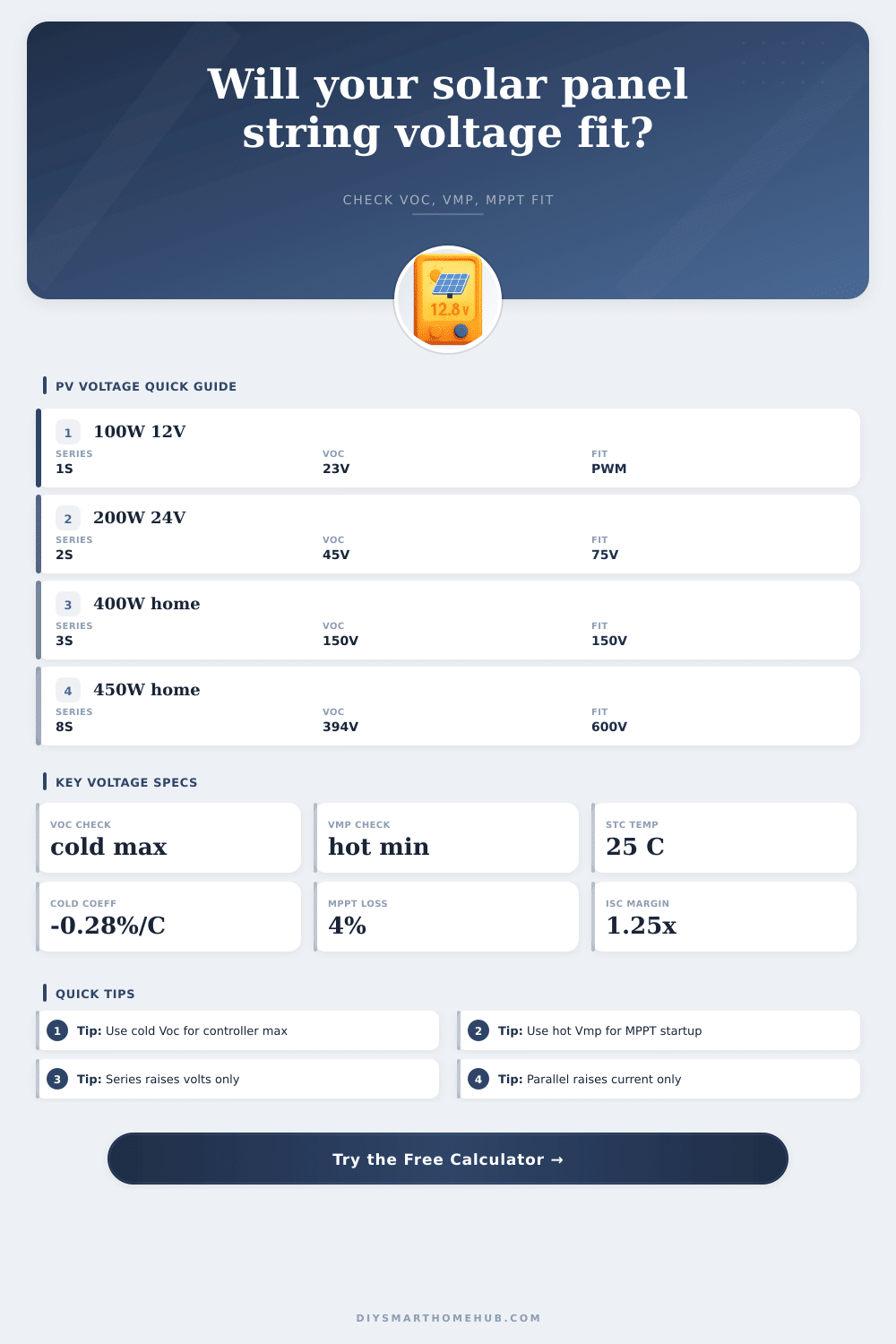
Thus, the voltage of the solar array must be calculated for both the coldest and hottest temperature that the solar array will reach during its operation. Calculating for the coldest temperature will ensure that the voltage does not exceed the maximum voltage of the charge controller. Calculating for the hottest temperatures will ensure that the voltage is enough high to allow the MPPT to function.
How to Plan Solar Array Voltage and Current
The way in which the solar modules are connect will impact both the voltage and current of the solar array. If you connect the solar modules in series, the voltage will increase, but the current will remain the same. If the solar strings are connected in parallel, the current will increase, but the voltage of each string will remain the same.
These connections impact the voltage and current requirements for the wires for the solar array, as well as the requirements for the charge controller. The type of charge controller that you will use will impact the way in which the voltage of the solar array is to be manage. PWM charge controllers requires the voltage of the solar modules to be similar to that of the battery bank.
Thus, using a PWM charge controller with long strings of solar modules is not efficient. MPPT controllers can accept a wider range of input voltages from the solar array and can convert that voltage to the voltage of the battery bank. Thus, people often use MPPT controllers in solar array systems with larger number of solar modules.
An MPPT charge controller can handle higher voltages create with an increased number of solar modules connected in series. In addition to calculating the voltage of the solar array, it is also important to calculate the output current of the solar array to ensure that the charge controller can handle that current. To calculate the output current of the solar array, divide the watts of the solar array by the voltage of the battery bank.
Account for efficiency loss in the system. Ensure that the output current is within the current limit of the charge controller. Choose a charge controller with a higher current rating then the calculated output current of the solar array.
Using a larger charge controller will reduce the amount of heat created in the controller, as well as extend the life of the charge controller. The temperature of the solar array will impact the voltage of the solar array. A solar array that is in full sun will reach hotter temperatures than a solar array that has airflow underneath the solar array.
The hotter the solar array becomes, the lower the voltage of the solar array will be. Thus, shading from an object like a tree or a pipe may also impact the voltage of the solar array. Though the calculator can provide the voltage of the solar array under standard conditions, adjustments for these factor must be made.
If you dont calculate the voltage of the solar array correctly, problems can occur with the solar array after it is installed. The voltage may be too high for the battery bank when it is cold, or the voltage may be too low when the solar array is too hot. These problems are difficult to fix after the solar array is mounted onto the roof.
Therefore, you must perform the calculations prior to purchasing the solar array component. The tables will provide an example of how solar modules will behave at different temperatures. The tables will also display the different voltage class of the charge controllers and the battery banks to which they can be connected.
These tables can be used to gain an idea of the scale of your solar array prior to plugging into the calculator. For residential solar arrays, each solar module produces between forty and fifty volt. Thus, three or four solar modules in series can be connected to a one hundred fifty volt charge controller.
Another factor to consider when planning your solar array is the short circuit current of the solar array. You multiply the short circuit current by 1.25 to account for periods of bright sun and cold temperatures. This 1.25 multiplier can be seen in the calculator to determine the input current for the solar array.
The input current will tell you the size of the wire and the fuse for the solar array. The voltage of the battery bank will impact the output current of the solar array. A forty-eight volt battery bank will require less charging current than a twenty-four volt battery bank.
A lower output current for the solar array is beneficial in that it allows for the use of smaller wire to carry that current. Use the calculator to determine the output amp number for your battery bank voltage to ensure that you use the appropriate charge controller for your solar array. The calculator will provide you with a safe series range for your solar array.
The safe series range for your solar array will tell you the minimum and maximum number of solar modules that can be connected to your controller. If your calculated number of solar modules falls within the middle of this range, you have a safety margin. If the number of solar modules falls on the edge of this range, fluctuations in the temperature of the solar array may cause the voltage to become outside of the safe series range.
The goal in planning your solar array is to place the voltage of the solar array within the middle of the voltage range for the battery bank. You want the voltage of the solar array to be low enough that it will not create an overvoltage error in the battery bank during periods of cold weather, yet high enough that it will not create a low voltage error during hot weather periods. By placing the voltage within this middle range, your solar array will remain within a safe range of operation.