Solar Panel Load Calculator
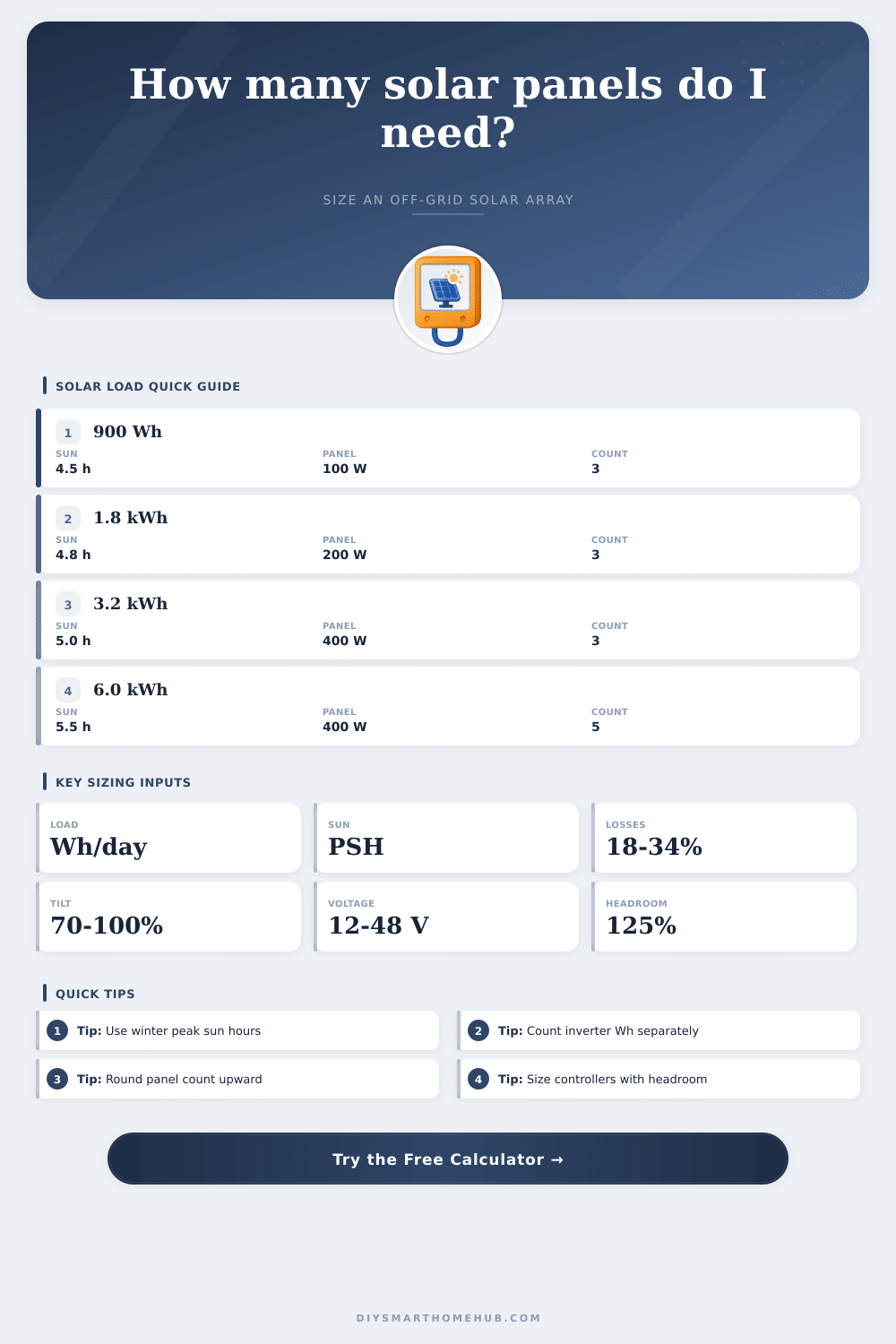
Estimate off-grid solar array size from daily watt-hours, inverter loads, peak sun hours, real system losses, roof orientation, panel wattage, battery voltage, and controller headroom.
⚡Real Off-Grid Presets
📊Load and Solar Inputs
Full Calculation Breakdown
🔌Solar Module / Inverter / Spec Comparison
☀Peak Sun Hour Planning Table
| Planning Condition | Typical PSH | Use When | Sizing Effect |
|---|---|---|---|
| Cloudy winter northern site | 2.0 to 3.0 h/day | Critical loads must work year-round | Largest array for same Wh load |
| Mixed-season temperate site | 3.5 to 4.5 h/day | Cabins, sheds, and backup loads | Moderate array with useful reserve |
| Sunny inland or summer RV use | 5.0 to 6.0 h/day | Seasonal mobile or fair-weather systems | Fewer panels, less winter margin |
| High-sun desert planning | 6.0 to 7.0 h/day | Dry climates with open exposure | Strong daily harvest if heat losses are managed |
💡Common Off-Grid Load Reference
| Load Type | Typical Running Watts | Example Runtime | Daily Energy |
|---|---|---|---|
| LED lighting circuit | 20 to 60 W | 5 h/day | 100 to 300 Wh/day |
| WiFi router and modem | 10 to 25 W | 24 h/day | 240 to 600 Wh/day |
| Efficient DC fridge | 35 to 60 W cycling | Duty-cycle averaged | 500 to 900 Wh/day |
| Laptop and monitor work block | 70 to 140 W | 6 h/day | 420 to 840 Wh/day |
| Small pressure or well pump | 500 to 900 W running | 0.5 to 1 h/day | 250 to 900 Wh/day |
⚙Derate and Loss Factors
| Factor | Typical Range | Calculator Use | Why It Matters |
|---|---|---|---|
| MPPT harvest efficiency | 92% to 98% | Included in loss profile | Controller conversion and tracking losses reduce usable charge energy. |
| Battery charge efficiency | 80% to 98% | Included in loss profile | Lead acid systems need more array for the same delivered Wh. |
| Wiring and connection loss | 2% to 5% | Included in loss profile | Voltage drop rises with current, long cable runs, and small conductors. |
| Tilt / azimuth derate | 70% to 100% | User-selected multiplier | Flat, east/west, shaded, or off-angle arrays receive less daily sun. |
| Controller headroom | 125% common | Installed W / V × 1.25 | Headroom covers high irradiance moments and rating selection margin. |
📋Common Project Sizes
| Project | Daily Load | Typical Array | Notes |
|---|---|---|---|
| Security camera and router node | 300 to 700 Wh/day | 200 to 400 W | Use winter PSH because loads run overnight and in storms. |
| Weekend cabin essentials | 900 to 1800 Wh/day | 400 to 800 W | Lighting, charging, modem, fan, and short inverter use. |
| RV fridge and electronics | 1200 to 2600 Wh/day | 600 to 1200 W | Flat roof derate usually matters more than panel nameplate watts. |
| Tiny home essential loads | 3000 to 6000 Wh/day | 1200 to 3000 W | 48 V systems lower controller current and cable size pressure. |
✅Solar Sizing Notes
Calculating the size of an off-grid solar array are a complex calculation because there are a variety of variable that will impact the amount of energy that the solar array will produce. There are many different variables that must be accounted for in order to ensure that the solar array can provide enough energy for the electrical loads of an off-grid home, as well as to compensate for the energy that is lose by the solar array. The energy that the solar array lose can be lost during the DC to AC power conversion process, due to the electrical losses of the wiring of the solar system, and due to the efficiency of the batteries that is used to store the energy produced by the solar array.
The calculator that is provide above will automatically calculate each of these variables for you once you have entered your own specific variable into the calculator. Each of these variable includes the type of electrical loads that the solar array is to supply, the amount of peak sun hours that is available to your panels each day, the efficiency of your hardware and wiring (represented by the loss profile), the angle of your solar panels (represented by the tilt derate option), the size of your charge controller, and the size of your solar array. Each of these factor are important to ensure that you have a solar array that can supply the energy requirement of your off-grid home.
How to Size an Off-Grid Solar Array