Projector Lumens Calculator
Estimate projector brightness from screen size, aspect ratio, foot-lambert and nit target, screen gain, ambient light multiplier, lamp or laser aging, throw distance, and real delivered-lumen loss.
📌Real Projector Room Presets
Loaded preset: 100 Inch Dark Cinema. A dark room lets screen area and target foot-lamberts dominate the lumen requirement.
⚙Projector Brightness Inputs
Calculation Breakdown
📊Projector Spec Comparison Grid
📋Reference Tables
Brightness Targets
| Use case | Target fL | Target nits | Best environment |
|---|
Ambient Light Multipliers
| Room condition | Multiplier | Planning cue | Watch point |
|---|
Screen Gain Effects
| Screen type | Typical gain | Lumen effect | Best fit |
|---|
Preset Lumens Snapshot
| Preset | Diagonal | Target | Rated lumens |
|---|
💡Planning Notes
Choosing a projector require you to understand how much light the projector must deliver to the screens. The amount of light that a projector will deliver to the screen depend on several factor. These factors include screen size, light level in the room where the projector will be viewed, and the age of the projector lamp or lasers.
The lumen number printed on the projector box will indicate the maximum amount of light that the projector will output when measure under ideal conditions in the laboratory. However, the lumen measurement printed on the projector box will not necessarily reflect the bright when used in a home environment. As the projector lamp or laser age, the projector will naturaly release less light then when it was new.
How Much Brightness Do You Need for a Projector
The size of the screen will be a determining factor in the amount of light that the screen will output. The more larger the screen size, the more the light will be dispersed across the screen. As a result, the brightness of the screen will decrease.
For instance, a projector may be bright when displayed on an 85-inch screen but appear relatively dim when displayed on a 150-inch screen. In order to calculate the brightness of the screen, an screen area calculator can be used. Another factor that will determine the amount of brightness require from the projector is the lighting in the viewing room.
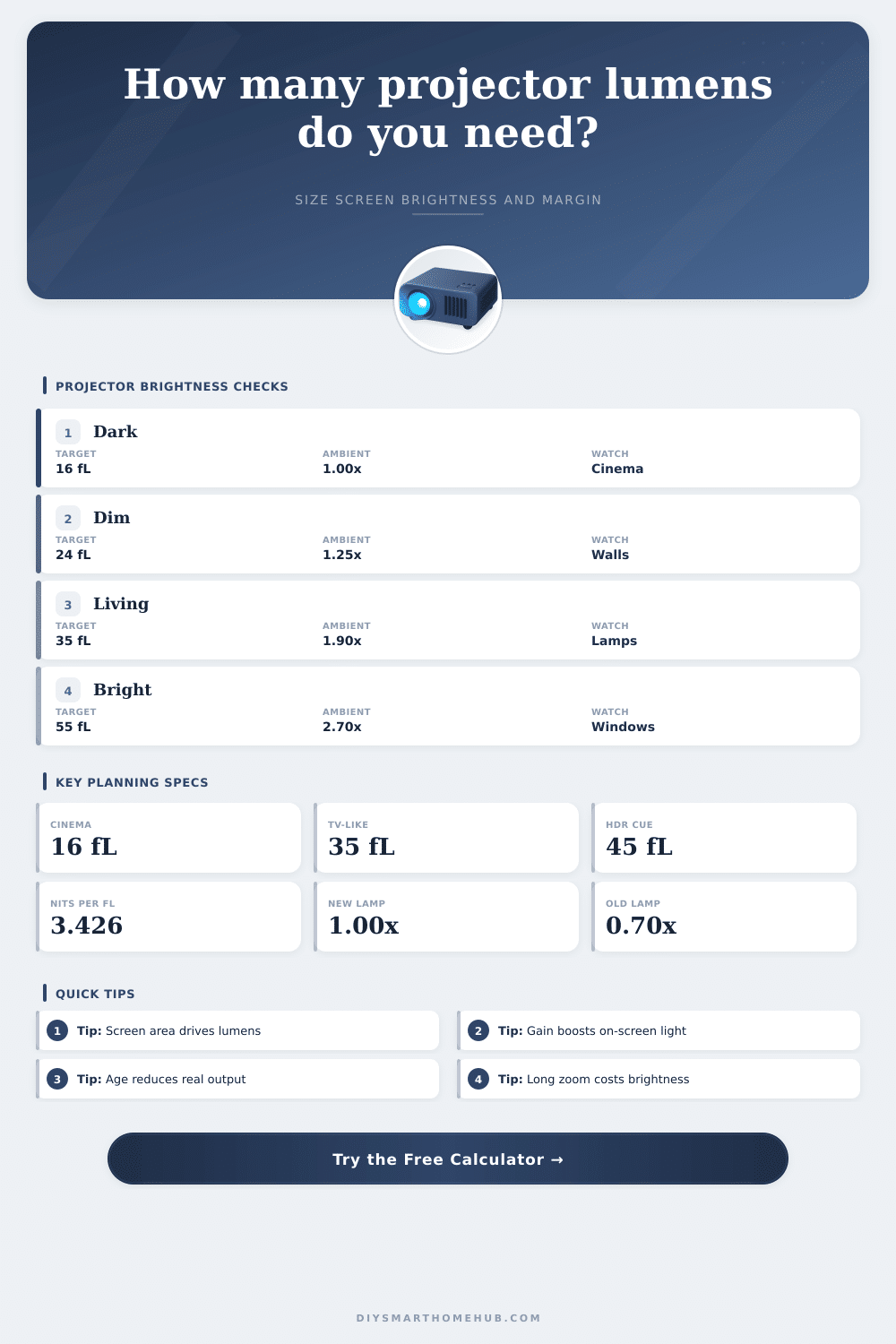
For viewers in a darkened room, a projector with low brightness will work well. However, viewers in a living room with lamps or light colored walls will require a projector with higher brightness. Brightness is lost in a room due to ambient light.
The required brightness for a living room will be twice that of a dark cinema room. Another factor to consider is the gain of the screen. Screens with a gain higher than 1.0 will focus the projectors light toward the center of the screen, increasing the brightness for those who view the screen from the center.
High-gain screens, however, can cause hot-spotting for those viewers who are to the side of the screen. Additionally, viewers have to be within a narrow viewing angle to enjoy the brightness of a high-gain screen. Screens with lower gains will emit light more even across the screen.
However, the projector will have to emit more light for viewers to perceive the same level of brightness on a low-gain screen. The age of the projector’s lamp or laser is another consideration when choosing the projector for a room. A projector lamp or laser will naturally release less light with time.
The projector that is used in a dusty environment may lose its brightness at a faster rate. People can plan for the decrease in brightness of the projector over time. A brightness calculator will assist in understand how the brightness will change with the projector lamp or laser at 80 percent or 70 percent of its original strength.
Other factors to consider when choosing a projector that will brighten a screen are the throw distance and zoom position of the projector. Projectors with a long throw distance can reduce the amount of light that reaches the screen. Additionally, the short throw distance of a projector may also reduce the amount of light that reach the screen.
The amount of light that reaches the screen may be less than the amount advertise in the projector catalog. Once you calculate the amount of brightness that will be required for the screen, it is important to include some margin of brightness in your calculation. A projector that provide the amount of brightness required for the screen may not provide enough excess brightness for the projector to last the lifetime of its lamp or laser.
A projector may be bright for the initial length of viewing but will eventually reach a point where the screen is too dark to view. To provide some extra margin for brightness with age of the projector lamp or laser, a brightness calculator can determine the percentage of extra brightness that you would like to include in the brightness of the projector. Many people make mistake when purchasing a projector by treating the lumen brightness of the projector as the guaranteed brightness of the projector.
When people purchase projectors, they often focus on the brightness of the projector as the determining factor in the purchase. People also tend to ignore other factors such as screen size, ambient brightness in the room, and the age of the projector lamp or laser. Additionally, advertised LED brightness for projectors is not the same as the ANSI brightness of the projector.
A projector with 4000 LED lumens may not be as bright as a projector with 2500 ANSI lumens. All of these variables can be calculated to ensure that you have the amount of brightness that you need on your screen. Your projector will need to provide enough light on the screen to allow you to view the screen clear.
Additionally, there needs to be some extra brightness so that the projector does not lose that brightness over time as the projector age. By calculating these variables in advance, you can use a calculator to test these variables prior to purchasing your projector or screen.