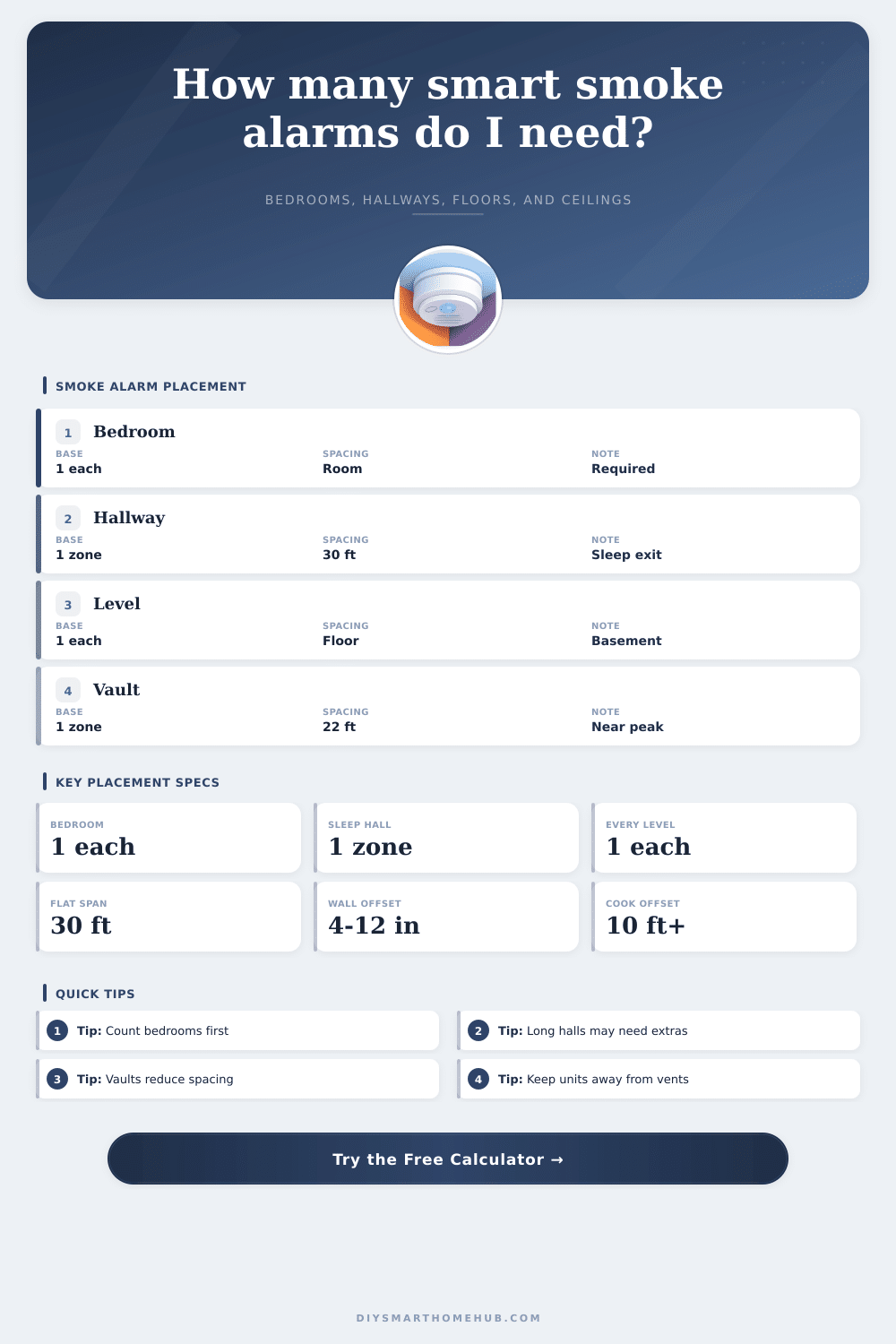
Smart Smoke Alarm Placement Calculator
Estimate a location-first smart smoke alarm plan using bedrooms, separate sleeping hallways, every floor, long hallway spacing, open coverage zones, and vaulted ceiling adjustments.
Pick a realistic layout, then adjust any field. These presets fill bedrooms, floors, hallway zones, open area, vaulted spaces, and remote separation zones.
Coverage preview
This is a planning calculator, not a code approval. Verify local rules, product listing, and manufacturer instructions before final placement.
Smoke alarm placement estimate
Full calculation breakdown
NFPA-style location basis
Use these as planning references for the calculator logic; local code and the device listing can be stricter.
| Location | Planning count | Calculator formula | Placement intent |
|---|---|---|---|
| Bedroom | 1 alarm inside each bedroom | Bedrooms × 1 | Alerts occupants before smoke reaches the hallway. |
| Outside sleeping area | 1 per separate sleeping hallway zone | Sleep zones × 1 | Covers bedroom doors and the escape path. |
| Every level | 1 per floor including basement | Floors × 1 | Gives each occupied level a local alarm point. |
| Remote separation | 1 per isolated finished or utility zone | Remote zones × 1 | Adds coverage where sound or smoke travel is separated. |
Ceiling and offset reference
Ceiling geometry changes where the alarm belongs and how aggressively the calculator derates spacing.
| Ceiling condition | Placement reference | Spacing factor | Calculator effect |
|---|---|---|---|
| Flat smooth ceiling | Ceiling mount or high wall near ceiling | 1.00x | Uses the full nominal spacing profile. |
| Wall mount | Top of alarm about 4-12 in below ceiling | 0.95x | Preserves high placement while allowing wall devices. |
| High flat ceiling | Ceiling mount; review product listing | 0.80x | Reduces coverage zone to account for delayed smoke layer. |
| Vaulted or peaked ceiling | Near highest point, about 4-12 in down | 0.72x | Adds peak zones and shortens hallway spacing. |
Spacing formulas used by the calculator
Residential smoke alarms are primarily location-based; these formulas catch long halls, open plans, and high-ceiling gaps.
| Need | Formula | Default input | Why it matters |
|---|---|---|---|
| Base locations | Bedrooms + sleep zones + floors | User counts | Builds the minimum location-first layer. |
| Hallway extras | max(0, ceil(hall length / spacing) - sleep zones) | 30 ft flat profile | Long bedroom wings should not rely on one end alarm. |
| Open zones | ceil(open area / zone capacity) | 900 sq ft flat zone | Large connected spaces may need more than the level alarm. |
| Vault allowance | ceil(vaulted zones × 0.8) | 0 zones | Peak geometry can isolate smoke at the high point. |
Common home layout outcomes
These examples show why the same bedroom count can need different alarm totals when hallways, floors, and ceilings change.
| Layout | Typical inputs | Likely count | Main driver |
|---|---|---|---|
| 1-bed apartment | 1 floor, 1 bedroom, 1 hall zone | 3-4 alarms | Bedroom, hall, level, open zone. |
| 3-bed ranch | 1 floor, 3 bedrooms, one hall | 5-7 alarms | Bedroom count plus common area. |
| Two-story townhouse | 2 floors, 3 bedrooms, stairs | 6-8 alarms | Every level and sleeping hallway. |
| Large vaulted plan | 3 floors, 5 bedrooms, high ceiling | 10-14 alarms | Open coverage and vaulted derating. |
Smoke alarm must be placed in specific location in a house. Smoke will rise to the ceiling. Once the smoke reach the ceiling, it will spread horizontal across the ceiling.
Smoke alarms on high walls will detect smoke more fast than smoke alarms on lower walls. If the ceiling are vaulted, smoke will collect at the peak of the vaulted ceiling. Smoke alarms placed on standard walls wont detect smoke in time to allow for an escape.
Where to Put Smoke Alarms in a House
If the dimension of the house are entered into a calculator, the calculator can determine where to place smoke alarms to allow for the vaulted zones in the house. Bedrooms must has smoke alarms. When sleeping in a bedroom, a person may not notice smoke.
Each bedroom must have at least one smoke alarm. Additionally, a smoke alarm must also be placed in the hallway to that bedroom. If sleeping zone exist on other floors in the house, smoke alarms will also be required in those sleeping zones hallways.
Smoke alarms is also required in the basement and the upper floor of the house. A smoke alarm calculator will calculate the number of smoke alarms based on the number of bedrooms, sleeping zones, and floors in the house. Long hallways require smoke alarms to be place in specific locations.
If you only install smoke alarms at one end of a long hallway, smoke may spread into the bedrooms before the smoke alarm can detect it. Rules about the maximum distance between smoke alarms can be entered into the smoke alarm calculator. The smoke alarm calculator will determine the number of smoke alarms that is required in a long hallway based on the distance of the hallway.
Open areas in the house must also have smoke alarms to ensure that each area can be cover by smoke alarms. If the size of the open area in the house is entered into the smoke alarm calculator, the smoke alarm calculator will calculate the number of smoke alarms that are required for that area. The square footage of the area will be divided by the coverage capacity of the smoke alarm that is select.
If the area is too large for one smoke alarm, the smoke alarm calculator will calculate the additional smoke alarms that are required for those area. Remote zone, such as basements and mudrooms, may not be covered by smoke alarms in the rest of the house due to the doors blocking the smoke and sound from those smoke alarms. Smoke alarms will be required in each of these zones in case of fire.
Additionally, the type of smoke alarm will also impact how the smoke alarms will function in the house. Photoelectric smoke alarms will detect smoldering fire. Therefore, they will be appropriate for placement in bedrooms.
Dual sensor smoke alarms will also detect smoldering fires and flaming fires. However, they may go off in the house due to smoke from the kitchen. Carbon monoxide detection device can be placed in sleeping areas to detect carbon monoxide from combustion fires.
The placement of these smoke and carbon monoxide detectors will be the same as smoke alarms. Hardwired interconnected smoke alarms will allow for one smoke alarm to trigger all smoke alarms in the house. However, there placement will be the same as smoke alarms.
While there may be a high number of smoke alarms in the house, this does not necessarily mean that the smoke alarms will be effective. Smoke traveling through the air may encounter a closed bedroom door which will reduce the volume of the smoke alarm by half. In this case, there must be a smoke alarm in each bedroom and in each hallway.
Additionally, smoke alarms will also be required in each remote zone. All smoke alarms must be placed in such a way that all individual in the house can hear the smoke alarm even through a closed bedroom door. Each escape path should also be covered by smoke alarms before the smoke fill the escape path.
Smoke alarms must always be placed according to local rule. Additionally, the manufacturer of smoke alarms also provide guidelines for the placement of smoke alarms. While the smoke alarm calculator will calculate the number of smoke alarms that are required in the house, it will not provide a legal permit for the installation of smoke alarms.
The smoke alarm calculator will calculate the number of smoke alarms that are required in the house based on the number of bedrooms, sleeping zones, floors, long hallways, and open area. Smoke alarms should be placed in locations where smoke will reach the smoke alarms first. Additionally, smoke alarms should also be placed away from vent and cooking surfaces in the house.
Each bedroom cluster must include a smoke alarm that is placed in the bedroom and another smoke alarm in the hallway to that bedroom.