Smart Water Leak Sensor Quantity Calculator
Estimate how many smart leak sensors your home needs by counting fixture clusters, appliance zones, floor levels, coverage gaps, high-risk rooms, and reserve sensors.
📍Real Home Presets
💧Leak Sensor Inputs
Calculation Breakdown
⚙Device Spec Comparison Grid
🚰Placement Baseline Table
| Zone Type | Counted Input | Baseline Sensors | Reasoning |
|---|---|---|---|
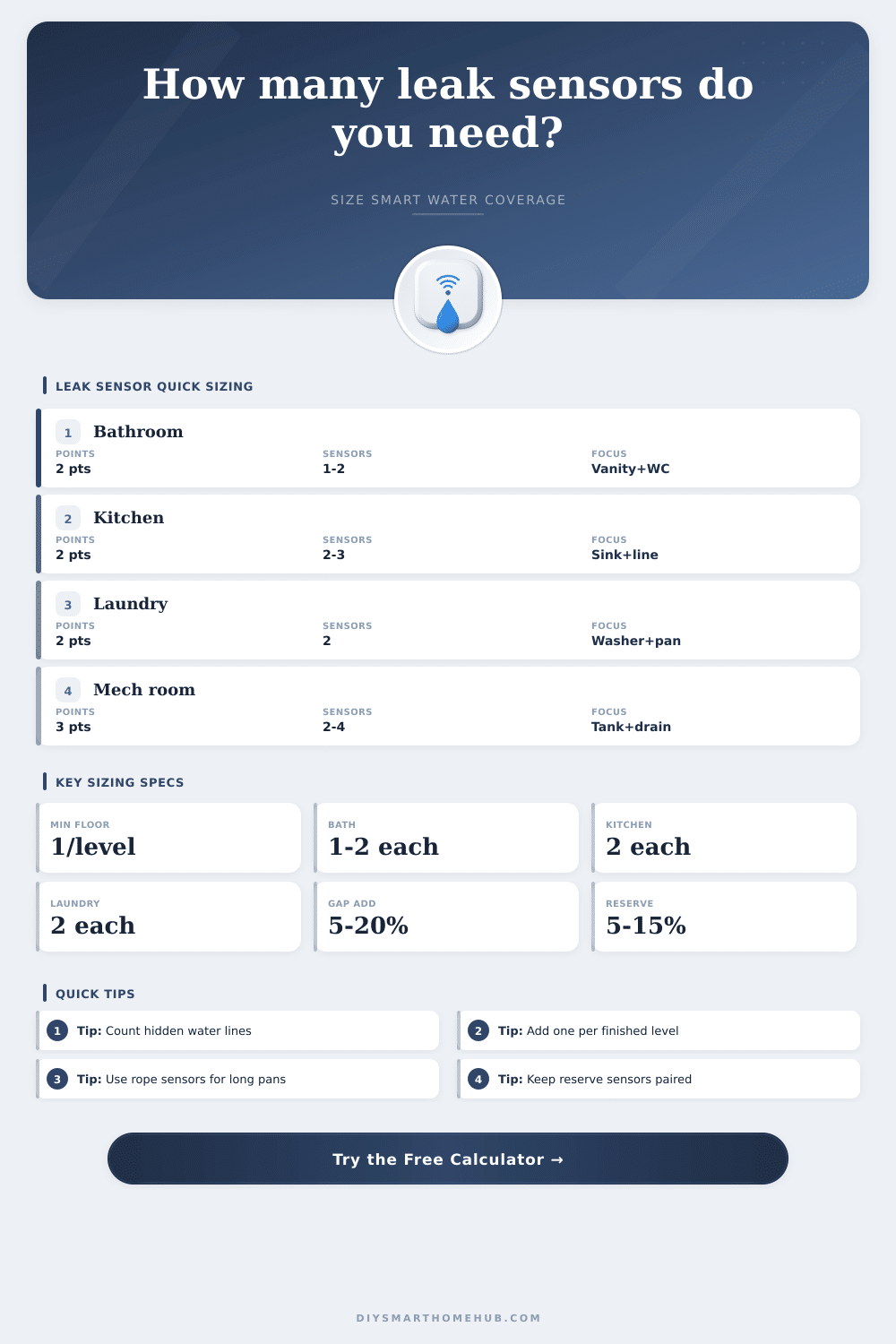
| Bathroom or powder room | Bathrooms | 1.6 per room, rounded up | One device cannot reliably watch both vanity drain/supply and toilet supply in many layouts. |
| Kitchen, wet bar, kitchenette | Kitchen zones | 2.0 per zone | Sink base plus dishwasher, refrigerator, filter, or ice-maker line are often separated. |
| Laundry room or washer closet | Laundry rooms | 1.8 per room, rounded up | Washer pan, hose valves, and nearby drain/utility sink may not share the same low point. |
| Mechanical water zone | Mechanical zones | 1.4 per zone, rounded up | Tanks, sumps, condensate, filters, and shutoff manifolds benefit from direct nearby detection. |
| Separate water-fed appliance | Appliance zones | 1.0 per appliance | Appliances commonly hide small supply lines behind cabinets or under finished flooring. |
| Finished level minimum | Floor levels | 1.0 per level | Each plumbing level should have at least one independent low-point or central-area sensor. |
📊Coverage Gap and Reserve Profiles
| Profile | Gap Allowance | Reserve Allowance | Best Fit |
|---|---|---|---|
| Tight layout | 5% of baseline | 5% after gap | Small homes where wet zones share adjacent cabinets or rooms. |
| Standard layout | 10% of baseline | 10% after gap | Most homes with separated bathrooms, kitchen appliances, and a mechanical room. |
| Complex layout | 15% of baseline | 12% after gap | Homes with long pipe runs, closets, split plumbing stacks, or crawlspace transitions. |
| Large lower level | 20% of baseline | 15% after gap | Finished basements, multi-level homes, or layouts with valuable rooms below wet areas. |
🔍Sensor Type Comparison
| Device Type | Detection Footprint | Typical Use | Quantity Note |
|---|---|---|---|
| Point contact puck | One small low point | Under sinks, behind toilets, beside water heaters | Count one per separated leak point. |
| Probe sensor | Probe tips at floor or pan | Washer pans, sump rim, condensate pan edge | Useful when the transmitter must sit above splash level. |
| Rope or cable sensor | 4-20 ft detection length | Long appliance bays, mechanical platforms, wall-to-wall pans | May replace several point sensors in a single continuous trough. |
| Valve-linked sensor | One point plus shutoff action | Main valve, water heater, mechanical room | Still count remote fixtures separately. |
| Hub protocol sensor | Depends on sensor body | Zigbee, Z-Wave, Thread, or proprietary hubs | Plan extras for weak-signal floors or detached spaces. |
| WiFi sensor | One point or probe | Homes without a sensor hub | Check 2.4 GHz coverage before counting a remote location as protected. |
🏠Common Project Size Reference
| Project Scenario | Typical Inputs | Recommended Sensors | Primary Focus |
|---|---|---|---|
| Studio or one-bedroom condo | 1 level, 1 bath, 1 kitchen, 1 laundry closet | 8-10 sensors | Kitchen, bath, washer, water heater closet, and reserve. |
| Two-bath townhome | 2 levels, 2 baths, 1 kitchen, 1 laundry | 12-15 sensors | Each floor plus bathrooms, kitchen appliance lines, and laundry. |
| Finished-basement single family | 2 levels, 3 baths, kitchen, laundry, 3 mechanical zones | 18-23 sensors | Basement ceiling risk, mechanical room, and upper-level wet rooms. |
| Large multi-level smart home | 3 levels, 4 baths, 2 kitchens, 5 appliances | 25-32 sensors | Separated wet rooms, long pipe runs, and high-value lower spaces. |
💡Quantity Planning Tips
Smart water leak sensor are placed on the floor to detect moisture. When the water leak sensors detect moisture, the sensors will automaticly sending an alert to the person who has purchased the sensors. A person must decide how many smart water leak sensors to purchase.
Additionally, a person must also decide where to place the smart water leak sensors. The number of smart water leak sensors that a person purchases can determine whether or not a person will be able to catch a leak under a vanity or behind a refrigerator. If a person misses a leak, it can cause thousands of dollar in damage to there home.
How Many Smart Water Leak Sensors You Need and Where to Put Them
Thus, determining the number of smart water leak sensors that a person need to purchase is a necessary step for every homeowner. The physical layout of water in a person’s home will determine how many smart water leak sensors are necessary to place in those areas. For example, every finished floor level in a home will have areas where the water will collect.
Thus, each finished floor level will require a person to place smart water leak sensors in those low points in the floor. Areas that should have smart water leak sensors include bathrooms and kitchens. Bathrooms and kitchens are the most common areas in which leaks occur.
Additionally, laundry rooms are another area where water leaks are prone to occur. Areas under appliances such as dishwashers and refrigerators may have lines for those appliances that is placed behind the appliances in the kitchen. Therefore, smart water leak sensors can be placed near those appliance lines.
Other areas to include smart water leak sensors include finished basements and areas underneath bathrooms on the upstairs level. These zones are high risk for water leaks and the water from those leaks will travel to the living area in the home. Once a person has determined the high-risk areas of a home, there may be additional smart water leak sensors that will be necessary for those areas.
For instance, areas with long pipe runs may require additional smart water leak sensors in those areas. Other areas that a person may need to purchase additional smart water leak sensors for may be where the signal from the smart water leak sensor weaken. In these instances, a person should also purchase additional smart water leak sensors that will sit in a drawer ready to be used if a person adds an appliance or finishes a new room in the house.
The additional smart water leak sensors that a person purchases should match the same smart system and signal hub that is used for the primary smart water leak sensors in the home. A calculator can help to determine the total number of smart water leak sensors that are necessary for a home. Using this calculator will remove the guess work for a person regarding how many smart water leak sensors to purchase for their home.
A person should not place smart water leak sensors in every room in the same way. For instance, a powder room that has only one toilet and sink may have only one smart water leak sensor. However, a full bathroom that includes a sink, a tub, and a toilet may have two smart water leak sensors because the low points of the fixtures in the bathroom are not within close proximity to one another.
Additionally, the kitchens in the home may not be the same. A smart water leak sensor that a person places under a sink will not catch leaks from appliances like a dishwasher or a refrigerator. A smart water leak sensor can be placed in a laundry room in the washer pan.
However, a person may forget that the other valves in the laundry room may also experience water leaks. Additionally, other areas in the home, like the mechanical room, may have additional water leaks from appliances like water heaters or ice machines. The type of smart water leak sensors that a person purchases will also affect the number of smart water leak sensors that are necessary in specific areas of a home.
Puck-shaped smart water leak sensors can only cover one small spot in a room. On the other hand, a rope or cable smart water leak sensor can cover an entire bay of appliances in the home. In some instances, a rope or cable smart water leak sensor will replace two or three puck-shaped smart water leak sensors.
Probe sensors are used in areas where the sensor need to remain above the water splash zones. Additionally, valve-linked smart water leak sensors are another type that a person can purchase that will automatically shut off the water to the appliance that is emitting the leak. If a person purchases Wi-Fi smart water leak sensors, each floor in the home will need to be checked for signal strength because the sensor will not work without being able to reach the router in the home.
The layout of the home will play a key role in determining how many smart water leak sensors to purchase for the home. For example, older homes that have many rooms filled with plumbing may have different needs than a new construction home. Finished lower levels of the home may present the same challenges as a vacation home in which a water leak can go on for an extended period of time without being noticed.
However, the baseline calculation of how many smart water leak sensors to purchase will apply to all types of homes. The final number, though, will depend on the amount of plumbing in those homes that is hidden from view. Using numerous smart water leak sensors will allow a person to reduce the number of insurance claims that are made on their home.
Additionally, using these smart water leak sensors will reduce the number of emergency calls that homeowners place. For example, one smart water leak sensor can be placed under the sink in the kitchen. This will allow a person to catch any supply line leaks under that sink.
Additionally, purchasing two smart water leak sensors for the laundry room will allow a person to catch any leaks in the washer versus the drain lines. Additionally, if a person purchases a whole-house shutoff valve and links it to these smart water leak sensors, the damage that occurs from these leaks can be limited to only a few minutes instead of hours. These smart water leak sensors, if used with an established response system, become a protection plan for the home.
A person can prepare for where to place the smart water leak sensors in their home by walking through each room in the home with a notepad. Using the notepad, a person can make a list of how many smart water leak sensors are necessary in each room in the home. For instance, a person can use the notepad to determine how many smart water leak sensors are needed in each floor level, number of bathrooms, kitchens, and laundry areas.
In addition to these categories, a person can also use the notepad to determine how many smart water leak sensors are needed in the mechanical areas of the home and the appliances in those areas. Each of these numbers can be entered into the calculator for smart water leak sensors to determine the total number of smart water leak sensors that are necessary for the home. Finally, a person can use the information that they gathered during the walk through the home to determine what types of smart water leak sensors will be purchased.
Each finished floor level should of have at least one smart water leak sensor in the home.