Smart Window Sensor Quantity Calculator
Estimate contact sensor count from windows by floor, operable panes, double-hung sashes, multi-panel openings, spare reserve, and security priority.
Detailed quantity breakdown
| Priority profile | Floor coverage behavior | Extra sash logic | Best fit |
|---|---|---|---|
| Basic perimeter | All ground and basement, partial upper floor | Light extras for complex windows | Starter system focused on reachable openings |
| Balanced home | All entered windows are included | Normal pane, double-hung, and slider factors | Most whole-home security layouts |
| Strict security | All windows plus more emphasis below grade | Higher sash and panel duplication | Homes with many accessible windows |
| Hardened perimeter | All windows with conservative redundancy | Redundant contacts on likely bypass points | High-priority perimeter monitoring |
| Window style | Base count | Extra factor | Quantity note |
|---|---|---|---|
| Single casement or awning | 1 contact | 0.0 to 0.2 | Usually one sensor if only one side opens |
| Double-hung window | 1 contact | 0.3 to 1.1 | Add coverage when both sashes may be opened |
| Horizontal slider | 1 contact | 0.4 to 0.9 | Wide sliders often need second-panel attention |
| Bay or multi-panel set | 1 contact | 0.5 to 1.2 | Count each movable panel path, not the frame |
| Fixed picture window | 0 to 1 contact | 0.0 | Use glass-break or vibration logic separately if needed |
| Sensor type | Typical gap tolerance | Battery planning cue | Where it fits |
|---|---|---|---|
| Surface magnetic contact | About 3/8 to 5/8 in | Easy battery swaps, visible case | Most vinyl, wood, and aluminum windows |
| Slim magnetic contact | About 1/4 to 1/2 in | Smaller battery, tighter alignment | Narrow frames and trim-limited openings |
| Recessed contact | About 1/4 to 3/4 in | Service access depends on frame | Clean look where drilling is acceptable |
| Tilt or vibration sensor | Movement based | May need more false-alarm tuning | Special sashes, tilt windows, and glass movement |
| Project pattern | Window mix | Typical active contacts | Reserve suggestion |
|---|---|---|---|
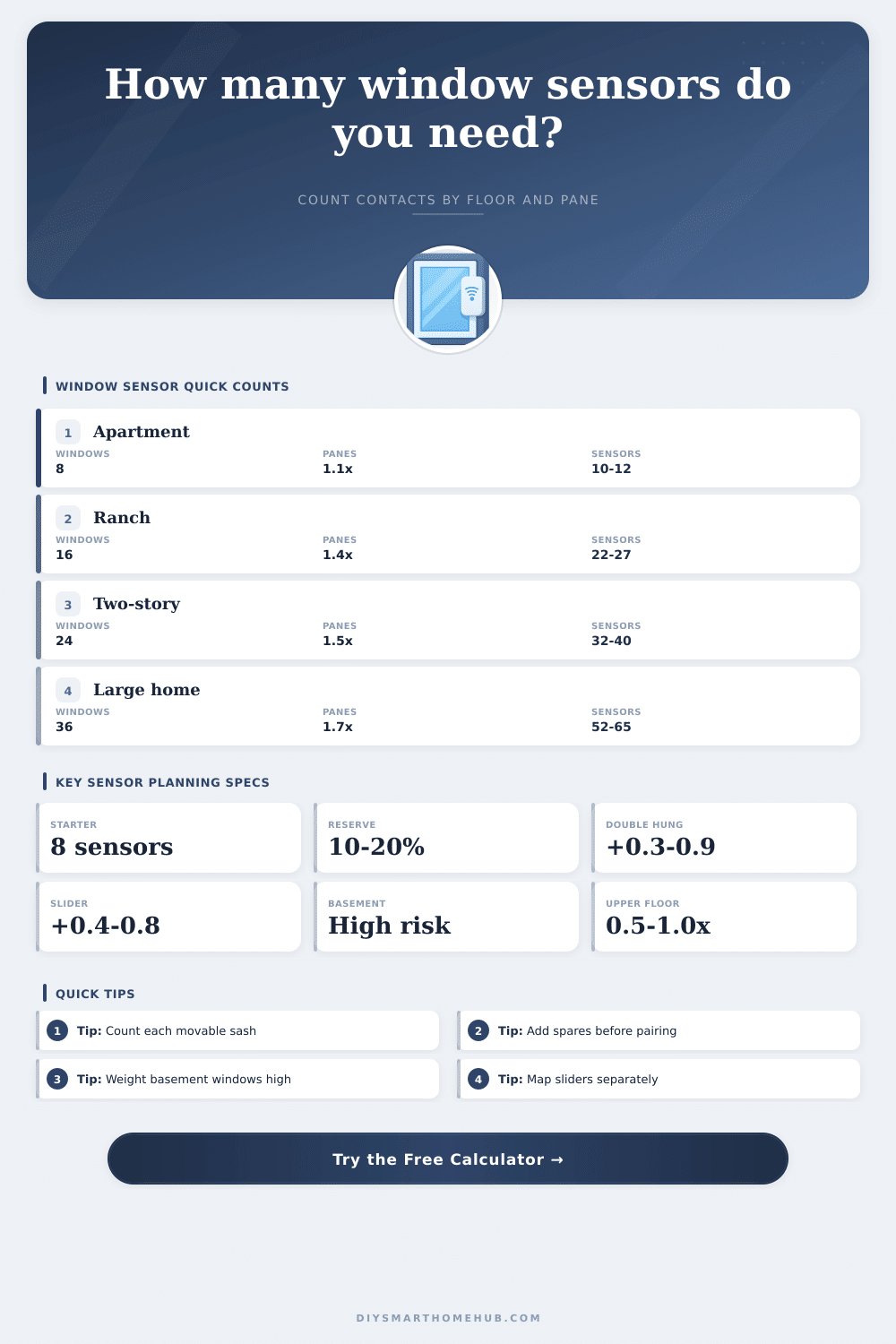
| Apartment or condo | 6 to 10 mostly simple windows | 7 to 13 contacts | Keep 1 or 2 spare sensors |
| Small ranch | 12 to 18 ground windows | 18 to 28 contacts | Use 10% to 15% reserve |
| Two-story home | 18 to 30 mixed windows | 28 to 46 contacts | Prioritize reachable and basement windows |
| Slider-heavy remodel | 16 to 26 multi-panel openings | 32 to 55 contacts | Add extras for panel mapping |
| Large perimeter | 32 to 48 mixed floors | 55 to 90 contacts | Stage pairing by floor groups |
Contact sensors
Best for open and closed state. Quantity should follow movable sash count, especially where two panes can open independently.
Tilt sensors
Useful when a window opens by rotating or tilting instead of sliding cleanly past a magnetic contact point.
Vibration sensors
Not a one-for-one contact replacement. Use them as an added layer on fixed panes or vulnerable glass zones.
Determining the correct number of window sensor is a necessary step in establishing a security system. Many individuals place there home security system’s functionality at risk if they make the mistake of counting the number of window frames instead of the number of openings that exist in those frames. Counting the number of openings is the correct method because a single frame can have more than one opening.
The number of ways a window can be opened or force is the measurement that determines the number of sensors necessary to provide an effectve security system. The window sensor calculator will help you determine the proper number of sensors by performing simple math calculations based off your homes floor plan and the types of windows that exist on each floor. The calculator categorizes Windows to account for the risk that each type of window poses to the security of your home.
How to Count the Right Number of Window Sensors
Windows that are situated on the ground floor or in the basement are accessible to an individual standing outside the home. Windows on the upper floors are less likely to be accessible to an outsider. However, if the upper floor include a deck or a low roofline, sensors may still be necessary for those windows.
Thus, the location of each window in the home will have an impact upon the total number of window sensors necessary to provide security to the home. Additionally, the number of panes in the window may pose a challenge to the placement of sensors. For example, a double-hung window can open at the bottom or at the top of the window.
Thus, double-hung windows require more than one sensor. Sliders that include multiple panels and bay windows also require individual sensors for each moving panel to determine which panel has been opened. The calculation also includes these sensors to ensure that there are not too few sensors for windows of this nature.
Spare window sensors should also be included in the total count. The reason for including spare sensors is in case one of the sensors within your security system breaks, or if you need to add a new window to the home and purchase sensors for that new window. The inclusion of a percentage for spare sensors in the calculation will provide flexibility for damaged sensors or for new windows.
Buying spare sensors in advance will save money, as purchasing individual sensors later will cost more money then purchasing a few extras up front. The number of spare sensors that will be recommended also relates to the priority settings that you choose in the calculation. The different types of windows that may be found in your home will also have an impact upon the total number of sensors that you need to purchase.
If you have casement windows, each will require one sensor. However, if you have tilt-turn windows, a different type of sensor may be required for those windows. If the windows in your home are fixed and picture windows, the windows will not require contact sensors.
However, if the windows are made of glass that can shatter if broke, sensors will be required for those windows. Sensors for operable panes are the sensors that the window sensor calculator calculates. Additionally, if your security system also includes glass break sensors or vibration sensors for each window, these will be accounted for once you have finished calculating the number of contact sensors required.
Basement windows and ground floor windows require special consideration in your sensor count. Both basement and ground floor windows is some of the most accessible windows to an individual outside the home. Basement windows are often very large and situated in locations that are not easily seen from the outside of the home.
Therefore, individuals looking to gain access to the homes interior often target basement windows. Ground floor windows that face side yards or back decks may also pose a risk to the security of the home. The sensor calculator will track these windows in order to provide you with a complete security system that is balanced to the number of windows that may be opened.
Some of the most common mistakes when calculating the number of sensors for your windows may be to count the frames instead of the openings of the windows. Additionally, windows on different floors pose different risks to the security of your home. An upper floor window that is above a porch roof may be more at risk than an upper floor window that is situated on a flat part of the homes exterior.
You may adjust these risks in the sensor calculator in order to ensure that you dont have to plan out your security system from the beginning. The results of the sensor calculator will provide you with an estimated number of sensors that your home will require. However, you should walk through your home to ensure that you have accounted for all sensors required.
Each sensor should have enough clearance for the sensor and the magnet for the sensor to effectively activate. Sliders or double-hung windows require more care in determining where to place each sensor. Ensure that your spare sensors are of the same sensor family as the others in your security system.
The main goal of this entire calculation is to determine the proper number of sensors to match the number of ways that an individual can enter the home. You need enough sensors to cover all potential openings in the home. Additionally, you need to have enough spare sensors in case your plans change or in case you need to replace any hardware.