Smart Speaker Quantity Calculator
Estimate how many smart speakers a home needs from room count, floor area, listening zones, coverage radius, stereo-pair preference, and voice assistant pickup range.
Full quantity breakdown
Compact voice speaker
Best for bedrooms, bathrooms, desks, and small helper rooms where voice pickup matters more than room-filling bass.
Balanced smart speaker
Good default for kitchens, living rooms, and offices because one device can cover normal music and assistant requests.
Premium room speaker
Useful when fewer larger speakers can cover open areas, but stereo zones still require two units for left and right separation.
Smart display speaker
Counts as a voice node, but the best placement is usually visual and counter-facing instead of perfectly centered for audio.
Assistant soundbar
Excellent for media rooms, but it should not be counted as the only voice node for bedrooms or separated kitchen spaces.
Weather-ready speaker
Outdoor and garage zones need shorter planning radii because background noise and placement height reduce usable pickup.
| Speaker profile | Music radius planning | Voice pickup planning | Best calculator use |
|---|---|---|---|
| Compact voice speaker | 8 to 12 ft for music | 12 to 18 ft in quiet rooms | One-room control, bedrooms, small offices |
| Balanced smart speaker | 12 to 16 ft for music | 16 to 22 ft in normal rooms | Default mixed music and voice planning |
| Premium room speaker | 16 to 22 ft for music | 16 to 24 ft depending on mic array | Open rooms, main living zones, fewer larger nodes |
| Smart display speaker | 10 to 14 ft from counter or desk | 14 to 20 ft when screen faces the user | Kitchens, desks, routines, visual controls |
| Soundbar with assistant | 18 to 25 ft in the media zone | 14 to 22 ft facing the seating area | TV room coverage plus a separate voice plan |
| Weather-ready speaker | 10 to 18 ft outdoors or garage | 10 to 16 ft with noise allowance | Patios, garages, covered porches, workshops |
| Entered radius | Circle area | Practical music coverage | Use note |
|---|---|---|---|
| 8 ft | 201 sq ft | 130 to 155 sq ft after room loss | Bathrooms, desks, small bedrooms |
| 12 ft | 452 sq ft | 295 to 350 sq ft after room loss | Bedrooms, offices, kitchen corners |
| 16 ft | 804 sq ft | 520 to 620 sq ft after room loss | Living rooms and open kitchens |
| 20 ft | 1,257 sq ft | 815 to 970 sq ft after room loss | Large open rooms with clear placement |
| 25 ft | 1,963 sq ft | 1,275 to 1,510 sq ft after room loss | Soundbar or large speaker estimates only |
| Project type | Planning area | Listening zones | Typical speaker count |
|---|---|---|---|
| Bedroom and bath pair | 150 to 250 sq ft | 1 to 2 zones | 1 to 3 speakers |
| Kitchen and dining zone | 300 to 500 sq ft | 2 zones | 2 to 4 speakers |
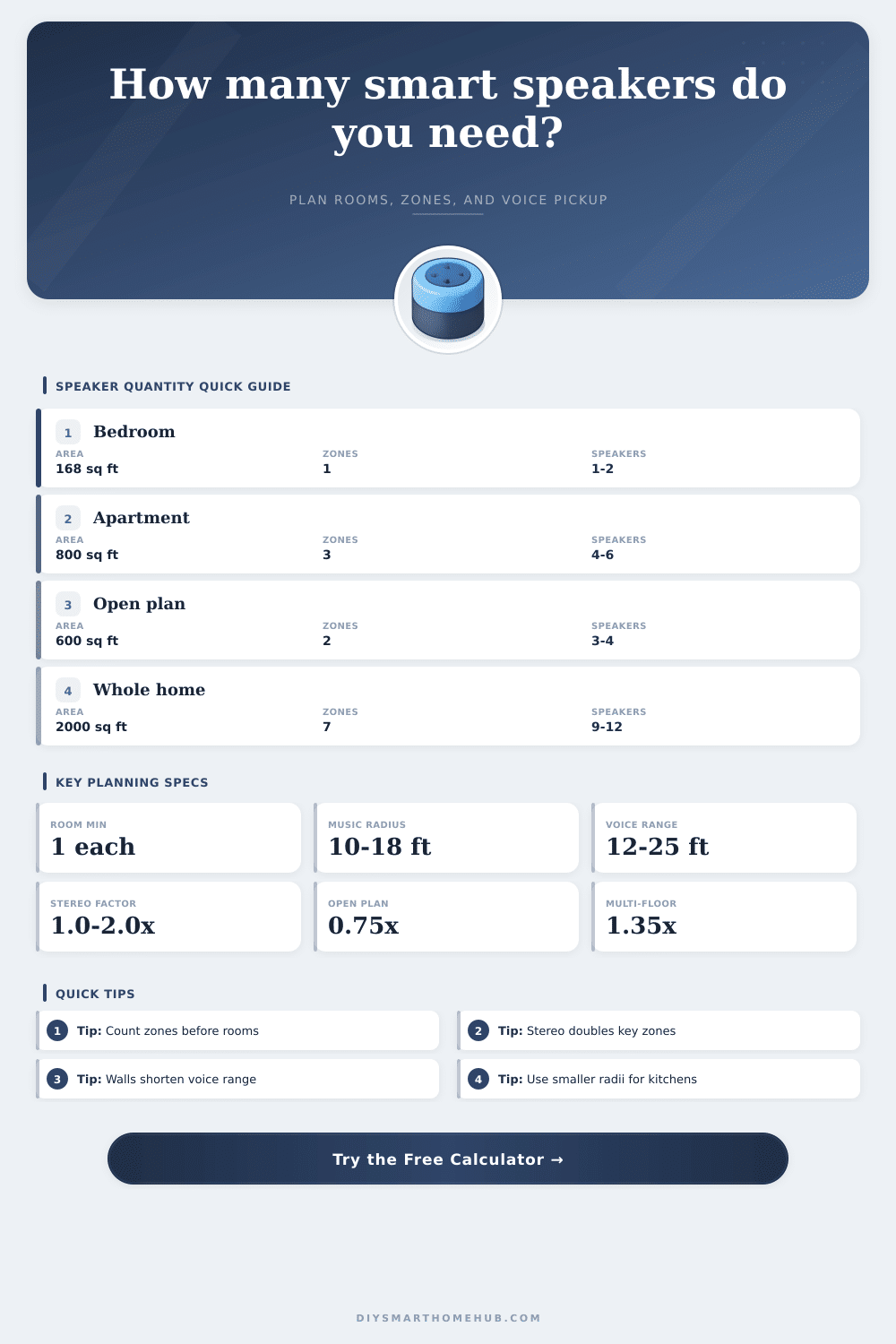
| Apartment coverage | 600 to 900 sq ft | 3 to 4 zones | 4 to 6 speakers |
| Open-plan main floor | 500 to 800 sq ft | 2 to 3 zones | 3 to 6 speakers |
| Whole-home voice and music | 1,800 to 2,400 sq ft | 6 to 9 zones | 9 to 14 speakers |
| Factor | Layout condition | Formula effect | When to use it |
|---|---|---|---|
| 0.75x | Open plan | Room minimum is reduced | Kitchen, living, and dining share one acoustic space |
| 1.00x | Normal walls | One speaker per room baseline | Typical single-floor layouts with standard doorways |
| 1.15x | Many closed rooms | More nodes than rooms | Bedrooms, offices, hallways, and divided zones |
| 1.35x | Multi-floor or heavy walls | Voice nodes increase sharply | Townhomes, basements, brick, plaster, or concrete |
| 1.50x | Chopped-up layout | Strong separation allowance | Odd room geometry or weak cross-room voice pickup |
Many people purchase a wrong number of smart speakers due to the tendency of people to purchase smart speakers one at a time without considering the entire dynamic of how many smart speakers a home require. For instance, an individual may purchase a smart speaker for a bedroom due to the convenience of a smart speaker in that bedroom, an individual may purchase a smart speaker for the kitchen to use as a smart speaker to set timers for cooking recipe, but those additional purchase will result in some rooms in the house potentially without any sound emanating from a smart speaker, forcing individuals to shout across the house to find a smart speaker. The number of smart speakers that an individual may need in there home is dependent upon the layout of their home, as the layout of the home contain considerations of how sound can travel within the home, as well as how their voice can be heard by a smart speaker within that home.
In order to determine how many smart speaker an individual may require in their home, there are a few different measurement that may assist in that process. One of the most important measurements of a home that should be considered is the room count within that house. The room count will tell an individual how many separate room are within the home.
How Many Smart Speakers Do You Need?
The floor area of a home is also important to consider in that this will show an individual the total area of that home. Additionally, individuals can also measure the listening zone within the home, as these are the areas in which individuals wish to play music. Furthermore, individual smart speakers has certain ranges as to how far they may be able to play music or hear an individual’s voice, and people should consider these ranges prior to purchasing smart speakers.
The separation of rooms within an individual’s home can also impact the function of the smart speakers that are placed in various locations within the home. For instance, one smart speaker may be able to cover two separate listening zones within an open-plan area of the home, but a hallway of the home may interrupt the sound from that smart speaker. Homes with many door or floors may require more smart speakers than homes with the same floor area.
Therefore, an individual may desire to utilize a calculator to determine how many smart speakers the home require, as utilizing such a calculator will save the individual from having to guess as to whether or not a smart speaker is required for each room within the individual’s home. Individuals may also wish to purchase stereo pair of smart speakers. Stereo pairs of smart speakers are not just used to amplify the sound that the smart speakers create.
Stereo pairs are used to create a left and right image of music when listened to through stereo speakers, and they are also most useful in a living room area where individuals may sit for long periods. However, stereo smart speakers may be inefficient in areas of the home like a hallway that is rarely use. Therefore, individuals should only purchase a stereo pair if individuals will use the stereo speakers in the same listening zones where individuals spend the majority of their time, and purchase single smart speakers for the remainder of the home.
The profile of a smart speaker may impact how that smart speaker plays music for individuals in the home, as well as how that smart speaker hear individuals’ voices. For instance, many people often sell compact smart speakers and they function well in quiet bedrooms for individuals who play music in their bedroom. However, the compact smart speakers may not be able to efficiently function in a kitchen area due to the presence of water in the kitchen.
Additionally, larger smart speakers often have greater driving power to play music throughout the home, but the user may require placement within the home such that the cabinet do not block the microphones of the smart speakers. Finally, outdoor-rated smart speakers may differ from indoor smart speakers in that wind and traffic noise may impact the voice pickup range of the outdoor-rated smart speakers. Many individuals make mistake when purchasing smart speakers.
For instance, many individuals may purchase a smart speaker in each of the bedrooms in their home, as smart speakers are small in size and may fit into those areas. However, the rest of the home may be arranged in a way that the hallways within the home may have better coverage than the living room, for instance. Furthermore, individuals often focus upon the need for smart speakers to play music for individuals in the home, but do not consider that a smart speaker may not be able to hear individuals’ voices as well.
Therefore, before purchasing smart speakers for the home, individuals should use a separation factor to recognize these issues within the planning process of purchasing smart speakers. Smart speakers may be purchased for individual homes with variables within the homes themselves. For instance, ceilings of various heights, curtains, and furnitures that may absorb some of the sound that is created by the speakers will impact how far the speakers may need to cover each area within the home.
Background noise in the home may impact how reliable the microphone of the smart speakers is at hearing individuals’ voices. Additionally, the presence of pets, children, or many individuals talking in the same area at once may also interfere with the ability for the smart speakers to identify an individual’s voice. These variables within the home are important to consider prior to purchase, as these details will allow individuals to determine whether or not the smart speaker purchase plan that is created for them is complete or frustrating to operate.
The goal for individuals is not to purchase the maximum number of smart speakers possible for their homes. Instead, individuals would like to have a smart speaker located in each spot in their homes where they would like music to play. In understanding each of these variables, an individual will know the correct number of smart speakers to purchase for their home.
When the individual reaches this understanding, the smart speakers will function in their homes as part of a complete system.