Capacitor Sizing Calculator
Estimate motor run capacitance, start capacitance, reactive power correction, phase angle change, installed capacitor kVAR, and tolerance range from HP, voltage, frequency, and power factor.
⚙Motor presets
⌁Motor and capacitor inputs
↻Live motor spec grid
Calculated capacitor size
Enter the motor data and calculate to see run, start, reactive power, and tolerance results.
Calculation breakdown
▦Capacitor and motor spec grid
Calculated from horsepower and profile efficiency.
Estimated single-phase RMS current at rated load.
Needed microfarads from the reactive power formula.
Intermittent duty estimate from run capacitor multiplier.
✓Capacitor sizing notes
ƒFormula reference
| Formula | Expression | What it tells you | Calculator use |
|---|---|---|---|
| Real input power | P = HP × 746 / efficiency | Motor electrical watts | Sets the real-power base before phase correction. |
| Phase angle | φ = acos(power factor) | Current lag angle | Converts the profile PF into a phase angle in degrees. |
| Reactive power | Qc = P × (tan φ1 - tan φ2) | VAR correction | Finds how much capacitive reactive power is needed. |
| Capacitance | C = Qc / (2πfV²) | Farads, then uF | Turns kVAR into a motor run capacitor estimate. |
| Tolerance range | Cmin/Cmax = C × (1 ± tol) | Acceptable measured value | Checks the marked capacitor against a realistic range. |
▤Motor profile assumptions
| Profile | Efficiency | Rated PF | Best use |
|---|---|---|---|
| PSC fan or blower | 62% | 0.72 | Small fan motors, air handlers, attic fans. |
| Cap-start pump | 74% | 0.78 | Sump pumps, jet pumps, shallow well motors. |
| Compressor duty | 78% | 0.80 | Refrigeration and air compressor motors. |
| Shop tool motor | 75% | 0.76 | Saws, grinders, and capacitor-start tools. |
| High efficiency motor | 84% | 0.86 | Modern pump or blower motors with better PF. |
| Older replacement motor | 58% | 0.66 | Aged or unknown motors needing wider checks. |
▥Capacitor type guide
| Capacitor type | Typical uF range | Duty | Use in this calculator |
|---|---|---|---|
| Motor run film | 3 to 80 uF | Continuous | Compare against required run capacitor and tolerance range. |
| Dual run film | 20/5 to 80/10 uF | Continuous | Use only the section connected to the motor being checked. |
| Start electrolytic | 80 to 700 uF | Intermittent | Estimated by multiplying the calculated run uF. |
| PF correction bank | 1 to 50 kVAR | Continuous | Use kVAR result for panel-level correction, not motor start torque. |
□Common motor capacitor examples
| Motor scenario | Typical voltage | Likely run capacitor | Likely start capacitor |
|---|---|---|---|
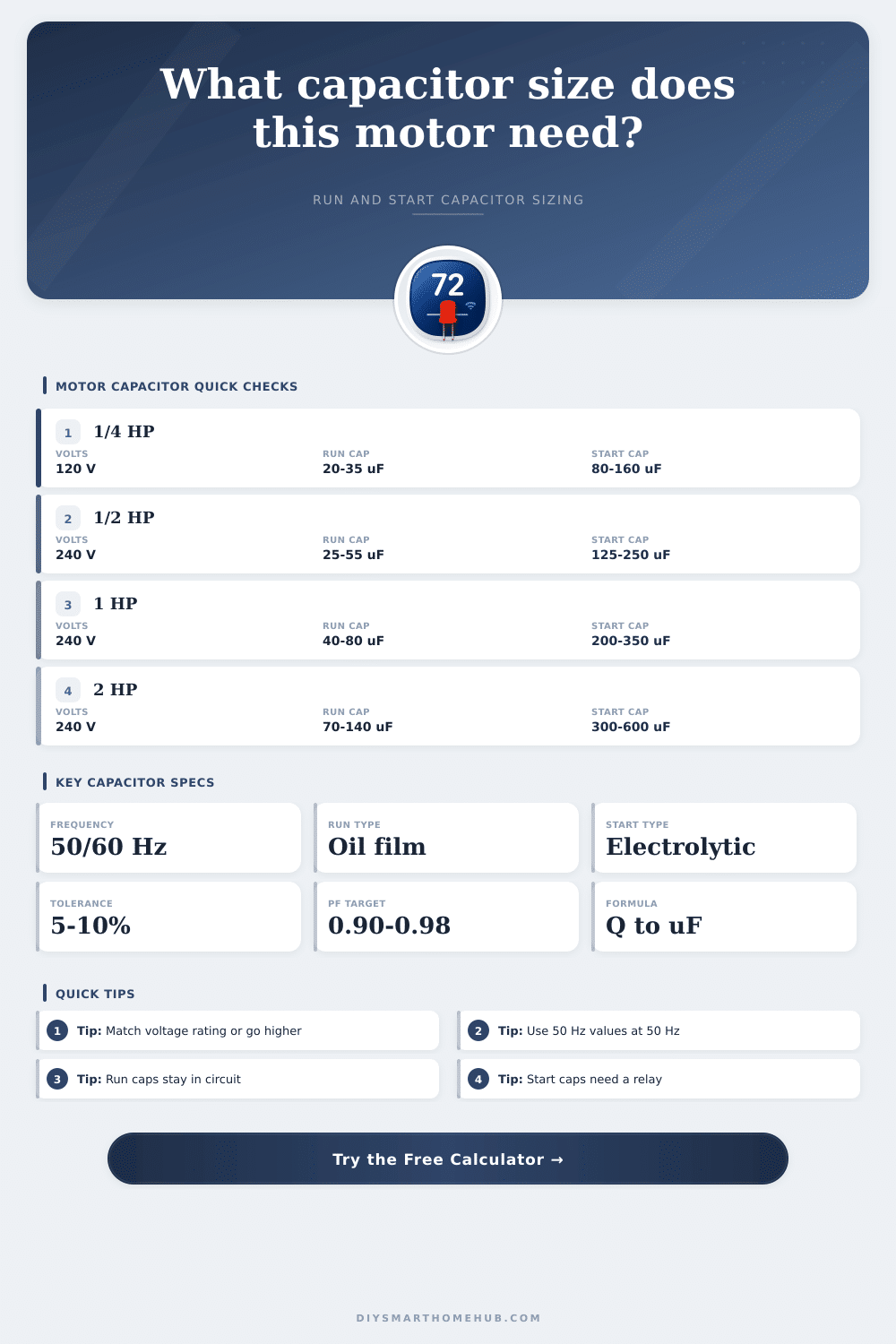
| Small bath fan, 1/15 HP | 120 V, 60 Hz | 4 to 8 uF | Usually none or 30 to 60 uF |
| Attic fan, 1/3 HP | 120 V, 60 Hz | 20 to 35 uF | 80 to 160 uF if cap-start |
| Sump pump, 1/2 HP | 120 V, 60 Hz | 30 to 55 uF | 125 to 250 uF |
| Well pump, 1 HP | 240 V, 60 Hz | 40 to 80 uF | 200 to 350 uF |
| Compressor, 2 HP | 240 V, 60 Hz | 70 to 140 uF | 300 to 600 uF |
Motors require a capacitor to function correct. The capacitor provides the electrical properties that the motor require to operate. If the capacitor isnt of a correct size for the motor, the motor will not operate efficient, and the motor may struggle to start.
Motors require a specific amount of capacitance to function correct. If the capacitance provided by the capacitor is not set to the proper level for the motor, the motor will struggle to operate correct. To calculate the correct capacitor for the motor, the person will need to know several input for the calculation.
How to Choose the Right Capacitor for a Motor
One of these input is the horsepower of the motor. Another important input is the voltage of the motor. Another important input is the frequency of the motor.
Capacitor rating are inversely related to cycles per second. The target phase angle for a motor is also an important input for calculating the correct capacitor value. Finally, the tolerance for the motor is also an important input for the capacitor calculation.
While these variable may seem abstract, these describe the actual condition of the motor that the capacitor will encounter. There are two main types of capacitor that are used for motors. These capacitors is run capacitors and start capacitors.
Run capacitors are designed for motors that need to stay in operation for extended period of time. Therefore, the motor will not continually energize start capacitors while it is running. Start capacitors are different than run capacitors in that start capacitors are only designed to provide energy to the motor for brief periods.
Start capacitors are used to provide the initial burst of energy to the motor to start it. Once the motor reaches a certain speed, a centrifugal switch will remove the start capacitor from the circuit. Therefore, start and run capacitors are different due to the way in which they are required to serve the motor.
Many individual will attempt to simply replace a failed capacitor with any capacitor that will fit into the motor. This solution, however, can cause additional problem for the motor. If the wrong capacitor is installed, the motor may draw too much current from the power source.
The additional strain on the motor can cause the capacitor to fail quick. The reason for the capacitor failure is due to the fact that the failed capacitor was not the same as the original capacitor that was installed into the motor. As motors and motor winding age, the requirements of the motor can change.
What may have been the correct capacitor for a new motor may not meet the requirements of an older motor. Therefore, it is important to check the electrical requirement of the motor. The reference table that can be found on this page contain examples of the various size of capacitors that may be required for motors of specific sizes.
However, the person should not use the reference tables in place of the calculation process for the capacitor requirements for a motor. The calculation process will take into account the voltage of the motor, the frequency of the motor, and the target power factor of the motor. Additionally, the efficiency rating of the motor is another important specification.
Motors with higher efficiency rating will have a different capacitor than those with lower efficiency ratings because of the different requirements of motors with these efficiency ratings. Another factor that can affect the capacitor that is required for a motor is the installation environment of that motor. Motors that are installed in hot area, such as an attic, will have capacitors that are capable of handling higher levels of heat than capacitors that are installed in more temperate area, such as an air-conditioned room.
Motors that are exposed to voltage spikes from other electrical equipment in the same area may require capacitors that are capable of withstanding these voltage spike. Such environmental factor can lead to the fact that two motors of the same make and model may not have the same capacitor requirement based off the environment in which they are installed. The motor calculator utilizes the mathematics behind the calculation of the capacitor requirements for a motor.
This calculator will determine the amount of reactive power that will have to be added to or subtracted from the motor to reach the target phase angle. Once the calculator determines the amount of reactive power, the calculator will derive the capacitance value that will provide that amount of reactive power at the specified voltage and frequency of the motor. This value will be an estimate of the correct capacitor value, which will save the motorist from the guesswork that can lead to motor failure.
After determining the capacitance value, the individual can purchase a capacitor that has the same voltage and tolerance specification as the motor itself. Every motor is a system of magnetic field and mechanical load that must be balanced by the capacitor. When the capacitor is of the correct size and provides the correct balance to the motor, the motor will start, run, and last long.
Providing the correct size of capacitor will ensure that the motor is operating in the way that it was design to. Its important to remember that the motors size and the way you install it can change things. You should of checked the manual too.
The motor’s performance depends on it. Youll see that the most moddern motors still need this. It is alot of work but its worth it.
You’re going to recieve better results if you do it right. Using the wrong parts is a big mistake. You’re making sure the motor stays running.
Dont forget to check the connections. It can be a bit luxurios to have a motor that dont fail. The capacitor’s job is critical.
All these parts is connected. The motor’s life depends on it. It’s easy to forget how much the temperature matters.
The heat can be too much for some capacitors. We’ve seen this happen alot. The way the motor runs can be different than you expect.
It is a bit diffrent than usual. This is naturaly how it goes. The capacitor will work good if you choose the right one.
The motor’s performance will be better. You should check the wiring. The electrical properties is very important.
Its a simple thing to do. The capacitor will be fine. The motor will be happy.
The machine will work. The technician will be able to fix it. The motor will run smooth.
The user will be satisfied. The job will be done. The capacitor is vital.
The motor needs it. The system works. The power is steady.
The voltage is correct. The frequency is right. The phase angle is set.
The capacitance is correct. The motor is ready. The task is complete.