Smart Dimmer Minimum Load Calculator
Check whether your bulbs meet a smart dimmer's minimum wattage, then compare the same load against LED equivalent watts, neutral wiring behavior, and multi-gang derating.
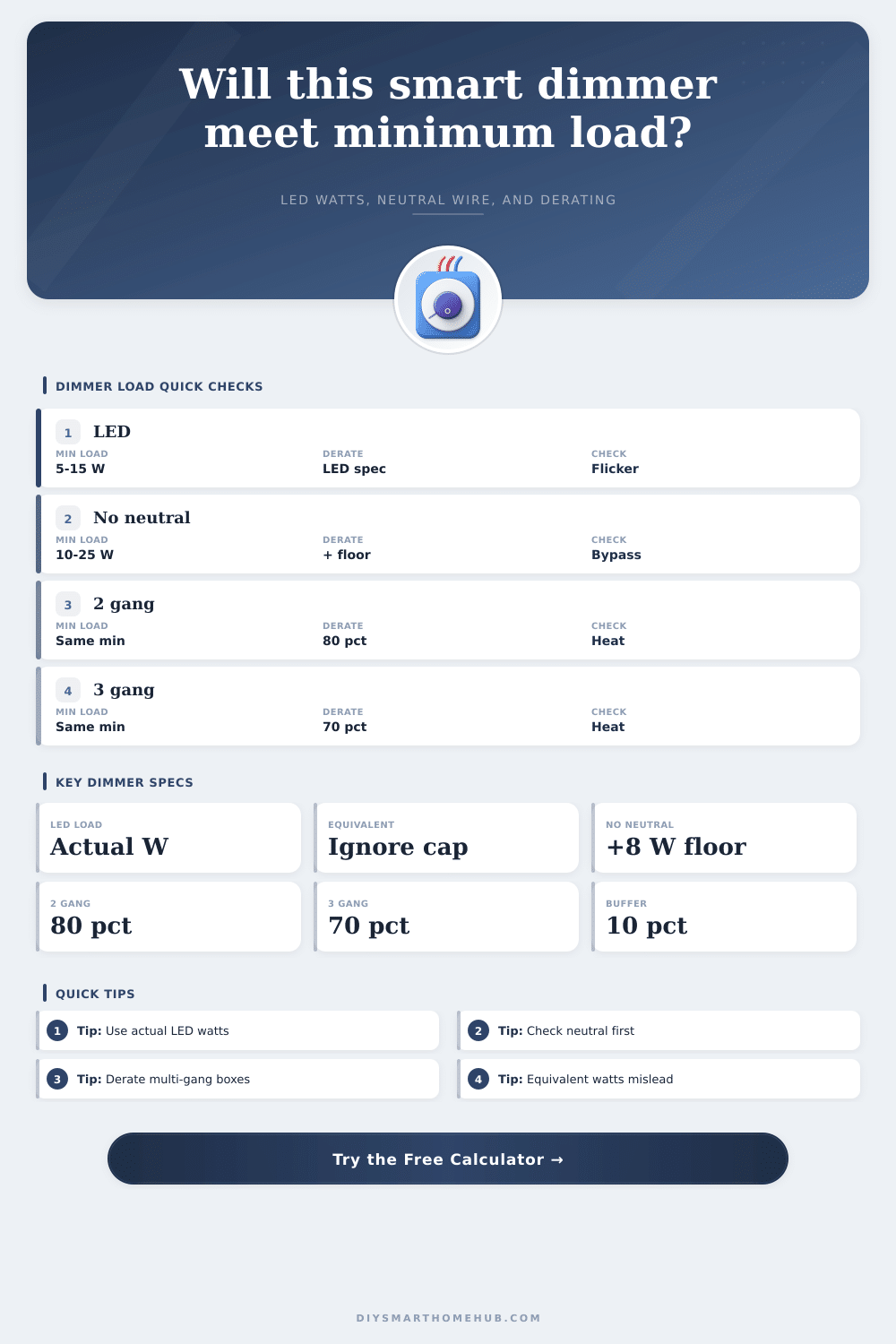
Use actual electrical watts for LED and driver loads. The LED equivalent field is shown for comparison only because a 60 W equivalent LED usually draws about 6 to 10 W, not 60 W.
Live capacity window
Full calculation breakdown
These tables are calculation references for planning. Always compare the result with the exact dimmer and lamp data sheets for the device in your wall box.
| Load type | Typical actual watts | Minimum behavior | Capacity behavior | Best calculator check |
|---|---|---|---|---|
| Dimmable screw-in LED bulbs | 5 to 12 W each | Can fall below smart dimmer minimum with only one or two lamps | Use LED-rated dimmer capacity, not incandescent equivalent brightness | Actual watts and neutral type |
| Incandescent or halogen bulbs | 25 to 100 W each | Usually easy to exceed minimum load | Thermal derating matters in multi-gang boxes | Connected watts and gang derating |
| Dimmable CFL bulbs | 9 to 23 W each | Often needs a higher practical minimum than LED | Lower compatibility margin due to ballast behavior | Minimum margin and load profile |
| Electronic low-voltage LED driver | 10 to 60 W per driver | Driver input may need a forward-phase or ELV-compatible dimmer | Driver inrush and waveform can reduce usable capacity | Load type and practical max |
| Magnetic low-voltage transformer | 20 to 150 W per transformer | Often has a higher stable minimum than simple LED lamps | Transformer heat increases the need for derating | MLV profile and gang factor |
| LED tape or strip driver | 24 to 150 W per supply | Minimum is driver-specific rather than lamp-count based | Long strips can approach the LED dimmer limit quickly | Driver watts and dimmer rating |
| Mixed lamp types | Varies by fixture | Least predictable because lamps do not dim the same way | Use conservative factors and watch maximum capacity | Mixed profile with buffer |
| Smart bulbs kept powered | 6 to 12 W each | Normally should not be power-cut by a standard dimmer | Load may be small but control behavior is the bigger issue | Status note and actual load |
| Wiring and dimmer style | Calculator minimum rule | Typical concern | What to change if low |
|---|---|---|---|
| Neutral wire present | Use published minimum unless load profile raises it | Usually stable with modern LED-rated dimmers | Use compatible bulbs or lower-minimum dimmer |
| No-neutral smart dimmer | Use higher of published minimum and no-neutral floor | Radio power passes through lamp circuit | Add load, use bypass, or choose neutral dimmer |
| One-gang wall box | 100 pct maximum rating | Minimum side unchanged | Check published LED capacity |
| Two-gang wall box | 80 pct maximum rating | Side tabs or heat reduce capacity | Lower connected watts or split zones |
| Three or more dimmers | 70 pct maximum rating | Heat stack can overload a full circuit | Use higher-capacity dimmer or separate box |
| Warm enclosure | 65 pct maximum rating | Insulation and tight boxes reduce heat shedding | Reduce load or improve approved enclosure conditions |
| Scenario | Actual load | Equivalent label | Likely minimum risk | Capacity note |
|---|---|---|---|---|
| Two 6 W LED sconces on no-neutral dimmer | 12 W | 80 to 120 W | High if minimum floor is 15 W or more | Maximum capacity is rarely the problem |
| Four 8.5 W LED recessed cans | 34 W | 240 to 300 W | Usually okay if dimmer minimum is 10 W | Good headroom on a 150 W LED dimmer |
| Six 5.5 W chandelier LEDs | 33 W | 240 W | Can be marginal on no-neutral models | Low load may need compatible bulbs |
| Four 50 W halogen lamps | 200 W | 200 W | Low risk for minimum load | Watch two-gang or three-gang derating |
| One 96 W LED tape driver | 96 W | Not useful | Driver compatibility matters more than count | May be near a 150 W LED limit with buffer |
| Six 20 W MLV track heads | 120 W | 120 W | Transformer minimum can be higher | MLV heat needs conservative derating |
| Formula step | Expression used | Why it matters | Result behavior |
|---|---|---|---|
| Actual load | Lamps times actual W | Dimmer electronics respond to real electrical watts | Compared to both min and max |
| Equivalent label load | Lamps times equivalent W | Shows brightness label mismatch | Displayed, not used for capacity |
| Adjusted minimum | Max(spec min times load factor, wiring floor) | No-neutral and reactive loads can need more load | Then buffer is added |
| Derated maximum | Rating times load factor times gang factor | Heat and driver behavior reduce usable capacity | Then buffer is removed |
| Minimum lamp count | Ceiling(required minimum / watts each) | Helps decide whether one more lamp fixes low load | Higher count means low-load risk |
| Capacity count | Floor(practical maximum / watts each) | Shows the safe fixture count before overload | Lower count means capacity risk |
Smart dimmers allows people to control the brightness of the lights in there homes. However, in instances in which the electrical load is too low for the number of lights connect to the circuit, the smart dimmer can cause the lights to flickers. This happens because smart dimmers requires a steady flow of electricity to maintain their operation.
If the lamp in the circuit dont provide enough electricity, the smart dimmer will not be able to maintain a steady flow of electricity to the lamp. As a result, the smart dimmer will have to find a way to stay awake and provide enough electricity to the smart dimmer to operate proper. If the lamps do not provide enough electricity, the smart dimmer could cause the lights to flickers.
How to Calculate Electrical Load for Smart Dimmers
Thus, understanding the relationship between the smart dimmer and the electrical load will help to prevent the flickering of the smart dimmers light. To properly calculate the electrical load for smart dimmers, you must distinguish between the equivalent watts of the lamps and the actual watts that they uses. The equivalent watts of a lamp is the wattage that is provided on the lamp as a means of illustrating how bright the light from that lamp will be.
The actual watts of a lamp are the watts that the lamp uses in the operation of emit light. Because smart dimmers respond to the actual watts of the lamps, it is necessary to use the actual watts when calculating the electrical load for those smart dimmers. One factor that can impact the operation of a smart dimmer is the presence of a neutral wire in the electrical box.
If a neutral wire is present, the smart dimmer will draw electricity directly from the neutral wire. If a neutral wire is not present, the smart dimmer will have to borrow electricity from the lamps in the circuit. Because the smart dimmer will have to borrow electricity from the lamps when there is no neutral wire, there will be a higher minimum electrical load for the circuit.
Consequently, small LED lamp may flicker if the smart dimmer is installed in an electrical box without a neutral wire. Another factor that can impact the electrical load for smart dimmers is the number of smart dimmers that are located within a single gang box. A gang box is the box that holds the smart dimmers within the wall.
If a large amount of electricity are generated within the gang box due to the high number of smart dimmers that is contained within a single gang box, the manufacturer will reduce the maximum wattage that can be allotted to the smart dimmers that are within that gang box. Thus, if an individual installs smart dimmers in a gang box, they must account for the reduction in the maximum wattage of the smart dimmers. The type of electrical load within the circuit can also impact the electrical load for smart dimmers.
For instance, if the electrical load consists of incandescent and halogen lights, more electricity will be drawn from the lamps than if LED bulb or low-voltage transformers are used. The dimmers will have less trouble providing electricity to the lights if they are incandescent and halogen lights than if they are LED bulb or low-voltage transformer. Thus, the type of load within the circuit will impact the electrical load for smart dimmers, and the load type must be accounted for in any calculation of the electrical load of the circuit.
In addition to the factors discussed above, it is also necessary to include a safety buffer in the calculations of the electrical load of the smart dimmers. A safety buffer will allow for the changes in the voltage of the circuit and the changes in the behavior of the lamps. If the safety buffer is not included in the calculations of the electrical load, the smart dimmer may begin to flicker if the voltage within the circuit change or if the lamps increase in temperature.
Thus, including a safety buffer in the calculations will ensure that the smart dimmer remains stable in its operation. The heat that is generated in the wall may also impact the electrical load of the smart dimmer. For instance, if the smart dimmer is installed behind the insulation in the wall, it will generate more heat.
The heat will reduce the capacity of the smart dimmer. Thus, if an individual determines that the smart dimmer will be in a warm environment in the wall, they will have to adjust the electrical load calculations for the smart dimmer. To ensure that a smart dimmer operates correctly within the home, an individual should follow a specific process.
First, an individual should find the actual wattage of each of the lamps in the circuit. In addition, it is also necessary to determine if there is a neutral wire in the electrical box. Second, it is necessary to count the number of smart dimmers within the gang box, and to determine the type of load of the lamps in the circuit.
Third, each of these numbers and variables will have to be entered into a calculation calculator to determine if the electrical load within the circuit is within the safe range for the smart dimmers. Should the electrical load be too low for the number of lamps in the circuit, an individual can install a bypass module or the lamps can be changed. Should the electrical load be too high for the number of lamps in the circuit, fewer lamp can be used, or a higher capacity smart dimmer can be installed.
By following this process each time that an individual changes the lamps or the wiring in the circuit, they can ensure that the smart dimmers will function proper without flickering.