Service Entrance Calculator
Estimate a dwelling service load from floor area, required small-appliance and laundry circuits, range, dryer, HVAC, fixed appliances, and continuous loads.
⚡Dwelling and service presets
📋Load inputs
Enter nameplate loads in volt-amperes or watts. For a 120/240V dwelling service, watts and VA are usually close enough for an estimator unless the equipment lists a power factor.
Service load result
Calculated dwelling demand and recommended standard service rating.
🔌Service equipment spec grid
📊Dwelling demand reference
| Load category | Estimator formula | Demand handling | Result use |
|---|---|---|---|
| General lighting and receptacles | 3 VA x dwelling ft2 | Combined with small appliance and laundry | Base dwelling VA |
| Small-appliance circuits | 1,500 VA x circuit count | Minimum two circuits in typical dwellings | Kitchen and dining load |
| Laundry circuits | 1,500 VA x circuit count | Added before general demand factor | Laundry branch load |
| General demand | First 3,000 VA at 100%; remainder at 35% | Applies to combined general load in this calculator | Reduced dwelling base |
🔥Large appliance and HVAC demand
| Load | Input | Calculator demand | Notes |
|---|---|---|---|
| Electric range | kW nameplate | 0, nameplate band, or 8 kVA plus 5% | Single residential cooking equipment estimator |
| Electric dryer | VA nameplate | Larger of nameplate or 5,000 VA | Set to 0 if no electric dryer |
| Heating and cooling | Heating VA and cooling VA | Larger noncoincident load | Use simultaneous loads only if they truly run together |
| Continuous loads | VA expected 3+ hours | Input x 125% | Useful for EVSE and long-duration equipment |
🏠Common dwelling presets table
| Scenario | Area | Major load pattern | Typical service range |
|---|---|---|---|
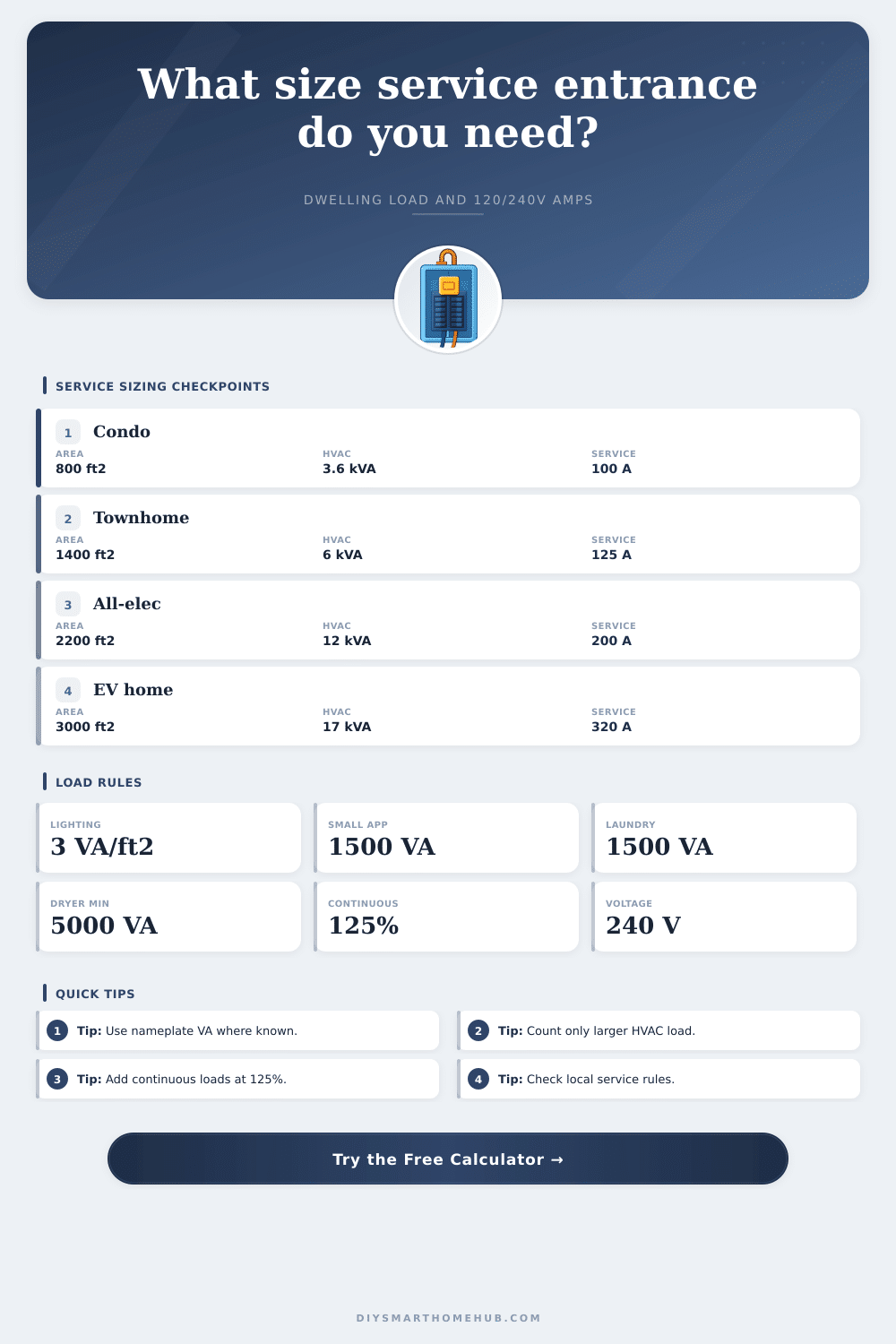
| Compact condo | 600-1,000 ft2 | Gas heat, smaller range, limited fixed appliances | 60-100 A |
| Mixed-fuel house | 1,200-2,000 ft2 | Electric dryer, cooling, gas heat or cooking | 100-150 A |
| All-electric house | 1,800-2,800 ft2 | Range, dryer, heat pump, backup heat | 150-200 A |
| EV-ready large home | 2,500+ ft2 | Continuous EVSE plus larger appliance load | 200-320 A |
🧮Recommended service rating table
| Calculated amps | Next rating | Panel planning signal | Service entrance note |
|---|---|---|---|
| Up to 100 A | 100 A | Small or mixed-fuel dwellings | Confirm minimum local service rule |
| 101-125 A | 125 A | Moderate remodel or appliance additions | May be a meter/main upgrade step |
| 126-150 A | 150 A | More electric appliances | Check available equipment ratings |
| 151-200 A | 200 A | Common modern dwelling target | Often chosen for future capacity |
| 201-320 A | 320 A | Large home, EVSE, or heavy electric heat | Utility coordination is usually required |
💡Calculation tips
Or perhaps you’re standing in your garage, staring at the wires behind the breaker box. You know that your house can’t accommodate what you’d like to do next. Maybe you could upgrade to all-electric heating. Maybe you want to add an electric vehicle charger? Can you run three high-end appliances without having to trip a switch?
Your house’s electrical service entrance is where utility power enters the home. It determines how much energy flows through each appliance and outlet at the same time. Most assume that number stamped on the door (the panel size) are the limit. But that’s almost never the entire story. Capacity is actualy determined by a measured demand, one that takes into account your specific loads, square footage, and usage patterns. Get it wrong, and you’ll waste money buying oversized equipment. And you might risk nuisance tripping when you prepare dinner.
How to Calculate Your Home’s Electrical Needs
How does this add up? That’s where the code comes into play. Specifically, the National Electrical Code, which sets standards for homes, acknowledges that not all appliances is used at 100 percent capacity at the same time. The clothes dryer doesn’t come on with the heat pump plus the dishwasher plus boiling water on the kettle. To complicate matters, different codes use varying demand factors, but these are accounted for in the calculator (above).
It starts by using a base of three volt-amperes per square foot for receptacle and general lighting loads (based off your dwelling size), then adds dedicated circuits for laundry and small appliances. Experience has shown that usage isn’t always consistent, so there is a demand factor that reduces this base load. If you don’t understand how the demand factor works, you might think an old house should handle as many devices as a new one, but it simply cannot.
When estimating the load for appliances there are some that need care. Dryers and electric ranges has special tables added to them as opposed to just plugging in the nameplate number. For example, a big range may have a very high max power rating, but you probably won’t run all burners on high while the oven is also roasting something. The tool includes a proper demand factor on those kinds of cooking loads.
Heating and cooling systems complicate things further. Most people don’t turn their heat on and air conditioner off at the same time. So, this calculation takes the larger of the two HVAC loads without adding both together. Avoiding a coincidence heating and cooling load approach will keep your estimates from overestimating what you need to support. That means more savings on the install side, but still plenty of margin for when you really need it on the hottest day of winter or summer.
But what if it’s a constant load? That’s a game changer. Anything used for more than three hours should be accounted for separately. Level 2 electric car chargers definitely fit the bill here. They just sit there. Then when plugged in, they pull electricity continuously for hours on end. To account for the constant load, we multiply it times one-hundred and twenty-five percent. This provides a cushion so that wiring isn’t overheating with continued use. It’s a necessary safety measure. Without this, it becomes nothing but guesswork; and that’s why you should of have a licensed electrician or engineer verify your final decisions.
When you start adding in your level 2 charger, you’ll notice just how fast the total amperage adds up. Lots of homeowners realize they don’t have enough service (one-hundred amps) for today’s EV charging needs and need to upgrade. Surprisingly, service size is also influenced by floor area. Clearly, bigger houses require more lighting circuits, and typically greater loads on general receptacles as well. Before adding appliances, the square footage input estimate that general load.
Because of its small size and perhaps gas heating, a cozy little condo can work easily at one hundred amps. On the other hand, an oversized all-electric family house, complete with workshop(s) and multiple laundry room, will rapidly exceed two hundred amps or more. The tool’s preset options provide some instant examples of where such variances occur. For instance, they demonstrate the impact on total demand when switching from gas to electricity for heat. Going from gas heat to electric resistance heating can essentially double your need overnight.
Panels are rated by amps, so when deciding on the correct size panel you’re balancing what you need now against what might be needed down the road. Typically, there are increments of standard services: one hundred, two hundred, three hundred twenty amps. So if your math puts you at one-hundred-and-fifty, you can’t just go out and purchase a one-hundred-and-fifty amp panel (that’s not a thing). You’d round up to the nearest standard size, typically two-hundred. And that makes a big difference in price.
Amps relate to size for main breakers, meter sockets, and service entrance cables. A jump from one-hundred-to-two-hundred-amps will likely require a replacement of the whole meter base. Doing it once now avoids paying twice later. Also check local utility guidelines here. Depending on where you live, they may have a minimum required load that overrides your calculations. Or perhaps they’ll incentivize proper sizing of any new installation.
Of course final decisions about all of this should be confirmed by an engineer or licensed electrician. These calculators are great tools for making budgets and plans, but they don’t consider any local amendments to electrical code, nor do they take into account special constraints on the structure. There’s no way for it to know what kind of grounding you have or where wires will run. Instead of letting these numbers end the conversation, let them begin it.
Now you’ll know if you need a 100-amp service or 200-amp service. This means you can have more leverage in getting those numbers on bids. You’ll know which bids seem high because you’re able to get a sense of why. Ultimately this is all about having a reliable, safe electrical system that supports your lifestyle and doesn’t limit you in ways you didn’t expect. And that begins with understanding just how much electricity your house actualy needs.