Appliance Load Calculator
Estimate running watts, startup surge, simultaneous demand, circuit amps, daily energy use, and the generator or inverter size needed for a household appliance load.
🔌Home appliance presets
⚙Load inputs
Calculation breakdown
📊Appliance watt/spec grid
Typical running draw with compressor surge around 3x.
Motor load with high startup current and short duty cycle.
Compressor appliance with a meaningful surge multiplier.
Resistive loads often use 100% duty while switched on.
📋Typical appliance load table
| Appliance | Running watts | Surge multiplier | Duty cycle | Notes |
|---|---|---|---|---|
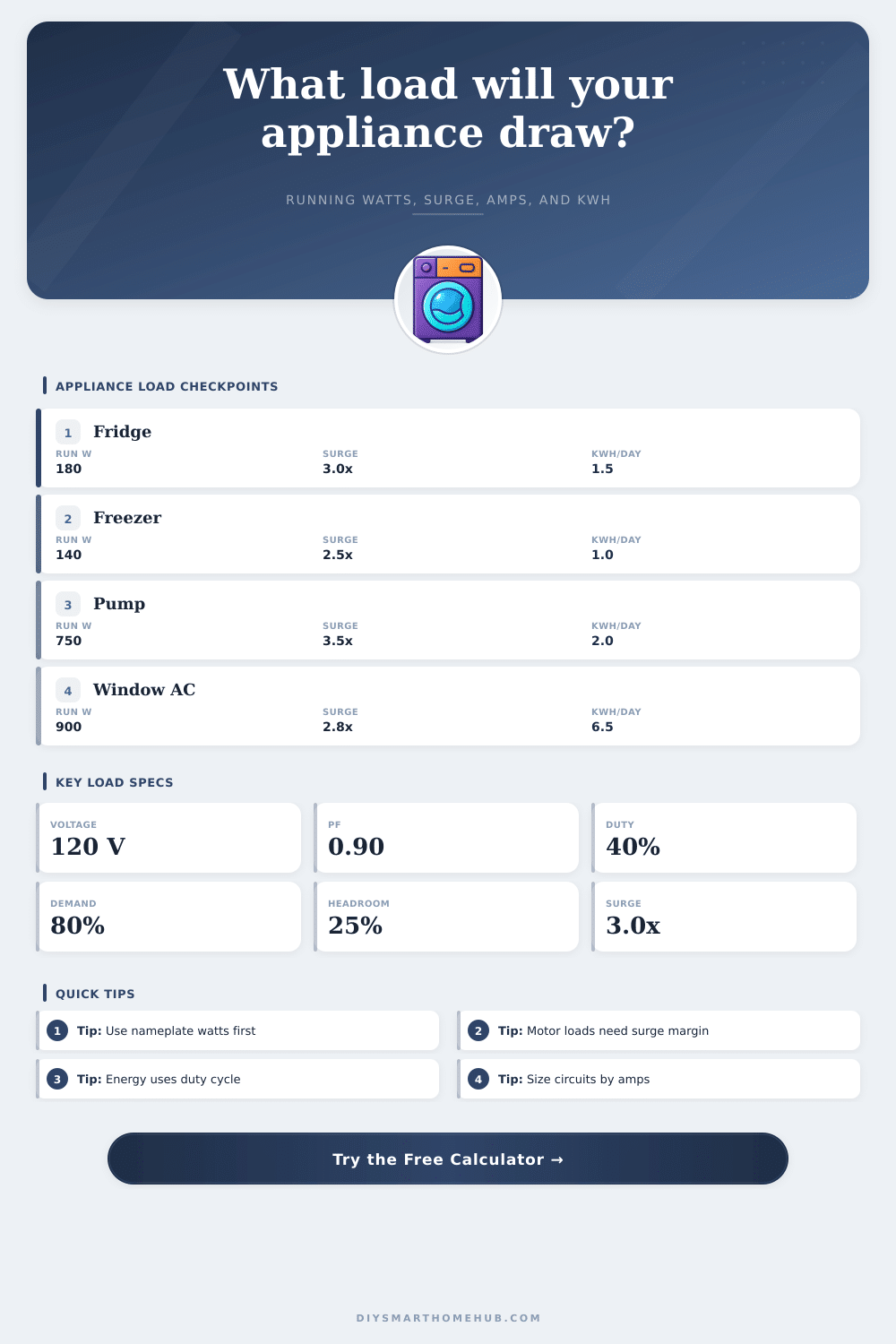
| Kitchen refrigerator | 120 to 250 W | 2.5x to 3.5x | 25% to 45% | Cycles often, long daily availability |
| Chest freezer | 100 to 200 W | 2.0x to 3.0x | 20% to 40% | Lower duty in cool rooms |
| Microwave oven | 900 to 1500 W | 1.0x | 100% while cooking | Input watts are higher than cooking watts |
| Sump pump | 500 to 1000 W | 3.0x to 4.0x | 5% to 25% | Surge usually drives backup sizing |
| Window AC | 600 to 1400 W | 2.0x to 3.0x | 40% to 80% | Higher duty during hot weather |
| Office electronics | 150 to 500 W | 1.1x to 1.3x | 80% to 100% | Usually low surge, steady runtime |
⚡Surge and sizing reference
| Load type | Common examples | Starting factor | Sizing caution |
|---|---|---|---|
| Resistive heat | Kettle, toaster, space heater | 1.0x | Running watts drive the design |
| Compressor | Fridge, freezer, AC | 2.0x to 3.5x | Allow one compressor to start at a time |
| Pump motor | Sump, well, washer pump | 3.0x to 4.5x | Check nameplate locked-rotor amps if available |
| Electronics | TV, router, laptop dock | 1.0x to 1.3x | Power factor may matter for small UPS units |
🔧Circuit amp checkpoints
| Circuit | 80% continuous load | 120 V watts | 240 V watts | Use case |
|---|---|---|---|---|
| 15 A | 12 A | 1440 W | 2880 W | Small appliance or electronics |
| 20 A | 16 A | 1920 W | 3840 W | Kitchen, laundry, garage branch |
| 30 A | 24 A | 2880 W | 5760 W | Dedicated appliance circuit |
| 50 A | 40 A | 4800 W | 9600 W | Large backup or appliance feed |
🏠Common backup examples
| Scenario | Running demand | Likely surge | Daily energy | Planning note |
|---|---|---|---|---|
| Fridge only | 150 to 250 W | 450 to 800 W | 1 to 2 kWh | Small inverter can work if surge is supported |
| Fridge plus freezer | 280 to 500 W | 700 to 1300 W | 2 to 3 kWh | Stagger compressor starts where possible |
| Sump pump backup | 500 to 1000 W | 1800 to 4000 W | Varies widely | Surge and duty cycle both matter |
| Room AC support | 700 to 1500 W | 1800 to 4200 W | 4 to 10 kWh | Headroom reduces overload trips |
💡Load calculation tips
Math does not involve electrons, and that is a good thing. This is where the calculator come in. It turns vague concerns about energy into specific amps and watts. So you can buy the right-sized equipment because otherwise your fridge won’t start when the backup system kicks on and will trip its own breaker instead. You don’t have to understand what happens with electrons, but you do have to do some math. Let the calculator do the work for you.
A name plate is more than just a single number most folks see. There is a difference between starting surge and the running power of something. Sure an electric fridge compressor will suck down 180 watts once it is running. But in that split second of that motor kicking on it could draw three to four times that much. Your back up won’t work if it can’t cope with that surge. That’s what the tool asks you about…multiplier for the surge so it sizes things properly. It doesn’t guess…it depends on physics.
Why You Need a Power Calculator
Not all appliances pulling power from an outlet is running at maximum output. Your fridge turns on and off during the day, but a space heater run at a 100 percent duty cycle once you turn it on. To calculate your daily fuel consumption (in kilowatt-hours), the calculator factors in both your duty cycle and operating hours. This determines the fuel cost part of the equation. So you can crank up your generator with sufficient power to kickstart the motor, but if it doesn’t have the gas to keep it humming for twenty hours, the whole thing come to a halt. Typical duty cycles for common item are listed in reference tables on the page.
In addition, the electrical code mandate headroom in wiring so it can’t overheat. For example, a fifteen amp circuit isn’t actualy a fifteen amp load limit. There’s an eighty percent rule baked into safety standards so a “fifteen amp” circuit is more like twelve amps when used continuously. Once you choose your power factor and voltage, the limits gets applied automatically by the calculator. That ensures you won’t design a system which in practical terms break local electrical codes. People forget about this when they’re waiting in line for an inspection.
How will you use it? What are you powering? A UPS backup can work if your devices don’t mind running on batteries. Some of the lower cost generators put out dirty power which sensitive electronics (routers, computers) abhor. For them you need a inverter that puts out clean sine waves. Heaters and motors is more forgiving but they also use a lot of power. The sizing target setting are tuned to match both requirements, considering efficiency lost in converting to batteries. No inverter is 100% efficient; some gets lost to heat in the process. If you do not plan for this it will cause problems later.
What about different types of loads? Not all loads act alike. Simple ones are resistive (like toasters and kettles) that pull steadily until burned out or tripped by an internal thermostat. Messy ones is motor loads that surge, jerk, and fluctuate. The tool separates those load profiles so you don’t apply a simple load like a kettle to a volatile load like a motor.
For multiples of appliances, it’ll also give you a sense of your simultaneous demand factor… How many can be expected to run at the same time. Yeah, you’re not doing the washer, AC, and boiling water all simultaneously at precisely the same second, right? Accounting for overlap keeps you from over-sizing which saves money.
To plan for power means managing expectations. You could of had an endless supply of power unless you rig up a massive solar array or have a large fuel tank. So make decisions based off what’s important: light the most important things, keep the fridge cool, pump out the water in a storm. Know what the limitations are; don’t expect to have unlimited power.
When you do that, when you use the calculator to understand exactly how much surge you’ll endure, exactly how many watts you’ll require, you stop guessing at what to buy. It fits. Precisely. And all the worry dissapears.