Swamp Cooler Efficiency Calculator
Compare measured inlet dry bulb, outlet dry bulb, wet-bulb temperature, delivered airflow, pad media, wetting quality, face velocity, and water bleed to estimate saturation efficiency, BTU/hr cooling, evaporation rate, and efficiency class.
📌Cooler Efficiency Presets
Start with a field-test pattern, then replace the readings with your measured temperatures and airflow. This tool is for direct evaporative swamp coolers and pad sections, not refrigerated air conditioners.
⚙Measured Efficiency Inputs
Run the calculator to compare the measured outlet temperature against wet-bulb potential and media target.
⚒Pad And Media Spec Grid
📊Reference Tables
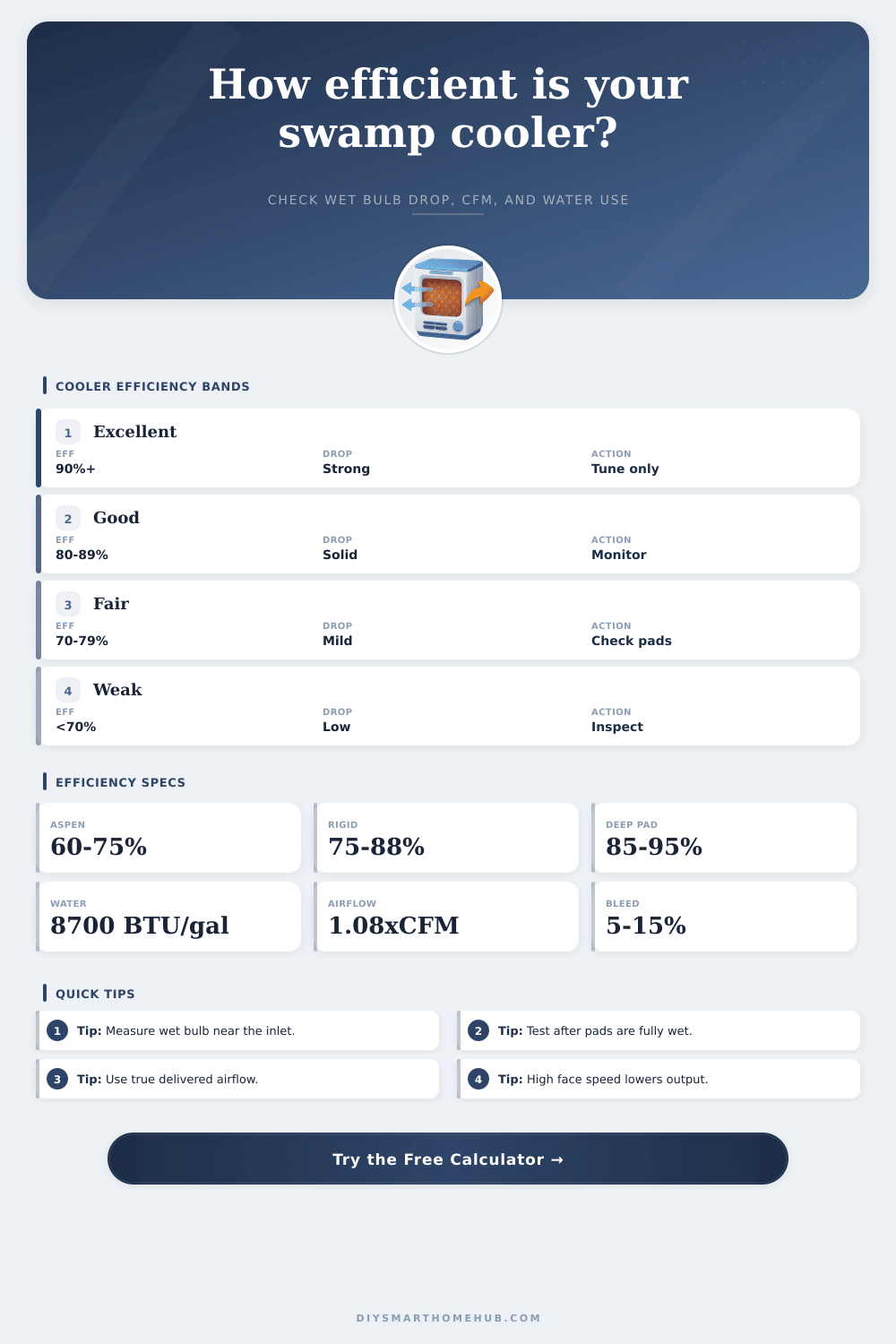
| Efficiency class | Measured saturation efficiency | Typical meaning |
|---|---|---|
| Excellent | 90% or higher | Deep pad or very well-wetted rigid media. |
| Good | 80% to 89% | Clean rigid media or strong aspen performance. |
| Fair | 70% to 79% | Usable cooling, but pad or airflow may be limiting. |
| Weak | 60% to 69% | Look for dry streaks, bypass, speed, or scale. |
| Poor | Below 60% | Field readings show a major efficiency loss. |
| Media type | Clean target | Face speed band | Best use |
|---|
| Measured pattern | Wet-bulb depression | Expected result | What to compare |
|---|---|---|---|
| 96 F dry, 65 F wet | 31 F | 24 to 28 F drop | Outlet near 68 to 72 F. |
| 100 F dry, 72 F wet | 28 F | 20 to 25 F drop | Humidity is still workable. |
| 90 F dry, 76 F wet | 14 F | 8 to 12 F drop | Small potential even if media is clean. |
| 105 F dry, 62 F wet | 43 F | 32 to 39 F drop | Airflow and water rate become critical. |
| Airflow test | Drop | Cooling output | Evaporation |
|---|---|---|---|
| 1500 CFM | 18 F | 29160 BTU/hr | 3.4 gal/hr |
| 2500 CFM | 22 F | 59400 BTU/hr | 6.8 gal/hr |
| 3500 CFM | 24 F | 90720 BTU/hr | 10.4 gal/hr |
| 5000 CFM | 28 F | 151200 BTU/hr | 17.4 gal/hr |
💡Efficiency Check Tips
Take inlet dry-bulb and wet-bulb readings where the cooler actually draws air. A nearby weather station can be several degrees away from the pad inlet condition.
If the blower motor is downstream of the media, subtract a small heat rise before judging pad efficiency. That keeps the outlet sensor from unfairly blaming the media.
A swamp cooler’s just an on-off thing for most folks; you flip it on in July and you expect the house to be cool. When it doesn’t work, you call someone to look at it. But that guy isn’t often the one who’s at fault. How the air meets the water and then enters your livig room is what’s typically at issue.
Saturation efficiency describe how well the air stay in contact with those wet pads so they could release their heat. Did the cooling process work? Or did it rush past to fast? Enter the actual airflow that you measure (the tool above does the math for you) as well as the outside temperature in degrees dry-bulb and wet-bulb. It’ll spit out if your system are running like it’s supposed to.
How to Check if Your Swamp Cooler is Working Well
Why? Because while both units might be blowing cold air, a unit that reaches 90 percent efficiency will feel cooler then one running at just 60 percent. That’s often the difference between sleeping soundly and waking up drenched in sweat. But first: you have to know what you’re taking.
What goes into it? Inlet Wet Bulb Temp. Your inlet temp will be the lowest your cooler can reach because the cooler cannot lower the air temperature below that point. No matter how hard your fan runs, the cooler can’t pull the inlet below this temp. Outlier temp closer to dry bulb (or above). If your outlet temp is more like the dry bulb than the wet bulb, then your pads aren’t working effective.
It’s similar to placing an ice cube in some water and trying to cool down the water. As long as the water doesn’t get warm again, the ice is melting correctly. But if the water doesn’t get cold and instead stays warm, something about the ratio of ice to water isn’t right or there is something wrong with insulation.
Swamp coolers works on the exact same principle of evaporative cooling/evaporative heat exchange, where water literal vanishes into the air, stealing heat away from the surrounding air. This is also where pad media size comes into play. The calculator has options for various types of pads. Cheap and old school Aspen is one option, but it degrades fast. It also holds less water per inch of depth compared to deeper poly or even rigid cellulose pads. Rigid pads will last longer, allowing for deeper installs for more evaporative surface area.
And you need surface area. Air is stubborn. It doesn’t want to give up its heat and it wants to be dry and warm. So you have to make it happen by distributing enough water and giving it enough time to make contact. Dry areas within your pad become dead zones; the air just moves right through them not cooling down at all.
A note on water: New owners are frequently amazed at how much water goes through their units. They assume efficiency equals conservation. Not necessarily. More efficient systems puts out more cool air. Each gallon of water used to evaporatively cool that airstream removes a predictable number of BTUs, about eight thousand per gallon. That’s why your water meter turns over more quickly in August than in April.
Don’t try to limit water flow. Doing so will lead to less cooling and more mineral buildup in the reservoir. You are also paying for that evaporation as water changes from liquid to vapor. Also, Altitude is a wrench-thrower, because thin air has less heat energy per volume than does dense air near sea level. To account for this, the tool calculates the sensible cooling output to provide an honest comparison, rather than raw BTUs that look impressive on paper yet fail to impress once on a mountaintop porch. Your fan may indeed be pushing plenty of cubic feet per minute… if you reside at or above two thousand feet. But each foot carries less heat than down in the valley.
But most of this involves knowing what you’re measuring. Once the pads have been running long enough, ideally ten or more minutes… To reach equilibrium with uniform wetting all over the surface, measure in the middle of the duct, not directly adjacent to a warmed wall where warm ambient heat might skew the reading. If your blower is downstream of the media, subtract the heat produced by the fan motor. This heat create a false temperature reading upstream of the thermometer.
Maintaining simply means keeping the pads fully saturated so that no part is dry or covered in mineral scale. Clogged pads will have dry spots on them just like an insulator that keeps cooling from happening. When you see your efficiency class drop below fair, it is usually time to flush the system or replace the media rather than blame the fan motor. You should of dont blame the fan motor. Keep the water moving, keep the air moving and let the physics take care of the rest.