Security Camera Field of View Calculator
Estimate horizontal and vertical angle of view, scene coverage, usable monitored area, pixel density, and ground reach from camera sensor size, lens focal length, distance, mounting height, and tilt.
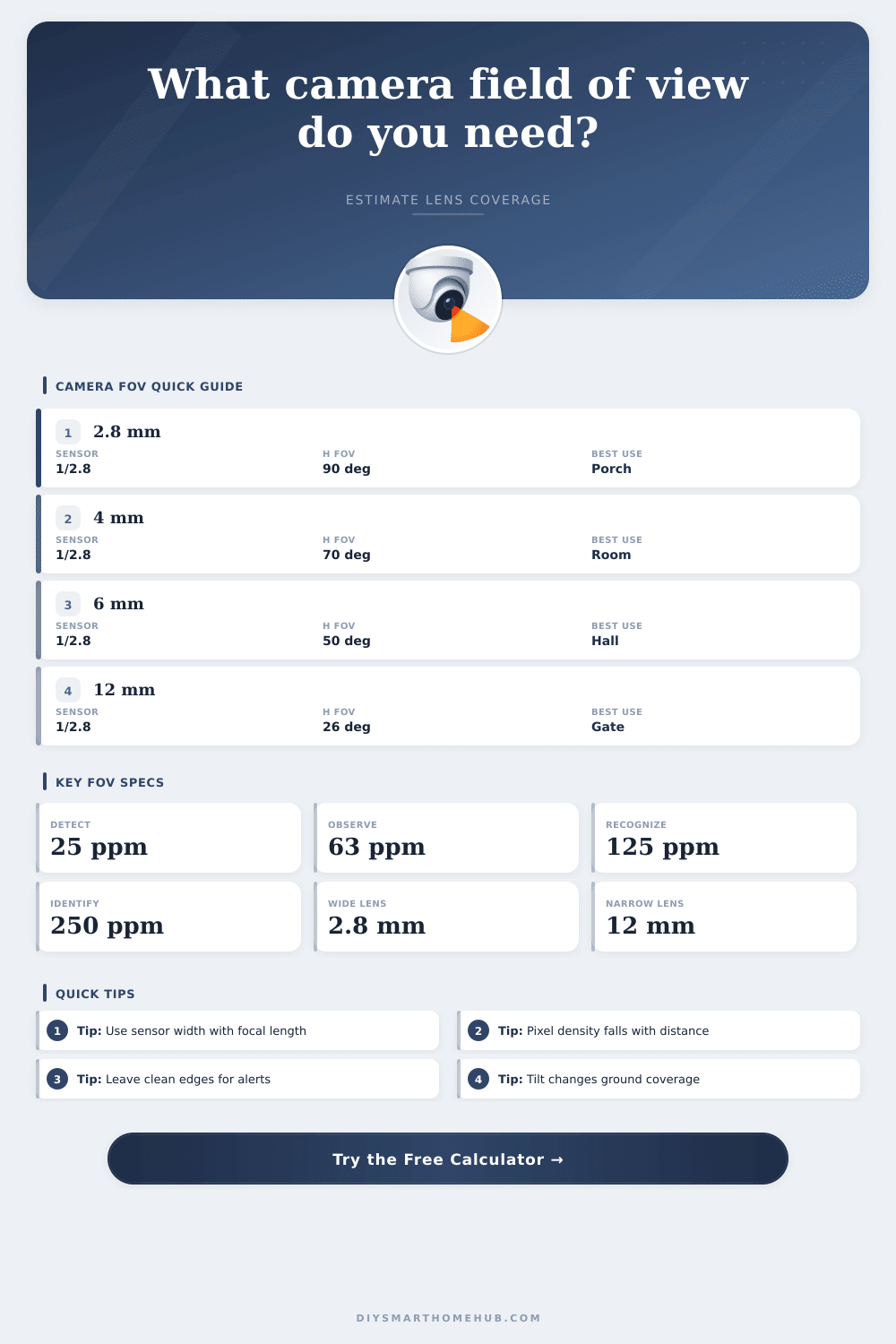
| Lens on 1/2.8 inch sensor | Approx. horizontal FOV | Scene width at 25 ft | Scene width at 7.6 m | Best coverage fit |
|---|---|---|---|---|
| 2.8 mm wide lens | 89.6° | 49.7 ft | 15.2 m | Porches, rooms, garage bays |
| 3.6 mm general lens | 75.5° | 38.7 ft | 11.8 m | Doorways, patios, small shops |
| 4 mm balanced lens | 69.7° | 34.8 ft | 10.6 m | Driveways, counters, rooms |
| 6 mm narrow lens | 49.8° | 23.2 ft | 7.1 m | Hallways, entrances, gates |
| 8 mm tele lens | 38.4° | 17.4 ft | 5.3 m | Long aisles, chokepoints |
| 12 mm identification lens | 26.2° | 11.6 ft | 3.5 m | Gates, lanes, plate zones |
| Camera profile | Active sensor used | Resolution | Effect on FOV | Where it helps |
|---|---|---|---|---|
| 2MP 1/2.8 inch | 5.57 x 3.13 mm | 1920 x 1080 | Common 16:9 baseline | General indoor and entry views |
| 4MP 1/2.7 inch | 5.37 x 3.02 mm | 2560 x 1440 | Slightly narrower than 1/2.8 | Sharper driveway or shop coverage |
| 5MP 1/2.7 inch | 5.37 x 4.04 mm | 2592 x 1944 | Taller 4:3 vertical view | Doorways and package zones |
| 8MP 1/2.8 inch | 5.57 x 3.13 mm | 3840 x 2160 | Same angle, more pixels | Wide scenes needing detail |
| 8MP 1/1.8 inch | 7.20 x 4.05 mm | 3840 x 2160 | Wider angle on same lens | Large outdoor views |
| 12MP 1/1.7 inch | 7.60 x 5.70 mm | 4000 x 3000 | Wide and tall 4:3 coverage | Face-height or room overview |
| DORI-style goal | Pixels per metre | Pixels per foot | Practical meaning | Typical camera task |
|---|---|---|---|---|
| Detect | 25 ppm | 8 ppf | Motion or person presence | Backyard overview, perimeter zones |
| Observe | 63 ppm | 19 ppf | Clothing color and general activity | Porch, hallway, garage monitoring |
| Recognize | 125 ppm | 38 ppf | Known person or familiar vehicle | Doorway, counter, shared entrance |
| Identify | 250 ppm | 76 ppf | Face or plate detail under good conditions | Entry face view, gate plate lane |
| Mount setup | Vertical FOV used | Down tilt | Approx. near ground | Approx. far ground |
|---|---|---|---|---|
| 7 ft porch camera, 2.8 mm | 58° | 35° | 5 ft from wall | 69 ft from wall |
| 9 ft garage camera, 4 mm | 43° | 25° | 7 ft from wall | 148 ft from wall |
| 10 ft patio camera, 6 mm | 29° | 25° | 12 ft from wall | 55 ft from wall |
| 14 ft warehouse camera, 8 mm | 22° | 18° | 28 ft from wall | 113 ft from wall |
| Camera or lens type | Typical focal range | FOV behavior | Strength | Watch point |
|---|---|---|---|---|
| Fixed wide turret | 2.8 to 4 mm | Broad, simple coverage | Rooms, porches, small yards | Faces get small at distance |
| Fixed narrow bullet | 6 to 12 mm | Narrower with higher pixel density | Gates, lanes, hallways | Needs careful aiming |
| Varifocal dome | 2.7 to 13.5 mm | Adjustable after mounting | Fine-tuning doorway or counter views | Recheck focus after zooming |
| Panoramic dual-lens | Usually fixed wide | Very wide stitched scene | Large room or parking overview | Lower pixels per target width |
| PTZ optical zoom | 4 to 120 mm equivalent | Wide overview or tight detail | Active tracking or guard use | FOV changes with zoom position |
Choosing the correct field of view for a security camera require a consideration of several factor. The field of view must be balanced between the desire to have a wide field of view to view large areas versus the desire to have a narrow field of view that allows for high level of detail of objects like faces or license plates. Choosing the wrong lens for a security camera or choosing the wrong angle at which to mount the lens will result in either missing the area that the security camera is to monitor or the field of view will not provide any details about the subject within the monitored area.
The calculator that is provide will help to avoid these choices by using factors like sensor size, focal length, distance, height, and tilt to determine the field of view and pixel count that will result from each of these variable. Many people begins to consider the field of view of security cameras with a consideration of only the width of the field of view. Fields of view that are made with lenses that are relatively wide allow for individuals to view larger areas of the subject of the security camera.
How to Choose the Right View for a Security Camera
With lenses that are relatively wide, however, the pixel that make up the security camera are spread out over a larger area. Thus, the closer that individuals are to the subjects that are to be view with the security camera with such lenses, the more acceptable the spreading of those pixels can be. With subjects that are at a more distant range from the security camera, however, using lenses with such a wide field of view will result in missing some of the details of those subject.
Lenses that are narrow in comparison will focus the pixels of the security camera to a small area. Using such lenses, an individual will be able to recognize the face of an individual that is viewing the security camera from a distance of only twenty feet. Using such lenses, however, means that the security camera will not be able to view subject outside of that small area.
Another factor in the field of view of a security camera is the sensor that is contain within the security camera. The sensor is just as important to the field of view of the security camera as the lens that is used. For instance, two security cameras may have the same lens, but the camera that includes a larger sensor will have a wider field of view.
This is due to the fact that the larger sensor will capture the light that enter the security camera from a wider cone. The security camera calculator consider the actual width and height of the sensor to calculate the field of view of the security camera, thus providing accurate result to the individual that enters the variables of sensor size, focal length, distance, height, and tilt. Factors like the height at which the security camera is mounted and the tilt of its lens can have a significant impact upon the field of view of the security camera.
Security cameras that are mounted at high position have a wide field of view of the ground beneath them, but only if the tilt of its lens is set to an appropriate angle. Angles that are too low to the ground will mean that the field of view will not cover the area that is to be monitored by the security camera. Angles that are too high to the ground will mean that the ground will fill the screen of the security camera to the point that the security camera’s lens will miss the horizon.
The calculations for the vertical field of view consider the angle of the lens and the angle at which the security camera’s lenses is tilted toward the ground. These calculations will provide an estimate of where the field of view of the security camera intersect with the ground. These determinations will allow an individual to understand whether the individuals that move toward the security camera will be visible within the field of view of the security camera or will be visible below the field of view of the security camera.
Another consideration for the field of view of a security camera is the pixel density of the security camera’s sensor. Pixel density is a measurement of the usefulness of the security camera’s field of view. Thus, pixel density is an important measurement.
For instance, it is possible to purchase a security camera that uses a wide angle lens and allows for the security camera to cover a large yard. The problem with security cameras with low pixel densities, however, is that it will not be possible to identify the individuals that move throughout that yard. The industry use pixel density as a way of determining the resolution of the security camera’s field of view to ensure that individuals can identify motion within the security camera’s field of view, the color of the clothing of the individuals that are visible to the security camera, the identity of the individuals that are within the security camera’s field of view, or the recognition of the license plates of the vehicle that pass within the security camera’s field of view.
This calculation will compare the calculated pixel density of the security camera to the desired pixel density for the security camera, thus allowing the individual to understand whether the lenses and distance at which they will place their security cameras will achieve the desired pixel density. Many security camera contain errors in their placement. For instance, individuals often do not consider that the field of view of the security camera is not a fixed value; rather, the field of view is the result of the relationship among several variable.
For instance, the field of view of many security cameras that are sold is advertised as having a field of view of 90 degree. The field of view of those security cameras will change based upon the size of the sensor that is contained within the security camera, the height at which the security camera is mounted, and the distance between the security camera and the action that is to be monitored by the security camera. The second of the error that security cameras often contain is the failure of the individual to consider the edges of the field of view of the security camera.
Pixels that are located on the edges of the field of view of a security camera are often less sharp than the pixels that are located in the center of the security camera’s field of view. Many security cameras allow individuals to set a percentage of the width and the height of the security camera that is to be monitored. By reserving some of the width and height of the security camera’s field of view, the individual ensure that the area that is to be monitored will remain in the area of the field of view that is most sharp and clear.
In addition to these errors, the environment in which the security camera is to be place also introduces several variables that cannot be accounted for with calculations. For instance, trees will grow within the area in which the security camera is to be place. These trees may cover the field of view of the security camera when the security camera is aimed appropriately during the winter month, but may cover the field of view during the summer months when the trees grow vegetation that cover the area that is to be monitored.
The calculations that are provide with the security cameras will provide an individual with a reliable starting point in purchasing security cameras for their homes or business. However, an individual still will have to walk the location that is to be monitored with a mobile security camera device to view the field of view that will result from various tilt in the height and angle of the security camera that is to be purchased. Several table are provided on this page as a means of helping individuals to understand the different options for security cameras.
The tables allow individuals to compare the specification of different security cameras before they are purchased. One table indicates the various width of the scenes that can be covered by the security cameras based upon the focal length of the lens of the security camera and the distance that the security cameras are placed from the scene. Individuals who are aware of the distance that the security cameras are to be placed from the scenes that are to be monitored can use this table.
The second table includes the pixel density that are indicated by security cameras. This table will allow individuals to decide whether the resolution of the field of view of the security cameras is to be high enough to allow for identification of individuals and their face or license plates, or if the security cameras are to only monitor for movement within their field of view. The third table indicates the impact that the tilt angle of the security cameras can have upon the point at which the field of view of the security cameras intersect with the ground.
This table is particularly useful for individuals who are placing security cameras above door or bay area in which individuals may enter. By understanding the various factor that impact the field of view that will result from a security camera, an individual will be able to choose the appropriate lens for their security camera. To determine the correct field of view for a security camera, the individual should measure the distance that the security cameras are to be placed from the scenes that are to be monitored, the height at which the security cameras are to be mounted, the desired pixel density of the security cameras’ field of view, and then use the security camera field of view calculator to determine the sensor and focal length of the lenses of the security cameras that will provide the desired field of view.
While the security camera field of view calculator will not allow for an individual to view the actual field of view that will result from the security cameras that are to be purchase, the calculator will allow for the individual to avoid some of the error that are often made when purchasing security cameras. Thus, the goal of the individual purchasing security cameras is to place the security camera in such a way that the important part of the scenes that are to be monitored are included within the field of view of the security cameras.