❄ Refrigeration Tonnage Calculator
Calculate refrigeration load (BTU/hr & tons) for cold rooms, walk-in coolers & smart home refrigeration
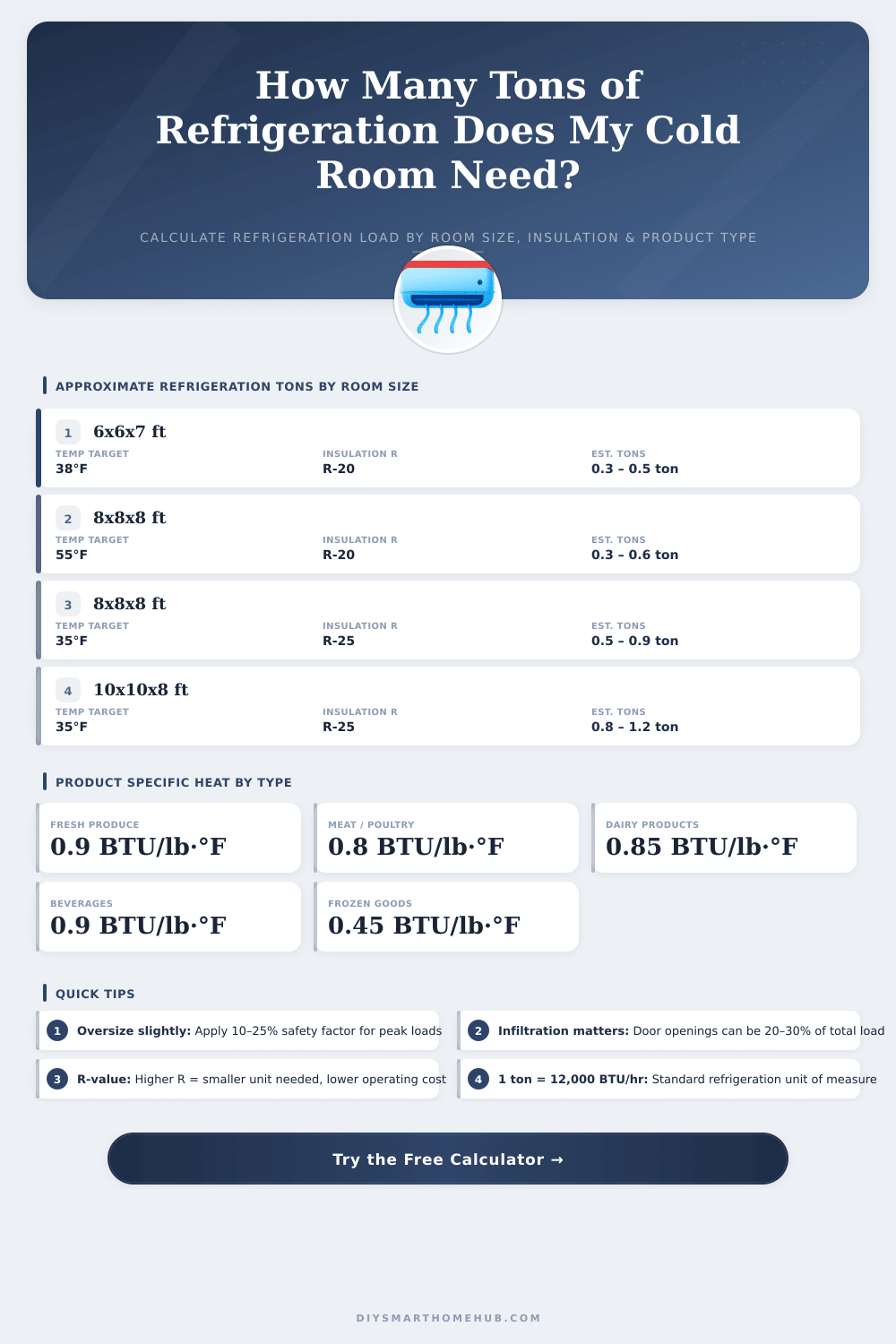
| Room Size (ft) | Temp Target | Insulation | Est. Wall Load | Est. Total BTU/hr | Approx. Tons |
|---|---|---|---|---|---|
| 6×6×7 | 38°F | R-20 | ~1,800 BTU/hr | ~4,500 BTU/hr | ~0.4 ton |
| 8×8×8 | 55°F | R-20 | ~2,200 BTU/hr | ~5,500 BTU/hr | ~0.5 ton |
| 8×8×8 | 35°F | R-25 | ~2,800 BTU/hr | ~8,500 BTU/hr | ~0.7 ton |
| 8×8×8 | 0°F | R-32 | ~4,200 BTU/hr | ~14,500 BTU/hr | ~1.2 ton |
| 8×10×8 | 38°F | R-25 | ~3,200 BTU/hr | ~9,500 BTU/hr | ~0.8 ton |
| 10×10×8 | 35°F | R-25 | ~3,800 BTU/hr | ~11,500 BTU/hr | ~1.0 ton |
| 10×12×8 | 35°F | R-25 | ~4,400 BTU/hr | ~14,000 BTU/hr | ~1.2 ton |
| 12×10×9 | 38°F | R-25 | ~4,800 BTU/hr | ~15,500 BTU/hr | ~1.3 ton |
| R-Value | U-Value (BTU/hr·ft²·°F) | Heat Gain per 100 ft² at ΔT 50°F | Typical Application |
|---|---|---|---|
| R-10 | 0.100 | 500 BTU/hr | Uninsulated / minimal retrofit |
| R-15 | 0.067 | 333 BTU/hr | Light residential cooler |
| R-20 | 0.050 | 250 BTU/hr | Home wine cellar / beverage cooler |
| R-25 | 0.040 | 200 BTU/hr | Standard commercial walk-in cooler |
| R-32 | 0.031 | 156 BTU/hr | Freezer rooms & low-temp coolers |
| R-40 | 0.025 | 125 BTU/hr | Deep freeze / Arctic-grade panels |
| Product Type | Specific Heat (BTU/lb·°F) | Approx. Freezing Point | Pull-Down Load Factor |
|---|---|---|---|
| Fresh Produce / Vegetables | 0.90 | 30–32°F | High — respiration heat adds 10–20% |
| Meat / Poultry | 0.80 | 28–30°F | Medium — minimal respiration |
| Dairy Products | 0.85 | 27–31°F | Medium — stable product load |
| Beverages (beer, wine, soft drinks) | 0.90 | 28–32°F | Medium — dense product, slow pull-down |
| Frozen Goods | 0.45 | Below 32°F | High initial — latent heat if unfrozen |
| Floral / Cut Flowers | 0.90 | 30°F | High — respiration + moisture load |
Refrigeration tonnage is a way to measure the power of a cooling system. One ton of refrigeration equals 12,000 BTU each hour. That number comes from the idea to melt one ton of ice during 24 hours So if you split 288,000 BTU through a day, you get 12,000 BTU per hour.
It can also be written as 200 BTU each minute, because an hour has 60 minutes. BTU/hr and Btuh are commonly used interchangeably and mean the same thing.
What Is a Ton of Refrigeration
This idea was born when people switched from natural ice to mechanical refrigeration. Before electrical refrigeration, people cooled things using ice. People gathered ice during the winter and stored it in separate houses, called ice houses, to distribute it later.
If this measure seems backward, it indeed is. It returns to the times when cooling machines were used chiefly in ice fatcories.
If we look at other measures, one ton of refrigeration equals about 3,024 kilo-calories each hour. According to the standard US definition, it equals 3.517 kW. Another way to express that is 4.7142 horsepower.
A ton of refrigeration is a unit that you use to describe the heat-extraction capacity of air conditioning and refrigeration devices. For every ton of capacity, a system can remove enough heat to freeze 2,000 pounds of water into ice during 24 hours.
BTU, or British Thermal Units, measure the amount of heat for home needs. On the other hand, tonnage is the measure for cooling. Tonnage does not relate to the temperature itself, but rather to how many BTUs are removed.
“Tons” are a term for pointing out the cooling capacity of a refrigeration system, rather than a hydronic system, that uses water. Basically, it shows how much energy the system can absorb from the air to cool it.
The ton of refrigeration, as a measure of cooling power, does not relate to the tons used in shipping, where “ton” usually means weight or volume.
In the United States, commercial refrigeration systems are mostly measured by tons, and this term is used also in other lands. Even so, outside the United States, cooling systems are usually specified by kW or MW. Some makers put the tonnage directly in the model number, although they commonly do not write the precise amount.
A helpful trick is to divide the two-digit number in the model by 12 to find the tonnage. But that figure alone should not substitute a real measure. Any company should do a right calculation of the load.
A compressor of 1 hp in a 1 ton condensing unit with one ton evaporator coil easily reaches 1 ton of refrigeration at 40 degree evaporator temperature and 90 degree condensing temperature. Medium temperature refrigeration would require about 2 hp per ton.