Refrigerant Line Sizing Calculator
Compare copper tube options for liquid, suction, or discharge runs using capacity, refrigerant, temperatures, equivalent length, lift, velocity windows, and pressure-drop targets.
📌Project Presets
⚙Line Design Inputs
Assumption basis: This calculator uses common HVAC copper IDs, refrigerant effect estimates, velocity windows for oil return, and pressure-drop screening to suggest a practical first-pass line size.
Recommended Tube Snapshot
Select a design case or press calculate to compare sizes.
📊Refrigerant Sizing Spec Grid
Estimated refrigeration effect
Active line density
Horizontal target, fpm
Total pressure-drop budget
📈Candidate Size Comparison
| Tube OD | Tube ID | Velocity | Drop | Vol / 100 ft | Status |
|---|
The recommended size is the smallest copper tube that clears the active velocity and pressure-drop checks. If none pass, the lowest-penalty fallback is shown.
📐Copper Tube Reference
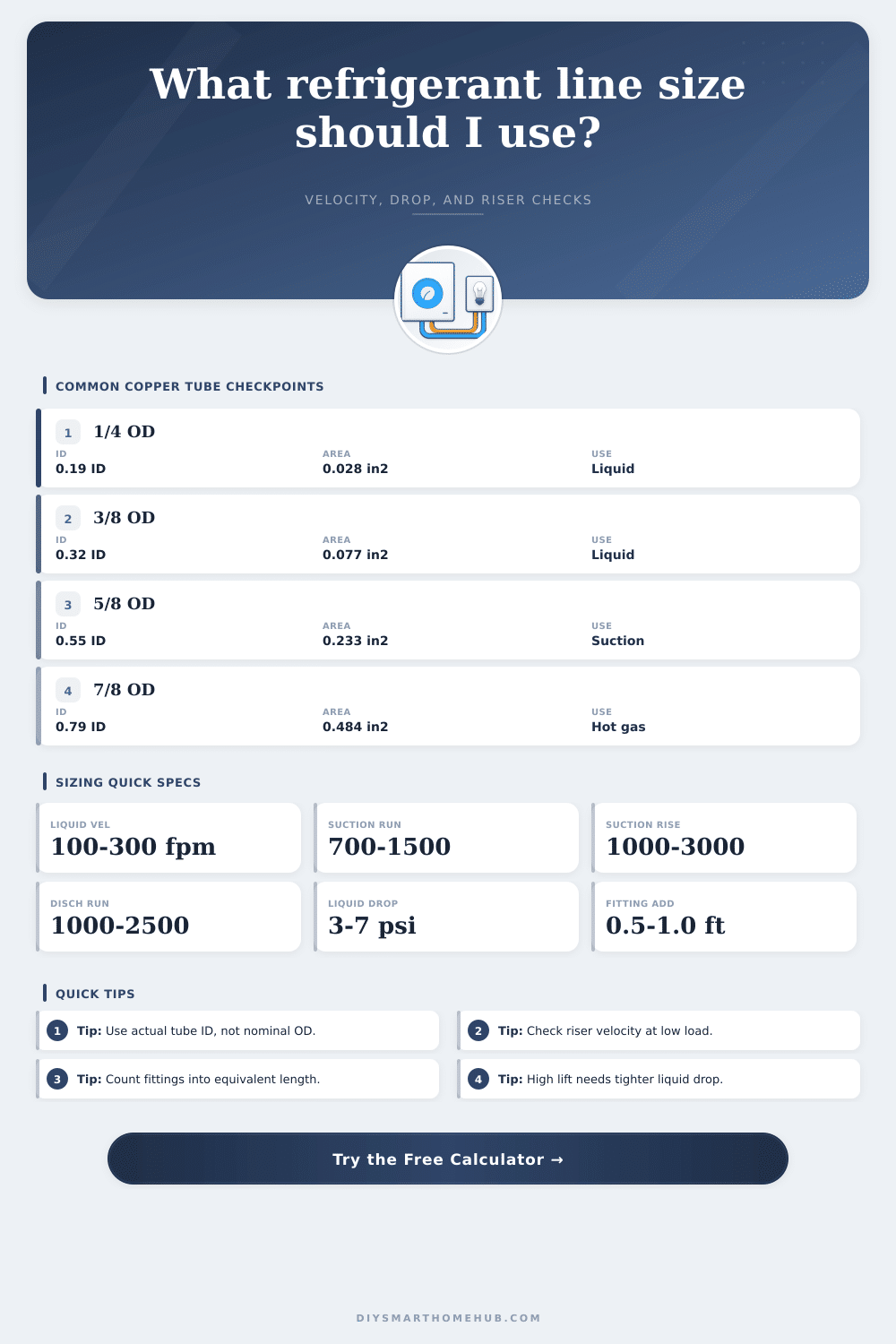
| Nominal OD | Approx. ID | Flow Area | Volume / 100 ft | Typical Use |
|---|
🚦Velocity And Drop Targets
| Line Type | Horizontal Band | Riser Minimum | Drop Budget | Primary Goal |
|---|
🧪Refrigerant Property Reference
| Refrigerant | Effect Base | Liquid Density | Vapor Density | Common Use |
|---|
📋Preset Application Table
| Preset | Capacity | Run | Rise | Focus |
|---|
💡Field Notes
Equivalent length matters: Long-radius elbows, oil separators, branch headers, and check valves all add friction. Include them before deciding whether a liquid line can stay at the smaller diameter.
Riser checks should be conservative: A tube that looks fine at full load can lose oil return margin at minimum capacity. Review the riser velocity band before locking in a vertical vapor line.
Refrigerant line sizing is the process of determining the proper diameter of refrigerant lines. Correct line sizing are required for refrigerant systems because improper line sizing will damage the compressor and starve the system of refrigerant. The three factors to consider when sizing refrigerant lines include velocity, pressure drop, and density.
Velocity refer to the speed of the refrigerant in the lines. Low velocities in refrigerant lines can cause the oil to pool in the lines and starve the compressor. High velocities can create noise in the refrigerant lines, erode the refrigerant lines, and create excessive friction loss in the system.
How to Size Refrigerant Lines
In the liquid lines, high velocities can cause the refrigerant to flash into a vapor, which will lower the subcooling of the refrigerant system. However, in the suction lines, high speed are required to move oil from the compressor. Equivalent length is another consideration in sizing refrigerant lines.
This accounts for the total length of the refrigerant lines, including the length of each elbow, tee, and strainer in the system. Each of these fittings adds to the length of the refrigerant line, which means suction lines should be sized for the length of the refrigerant line with all fittings added to the length of the line itself. For example, ten 90-degree elbow may turn a 50-foot refrigerant line into a 60-foot refrigerant line.
All refrigerant line fittings should be accounted for in the sizing process of the refrigerant lines. Oil return is another consideration in refrigerant line sizing. Since the compressor need oil to lubricate, but cannot do so with refrigerant vapor alone, oil return is critical to proper operation of the system.
High velocities are required in vertical suction lines in order to return oil to the compressor, espeshally when the system is not heavily loaded. Horizontal suction lines may have velocities between 700 and 900 feet per minute, but vertical suction lines may need velocities of 1000 feet per minute or more to ensure proper oil return. Refrigerant lines has different velocity requirements for liquid lines versus suction lines.
Since liquid lines carry a dense fluid, the velocities on those lines should be between 100 and 300 feet per minute. However, high velocities in liquid lines can cause refrigerant to flash into a vapor. Additionally, high pressure drop may exist in the liquid lines, which will reduce subcooling.
Subcooling is a factor in the refrigerant systems cooling capacity per pound of refrigerant. Static head may also impact the system. In tall refrigerant lines, a higher static head may exist at the indoor unit, which may require a larger refrigerant line size.
Refrigerant line sizing also takes into account the type of refrigerant that is used in the refrigerant system. For example, R-410A refrigerant is denser and hotter than R-32 refrigerant. Because of the density of the refrigerant, more R-32 is required for heat transfer than R-410A.
Thus, R-32 systems require smaller refrigerant lines. Additionally, since R-290 has a low refrigerant density, the velocity in those refrigerant lines must be closely controlled. Temperature swings also play into refrigerant line sizing.
Since changes in the temperature of the refrigerant changes the density of the vapor refrigerant, refrigerant line size may need to be altered based on these changes. Thus, changes in the density of the vapor refrigerant will require a change in the refrigerant line size by one size in the refrigerant lines. The pressure drop budget for refrigerant lines must also be accounted for.
Depending on the length of the refrigerant line and the type of refrigerant system, the budget for the pressure drop can range from a few psi for standard suction lines to less than 1.5 psi for critical refrigerant paths. The pressure drop must not be allowed to be exceeded or the compressor will overheat and overwork. Sizing tools will help determine the smallest diameter of refrigerant tubing that will allow refrigerant to move at the necessary velocity with the required pressure drop.
However, a refrigeration technicians judgment must also be used to decide the proper refrigerant line size because refrigerant lines can be underspecified or overspecified. For example, if the liquid line is underspecified, the refrigerant may flash into a vapor during hot weather and starve the evaporator. If the suction lines are overspecified, the lines will trap oil when the system start up.
However, refrigerant line sizes should always be double-check to ensure proper function of the refrigerant system. For example, velocities should be checked in vertical suction lines at 50 percent of the systems load. Most oil return problems are with refrigerant systems that are at 50 percent of their load.
Refrigerant line sizing tools account for the actual inside diameter of the refrigerant line tubing. For example, the outside diameter of tubing may be 5/8 inch in size, but the inside diameter of that refrigerant line may be 0.545 inches. Thus, line sizing tools use this measurement rather than the outside of the refrigerant line.
Additionally, the direction of the vertical refrigerant rises must be accounted for. If the indoor refrigerant unit is positioned above the outdoor unit, a static regain must be provided for the refrigerant to properly return to the indoor unit. Discharge lines also require proper sizing even though they are often overlooked in sizing refrigerant lines.
However, the hot gas in the condenser and discharge lines can have higher velocities in those lines, up to 2500 feet per minute. High velocities in the discharge lines, however, may create noise in the refrigerant system. Thus, velocities should be limited in the discharge lines.
Additionally, the minimum velocity in the discharge lines should be 1500 feet per minute to prevent refrigerant from slugging back into the compressor dome. Finally, refrigerant line sizing involves a balance between proper refrigerant flow, even friction losses, proper refrigerant oil return, and minimizing the cost of the refrigerant lines. While the sizing refrigerant lines involves math to calculate refrigerant velocity, the decision of the refrigerant line size involves the judgment of the refrigeration technician.
Thus, if the rooftop refrigerant line is sized properly, the entire refrigerant system will function properly throughout teh years.