Refrigerant Conversion Calculator
Convert a field pressure into saturation temperature, flip a target saturation back into pressure, and compare line temperature, charge mass, and absolute pressure in one HVAC service view.
📌Service Presets
⚙Conversion Inputs
Converted Service Snapshot
Run a calculation to see the converted pressure, temperature, charge, and line delta values.
📊Refrigerant Spec Grid
R-410A
Service interpretation
Low-side checkpoint
High-side checkpoint
📘Selected Refrigerant PT Slice
| Saturation F | Saturation C | Pressure psig | Pressure kPa g | Pressure bar g |
|---|
The PT slice refreshes when the refrigerant changes so you can compare the same temperatures across different refrigerant families.
🔢Pressure and Charge Conversion Table
| Input | psig | kPa g | bar g | Charge match |
|---|---|---|---|---|
| 10 psi / 1 lb | 10.0 | 68.9 | 0.69 | 0.45 kg |
| 25 psi / 5 lb | 25.0 | 172.4 | 1.72 | 2.27 kg |
| 50 psi / 10 lb | 50.0 | 344.7 | 3.45 | 4.54 kg |
| 100 psi / 20 lb | 100.0 | 689.5 | 6.89 | 9.07 kg |
📋Refrigerant Family Comparison
| Refrigerant | 40 F PT | 100 F PT | Glide | Safety | Best fit |
|---|
🗂Preset Snapshot Table
| Preset | Refrigerant | Pressure | Target sat | Charge |
|---|
Gauge pressure reads relative to ambient air, so the same psig value produces a different compression ratio at higher elevation. Use the absolute pressure result when comparing systems across sites.
Blended refrigerants such as R-407C and R-454B need a dew or bubble decision before you compare line temperature. The calculator flags glide so you can choose the correct side of the PT chart.
Refrigerant pressure-temperature relationship are essential to every refrigeration system. Every refrigerant behave differently due to the unique boiling point that every refrigerant has at specific pressures. The technician must have an understanding of refrigerant pressure-temperature relationships because the pressure that is correct for one refrigerant might not be the same for another refrigerant.
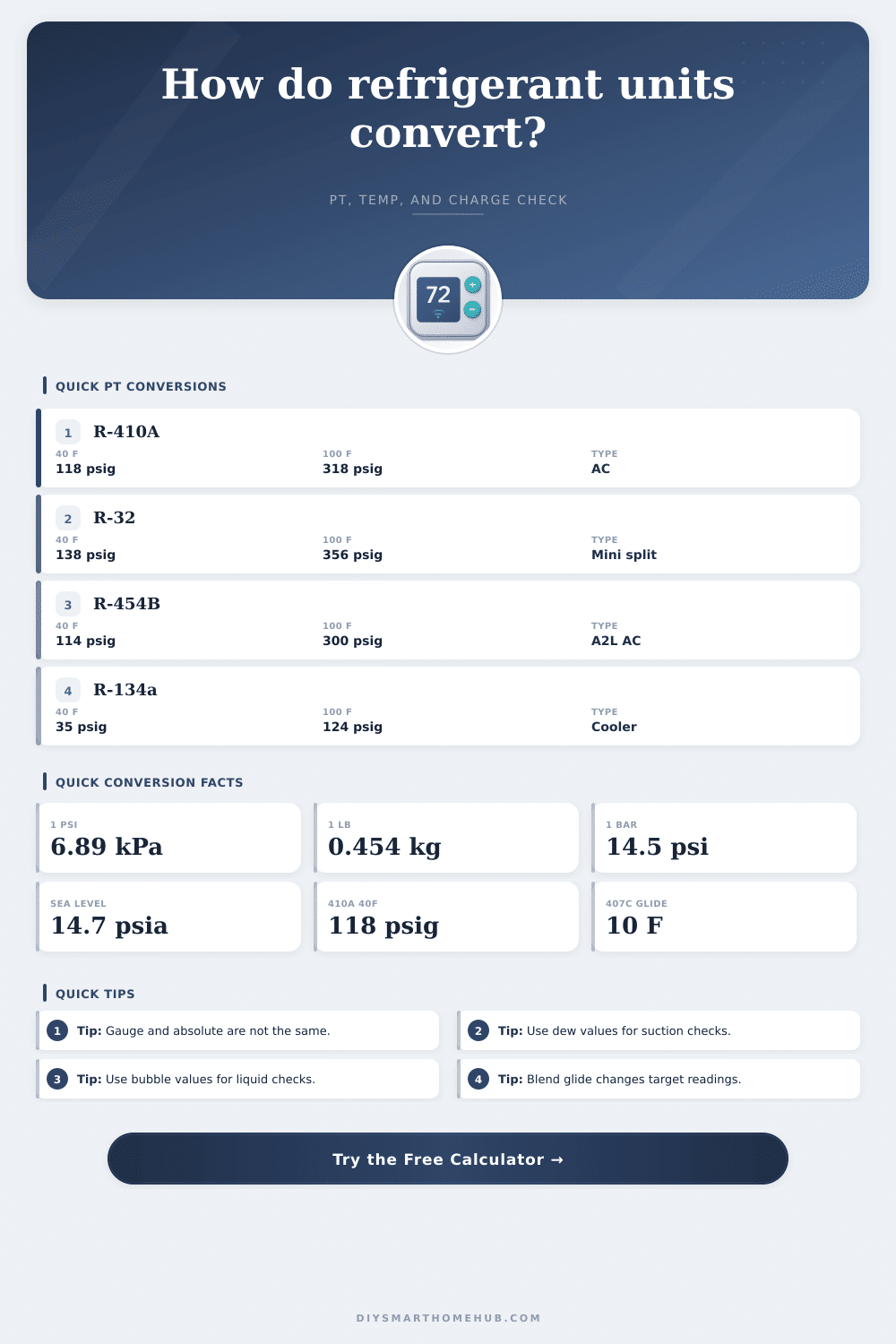
For instance, R-410A refrigerant work at high pressures and temperatures and might read 118 psig at 40 degrees Fahrenheit for its evaporation temperature. However, R-134a might read only 35 psig at the same temperature. Because refrigerants has different boiling points, the pressure reading that might be correct for one refrigerant is not going to be correct for another refrigerant.
Refrigerant Pressure and Temperature Basics
Refrigerant blends introduce further complexity into pressure-temperature relationship. Refrigerant blends have a property call glide. Because of glide, the refrigerant blend have different saturation temperatures for dew point and bubble point temperatures.
Technicians have to choose which saturation temperature to use for system check. If the technician does not account for glide, the technician could end up with incorrect superheat values for refrigerant blends. Refrigerant blends, like R-407C, might have a ten-degree swing in there saturation temperatures due to glide in the refrigerant blend.
Therefore, technicians have to be more precisly when dealing with refrigerant blends. The atmospheric pressure and elevation where the technician is working can also affect refrigerant pressure reading. Refrigerant pressure gauges will read gauge pressure, which is relative to an atmospheric pressure.
The pressure reading on the gauge will change based on the elevation of the technician. For instance, 118 psig reading at sea level will compress differently at an elevation of 5,000 feet. For refrigerant cycle mathematics to display the true math of the refrigeration cycle, the technician must use absolute pressure.
This value add the atmospheric pressure to the gauge pressure reading of the refrigerant. Technicians use line temperatures to determine the status of the refrigeration system. For instance, a technician can use the suction line temperature reading and the saturation temperature to determine whether the refrigeration system has an overcharge or restriction.
A healthy system will have the evaporator 10 to 18 degrees more warm than the saturation temperature. This temperature will depend on the specific design of the evaporator. Condensers will be between 6 and 16 degrees of subcooling off the bubble point saturation temperature of the refrigerant.
However, condensers will have to account for ambient air temperature. For instance, a rooftop unit will lose more heat from the hot air than a walk-in box refrigeration unit that can draw air from a 38-degree Fahrenheit environment. Not all refrigerants have the same pressure benchmarks for the same saturation temperature.
For instance, to reach a saturation temperature of 40 degrees Fahrenheit, R-32 will read 138 psig while R-454B will read 114 psig. Furthermore, legacy refrigerants, such as R-22, will read 68 psig at 40 degrees Fahrenheit. New A2L refrigerants are mildly flammable but will have similar pressure requirement to the legacy refrigerants that are commonly used in high-side refrigeration circuits.
Technicians will need to be able to convert the unit of refrigerant charge. For instance, when charging refrigerant into a system, a technician might need to convert from pounds to kilos or psig to kPa. At the rate of 1 psi = 6.9 kPa and 1 pound = 0.45 kilos, the technician might have to change the refrigerant charge by 5 or 10 percent.
Since the technician should never fill refrigerant recovery cylinders to more than 80 percent of the cylinders capacity, the technician will have to calculate the number of pounds of refrigerant that can be safely load into the cylinder. A technician can service a refrigeration system by using mathematical and physical observations of the system. For instance, the technician can feel the temperature of the suction line.
If it is too cold, there is a flooding problem. If too warm, there is a starvation problem. The technician can also listen to the compressor to determine if it is strained.
High head pressure can strain a compressor over time. Finally, the technician can examine the amp draw of the compressor. The compressor might draw the correct amount of amp to appear to be running normal but might be a weak compressor when under stress.