PVC Conduit Size Calculator
Estimate wire area, PVC Schedule 40 or Schedule 80 conduit fill, minimum trade size, equipment grounding conductor area, derate hints, and pull difficulty for common home electrical raceway layouts.
📌PVC conduit fill presets
⚙Conduit and wire inputs
PVC conduit fill result
Enter conductor sizes, counts, and PVC type to check fill and minimum trade size.
Calculation breakdown
📊PVC conduit and wire spec grid
📋PVC conduit internal area reference
| Trade size | Sch 40 total area | Sch 40 at 40% | Sch 80 total area | Sch 80 at 40% |
|---|---|---|---|---|
| 1/2 in | 0.285 sq in | 0.114 sq in | 0.217 sq in | 0.087 sq in |
| 3/4 in | 0.508 sq in | 0.203 sq in | 0.409 sq in | 0.164 sq in |
| 1 in | 0.832 sq in | 0.333 sq in | 0.688 sq in | 0.275 sq in |
| 1-1/4 in | 1.453 sq in | 0.581 sq in | 1.237 sq in | 0.495 sq in |
| 1-1/2 in | 1.986 sq in | 0.794 sq in | 1.711 sq in | 0.684 sq in |
| 2 in | 3.356 sq in | 1.342 sq in | 2.874 sq in | 1.150 sq in |
| 2-1/2 in | 5.858 sq in | 2.343 sq in | 5.217 sq in | 2.087 sq in |
| 3 in | 8.846 sq in | 3.538 sq in | 7.922 sq in | 3.169 sq in |
🔌Conductor area reference
| Conductor size | THHN/THWN-2 area | XHHW-2 area | Bare copper area | Common use |
|---|---|---|---|---|
| 14 AWG | 0.0097 sq in | 0.0139 sq in | 0.0032 sq in | 15 A lighting branch |
| 12 AWG | 0.0133 sq in | 0.0181 sq in | 0.0051 sq in | 20 A branch circuit |
| 10 AWG | 0.0211 sq in | 0.0243 sq in | 0.0082 sq in | 30 A branch circuit |
| 8 AWG | 0.0366 sq in | 0.0437 sq in | 0.0130 sq in | Large appliance circuit |
| 6 AWG | 0.0507 sq in | 0.0590 sq in | 0.0206 sq in | Feeder or charger circuit |
| 4 AWG | 0.0824 sq in | 0.0973 sq in | 0.0328 sq in | Feeder conductor |
| 3 AWG | 0.0973 sq in | 0.1134 sq in | 0.0413 sq in | Large feeder conductor |
| 2 AWG | 0.1158 sq in | 0.1333 sq in | 0.0521 sq in | Large feeder conductor |
⚖Fill rule and derate table
| Check | Rule used by calculator | Formula or trigger | Planning note |
|---|---|---|---|
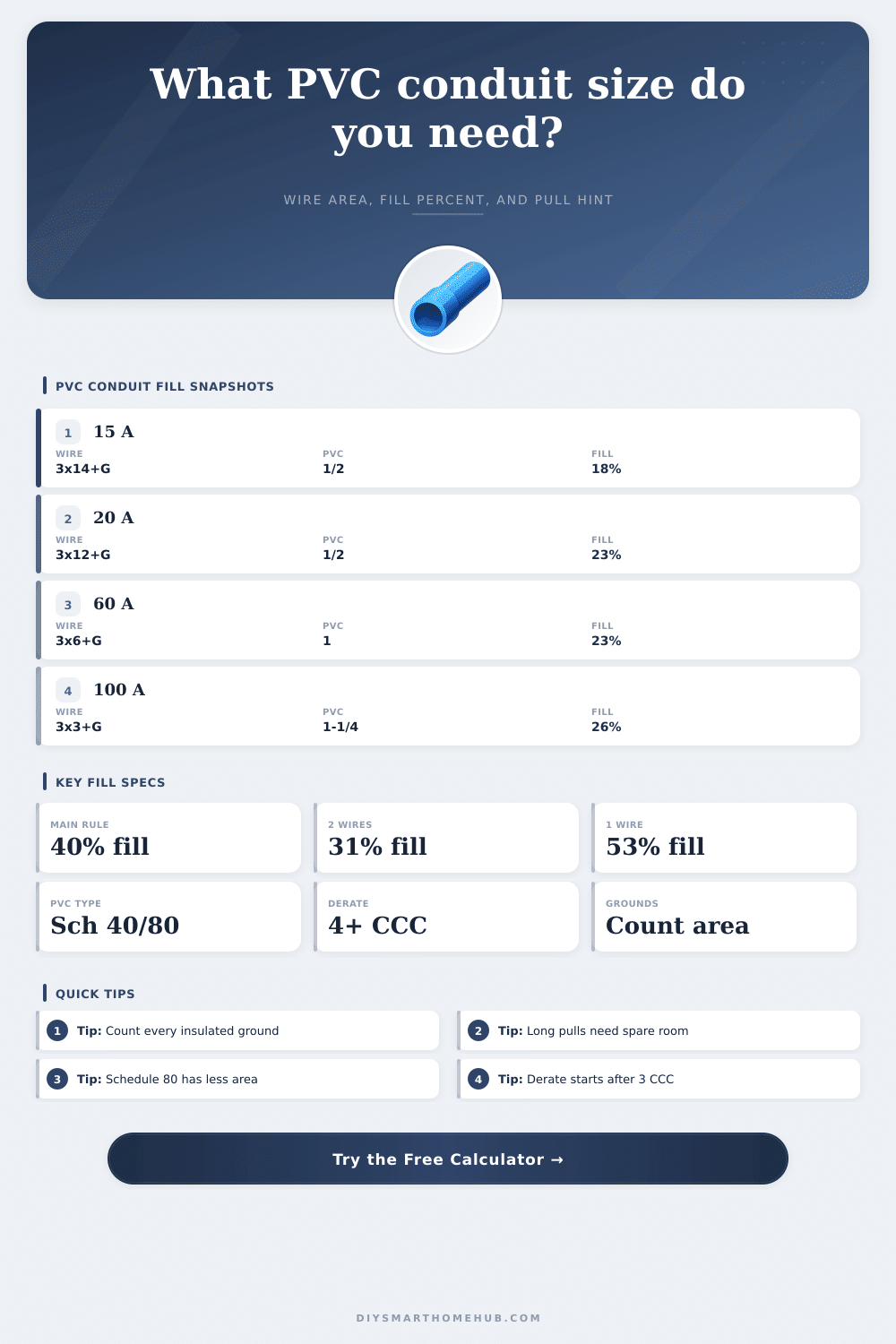
| One conductor fill | 53% maximum fill | wire area / conduit area | Rare for branch circuits, but included for completeness |
| Two conductor fill | 31% maximum fill | total wire area / conduit area | The two-wire rule is tighter than the 40% rule |
| Three or more conductors | 40% maximum fill | total wire area / conduit area | This is the standard branch-circuit raceway case |
| Derate hint | More than 3 current-carrying conductors | 4-6: 80%, 7-9: 70%, 10-20: 50% | Grounding conductors count for fill, not for CCC derating |
| Pull difficulty | Fill ratio plus bends and length | score = fill load + bend load + length load | Long runs and bends can be hard even when fill passes |
🏠Common PVC conduit size examples
| Example run | Typical conductors | Often starts at | Why size may increase |
|---|---|---|---|
| Smart switch or lighting branch | 14 AWG THHN plus ground | 1/2 in PVC | Travelers, multiwire branches, or spare wires |
| Outdoor receptacle or camera power | 12 AWG THHN plus ground | 1/2 in PVC | Long pull or Schedule 80 where exposed |
| Garage appliance branch | 10 AWG THHN plus ground | 3/4 in PVC | Neutral, spare conductor, or tight bend layout |
| EV charger or subpanel feeder | 6 AWG to 3 AWG conductors | 1 in to 1-1/4 in PVC | Four-wire feeder, insulated EGC, or XHHW-2 insulation |
✅PVC conduit sizing tips
You simply enter type of insulation and number of conductors into the calc above and it does the rest. You no longer has to guess if that raceway you have picked out will accomodate the bundle or not. It calculates how hard wire pulls, the minimum trade size, and amount of space the bundle uses. This help you determine what size to use before cutting any pipe.
It also includes a set of reference tables (on the page) showing the inside spaces for both schedule 40 and 80 conduit. That way, you can glance over and get an idea of how much less usable space you have when going up to bigger wall thicknesses.
Why Conduit Sizing Matters
And remember: Conduit sizing can be as much art as science, particularly with fat cables making sharp turns. That sounds straightforward, but it’s not. That’s because there’s a maximum amount of space that can be occupied within a pipe without exceeding temperature limits.
For three or more wires (or cables), that means no more than 40% of the interior volume of the pipe. Two conductors? That goes down to 31%. Why the numbers? Because electricity produce heat, which heats up plastic pipe. Plastic doesn’t like getting warm; it likes staying cool. Packing too many wires will cause insulation to break down over time as the heat they generate causes an “oven” effect inside conduit.
To account for this rule the calculator adjust itself to match what you enter. But knowing the rationale behind the rule also helps you troubleshoot if something seems too snug. Ideally, you want air between all the cables, so heat from one doesn’t damage nearby ones, it spreads out into surrounding area instead.
And they all neglect anything other than hot wires. Although equipment grounding conductor doesn’t help with derating because it’s not a current carrying conductor, it does add to the fill. And just because it’s bare doesn’t mean it takes up zero space, it’s thinner, sure, but it still exists. If your ground is insulated, it won’t short out at metal fittings and you can identify it among mixed metals in the same raceway. That additional jacket means there are more square inches of area. You can tell the tool if your ground is insulated or bare.
That makes quite a difference when calculating total volume for small pipes and is often the difference between pulling successfully or being stuck halfway through wall. Conduit projects has big lengths and bends. Two bends over a fifty foot run can be doable at a forty percent fill level. But add three elbows and stretch that out to one-hundred feet and you’ve got a problem keeping down friction. The calculator have hints for pull difficulty based off length and bend equivalents.
It’s practical for the real world because without any slack, those wires will snag on sharp edges inside the conduit. A little buffer space under max fill limit not only helps with pulling, but also shields insulation from abrasion damage during install. Sure, you may get away with a jam-packed pipe and still make code check, but I’ll bet you would of wished you didn’t when it comes time to replace a wire five years from now.
Another factor to consider here is whether you’re using Schedule 40 or Schedule 80 PVC. The latter is slightly larger (thicker walls) so will have less capacity for the given trade size. The calculator factors this into equation. Depending on the schedule used, you may find yourself going up to three-quarter-inch instead of half-inch simply to get enough fill. This often happens in exposed runs such as under windows where impact resistance outweighs cosmetic minimalism. It is a small trade-off, but it matters when you are working with tight budgets or limited wall cavities.
That’s all fine. But it gets complicated with the last layer: Derating. Running multiple current-conducting cables in one raceway reduce the maximum safe current each can handle due to inefficiency in shedding heat. For four to twenty conductors, there are standard adjustment factors built-in by default as a hint from tool. These factors also takes into account neutrals and grounds. Neutrals and grounds don’t carry much unbalanced current, but they do consume space.
Understand the difference between ampacity ratings and fill capacity to keep your circuits safe when loaded. It’s all about knowing what you’re measuring. Most of the time. In this case it’s about balancing thermal safety against mechanical pullability within a rigid, cylindrical piece of plastic. We have the calculator up top that does the math for you, but where you really shine is thinking through where those friction points might be before the glue sticks come out. Make wise choices and give your wiring some breathing room; it’ll be with house as long as you have it.