Outlet Wattage Calculator
Estimate the maximum safe wattage for an outlet or shared branch circuit using voltage, breaker amps, power factor, 80% continuous-load rules, device watts, startup surge, and existing circuit load.
🔌Outlet and circuit presets
⚙Outlet load inputs
Calculation breakdown
📊Outlet and circuit spec grid
Common 80% planning wattage before any power-factor adjustment.
Useful checkpoint for kitchen, garage, laundry, or dedicated branches.
Loads expected to run 3 hours or longer are commonly planned at 80% of breaker rating.
Motors and power supplies can draw more current than their real-watt output suggests.
📋Outlet wattage capacity table
| Circuit rating | Nominal voltage | Breaker watts at PF 1.0 | 80% continuous watts | Typical outlet use |
|---|---|---|---|---|
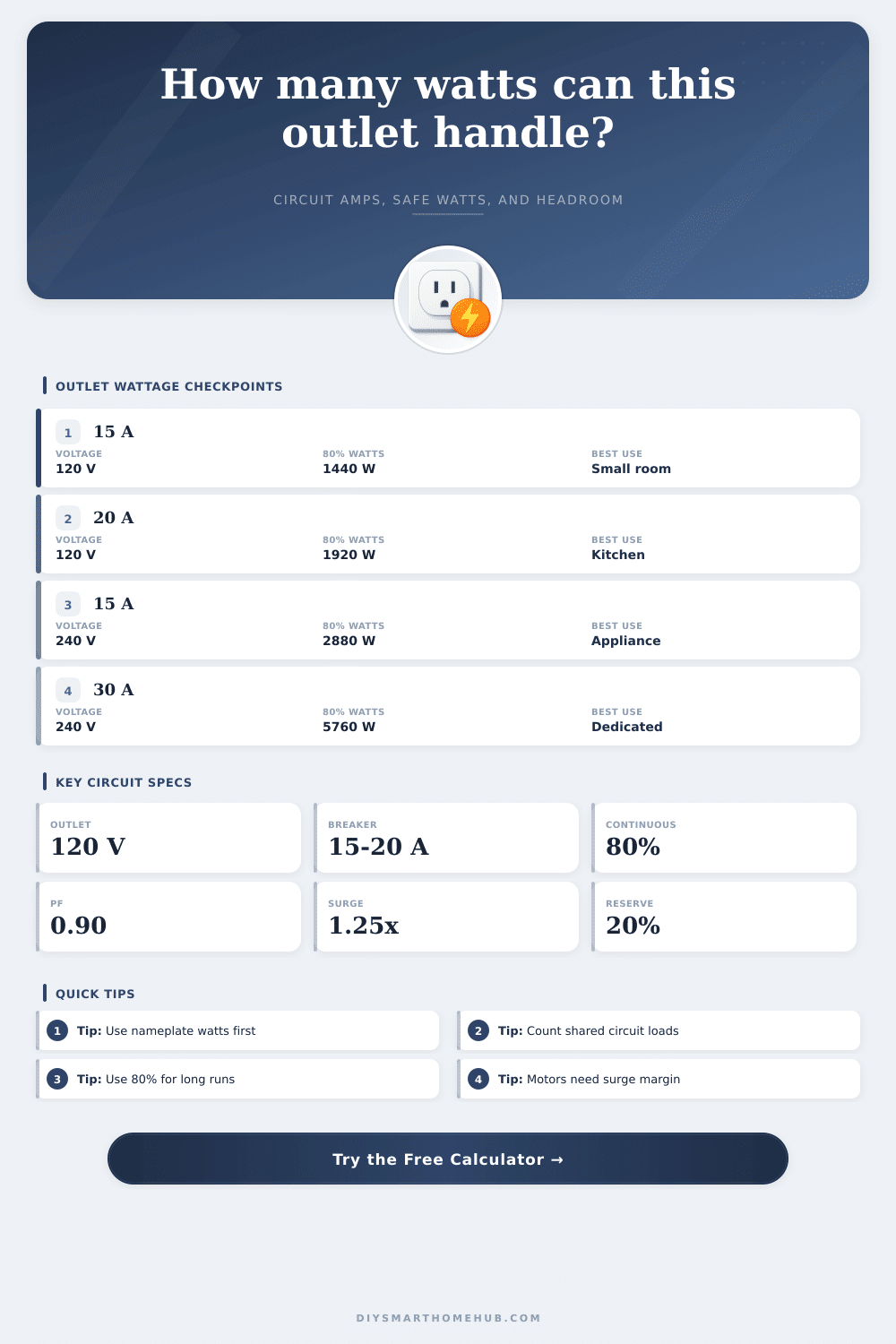
| 15 A branch circuit | 120 V | 1,800 W | 1,440 W | Bedrooms, living rooms, small electronics |
| 20 A branch circuit | 120 V | 2,400 W | 1,920 W | Kitchen counters, garage, laundry, workshops |
| 15 A dedicated circuit | 240 V | 3,600 W | 2,880 W | Small 240V appliance or tool branch |
| 20 A dedicated circuit | 240 V | 4,800 W | 3,840 W | Dedicated equipment with matching receptacle rating |
| 30 A dedicated circuit | 240 V | 7,200 W | 5,760 W | Larger appliance or equipment branch |
⚡Power factor and surge reference
| Load type | Typical power factor | Startup multiplier | Outlet wattage note |
|---|---|---|---|
| Resistive heater or kettle | 0.98 to 1.00 | 1.00x | Running watts are usually the limiting value |
| Computer and AV electronics | 0.90 to 0.99 | 1.05x to 1.30x | Shared outlet strips can hide total current |
| Refrigerator or freezer | 0.75 to 0.90 | 2.0x to 3.5x | Surge can exceed running load by a wide margin |
| Shop vac or small motor | 0.75 to 0.88 | 2.0x to 4.0x | Motor start may trip a heavily shared breaker |
| LED lighting driver | 0.85 to 0.98 | 1.05x to 1.20x | Many small drivers add up on a smart outlet |
🏠Shared circuit examples table
| Scenario | Breaker and voltage | Existing load | New device load | Planning signal |
|---|---|---|---|---|
| Home office outlet | 15 A at 120 V | 400 W | 320 W electronics | Usually comfortable if no heater is added |
| Kitchen counter circuit | 20 A at 120 V | 250 W | 1,200 W appliance | Close to continuous limit if run for hours |
| Media wall setup | 15 A at 120 V | 180 W | 650 W AV load | Watch shared lighting and plug strip totals |
| Garage tool outlet | 20 A at 120 V | 300 W | 1,200 W motor | Surge margin matters more than average watts |
| Network closet UPS | 15 A at 120 V | 150 W | 500 W equipment | Continuous-load check is the main concern |
🔧Outlet planning comparison table
| Planning check | Formula used | Good result | Caution result |
|---|---|---|---|
| Max safe wattage | Voltage x breaker amps x continuous factor x PF | Planned load stays below this value | Planned load exceeds safe wattage |
| Running amps | Total running watts / (voltage x PF) | Below 80% breaker target for long loads | Near breaker rating or above 80% for long loads |
| Surge amps | Surge watts / (voltage x PF) | Below breaker amps with reserve | Motor start may trip the breaker |
| Shared headroom | Safe watts - shared watts - device watts - reserve | Positive headroom remains | Negative headroom means reduce load or separate circuit |
💡Outlet calculation tips
If no wires have blown yet, you may assume the outlets are fine… So you’ll plug a space heater into this room and a coffee maker into the next. Dangerous assumption. Your wall outlets aren’t the only thing with a limit: It’s also the metal (or sometimes plastic) contacts within the wall outlet itself. It is also the circuit breaker panel. Other devices tapping into same wire are part of the problem as well.
Most home owners believe that an outlet is basically an unlimited supply of juice, like a tap into an endless river of electricity. It’s not. Every branch off the main line has a finite amount of power it can provide. You could overload your electrical panel if you string together multiple loads without calculating first. With the calculator up top, you know where your limits are. Don’t guess. Plan accordingly.
How to Stay Safe with Your Home Electricity
Shared circuits are a huge mistake. People don’t realize how much stuff shares same circuits. In many houses, all the outlets on one wall share the same breaker. All the ceiling lights does too. “So maybe you’re plugging in your little fan, and your desk lamp, and your laptop charger. And none of them feels like it’s heavy. But then you pick up a hair dryer or throw a space heater on there, and boom, now you’re pushing that wire to its thermal limit. It asks you about existing loads so you can see what’s plugged into it. That makes you think about what else is drawing electricity before you draw any more.
Most people just look at the wattage rating of something and go ‘ok.’ They don’t understand that the circuit they’re plugging into was probably already half-full because of lights or some other thing draining power in the room. Second, consider the sustained load. According to electrical code, when you’re operating something for over three hours, you need to reduce the amount by which you load an outlet by eighty percent. That means for heaters, your computer setup, your refrigerator, anything that’s on when you’re working, you can’t exceed eighty percent of what a breaker is rated. So a typical fifteen-amp circuit drawing power from a one-twenty volt socket looks like it will support eighteen-hundred watts. Except when you add in the safety buffer for continuous loads, then that number gets reduced down to fourteen-forty watts.
The calculator does all that math for you, since we don’t expect you to remember the national electrical code. Instead, it just lets you know what the real number is depending on your desired length of use. This helps keep those breakers from flipping out when you’re running something for a long time. This applies whether you are at work or gaming.
Then there’s power factor. Motors, whether switching power supplies or otherwise, don’t pull clean current. They’re sort of sloshing back and forth, requiring more amps than they say in watts. A vacuum cleaner rated for 50 watts on the packaging might pull so much current due to a bad power factor that it trips the breaker. It could do this just like your hundred-watt space heater will. With the tool, you can set that coefficient; it’s typically around zero point nine for electronics. That’s a slight adjustment at the input side, but a huge difference on the output: showing how much current is actualy being pulled on the wire. This isn’t about energy use here. This is about electrical stress.
And then there is the warning about startup surges. Motors and compressors need an instant burst of twice or triple the amount of current when they kick on. But that surge only lasts milliseconds. Breakers can still respond to it if they’re already hot because of other appliances on same circuit. There’s a surge multiplier field in the calculator for precisely this issue. If total startup load goes above the breaker’s instant trip level, your headroom will go negative. This means you either have to upgrade entire wiring or move that appliance onto another circuit.
Don’t guess. Plan. That’s why we have a guide for you! Don’t pay an electrician to let you know whether or not your kitchen counter supports plugging in that new microwave AND that brand-new blender. All you want to know is the capacity of existing circuits and how many spare watts you’d like to keep. On the page, we’ve provided a reference table explaining the typical scenarios, and making it clear how rapidly these wattage limits dissapears under real world use conditions. It moves from abstract amperage to practical decisions about where to plug what.
Electricity may be unpredictable, but electricity doesn’t get mad when you do something wrong. Electricity is unforgiving, but it is predictable. If you know how voltage, amperage, and shared load work together, there’s no more mystery. You won’t have to hope that the breaker won’t pop. Now you know it will hold. We don’t want to be afraid of plugging in anything. We want to be confident in our electrical systems capacity to keep us lit up at all times, without any surprises. Balance your circuits, follow the continuous load rules, and let the math tell you what you can plug into which before you turn on that space heater once more.