Prospective Short Circuit Current Calculator
Estimate available fault current at a service, panel, or equipment lineup from transformer kVA, transformer impedance, service conductor impedance, distance, upstream contribution, and interrupting rating.
⚡Service fault presets
🔧Fault current inputs
Estimated PSCC
Enter transformer, cable, and device data to estimate available short circuit current.
📊Utility and service equipment grid
📄Conductor impedance reference
| Conductor | Copper R/X ohms per 1000 ft | Aluminum R/X ohms per 1000 ft | Typical service use |
|---|---|---|---|
| 6 AWG | 0.491 / 0.050 | 0.808 / 0.052 | Small feeders and equipment taps |
| 2 AWG | 0.194 / 0.045 | 0.319 / 0.047 | Subpanels and small services |
| 1/0 AWG | 0.122 / 0.044 | 0.201 / 0.046 | Residential service conductors |
| 4/0 AWG | 0.061 / 0.041 | 0.101 / 0.043 | 200 A class service conductors |
| 500 kcmil | 0.025 / 0.039 | 0.041 / 0.041 | Large services and switchboards |
🛠Protective device interrupting guide
| Equipment point | Common rating band | Margin target | Calculator check |
|---|---|---|---|
| Residential branch panel | 10 kA to 22 kA | Positive AIC margin | PSCC below panel and breaker rating |
| Service disconnect | 22 kA to 65 kA | At least above calculated PSCC | Compare line terminals if data is known |
| Commercial panelboard | 25 kA to 65 kA | Include transformer changes | Shorter cable can raise PSCC |
| Main switchboard | 42 kA to 100 kA | Coordinate with study data | Utility contribution dominates |
📈Fault current bands
| Calculated PSCC | Typical interpretation | Design implication | Review priority |
|---|---|---|---|
| Under 10 kA | Common small service level | Standard devices may fit | Still verify labels |
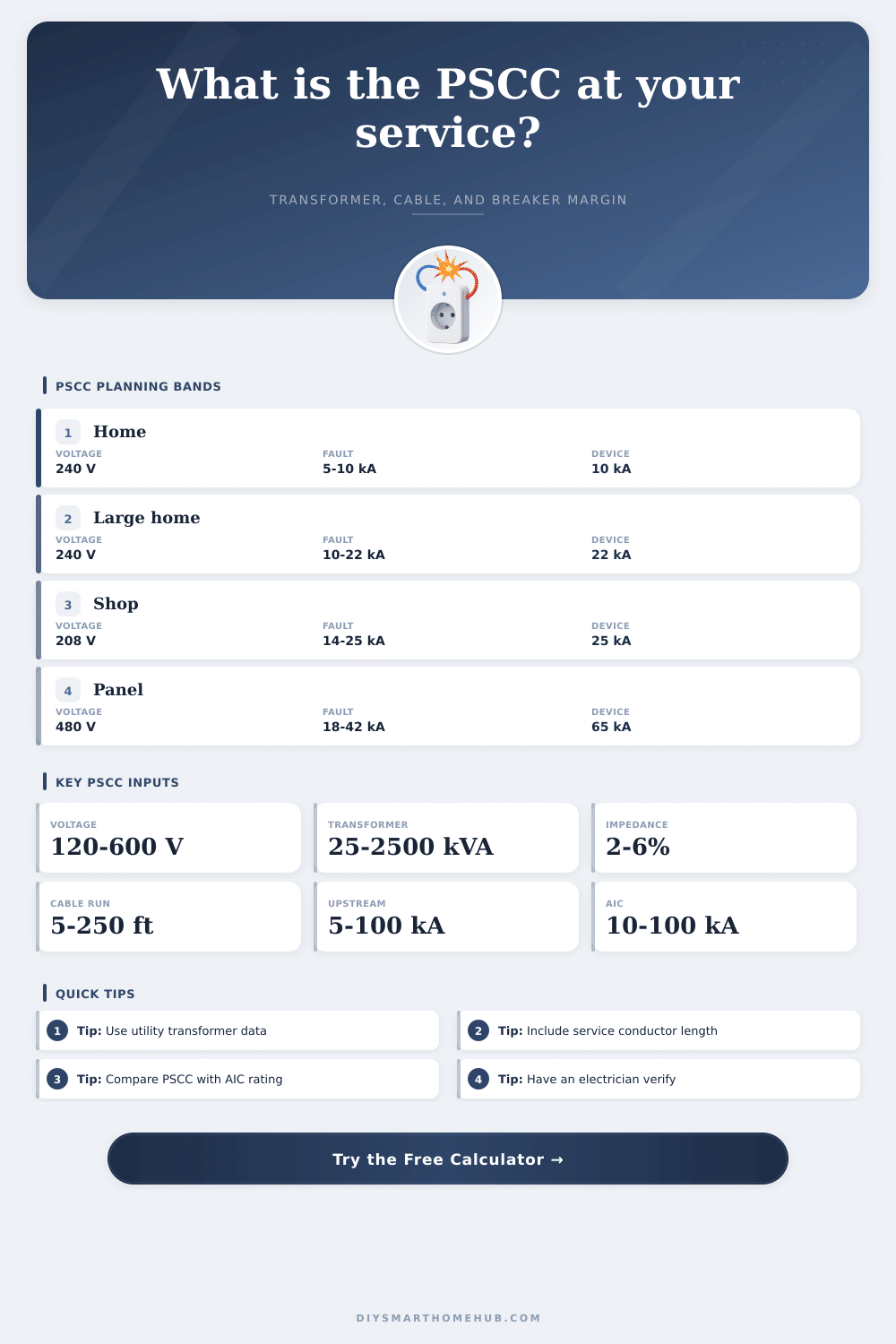
| 10 kA to 22 kA | Many residential and light commercial services | Check every panel AIC rating | Medium |
| 22 kA to 42 kA | Close transformer or larger utility source | Higher rated equipment likely | High |
| Over 42 kA | Large transformer or low impedance service | Study grade coordination needed | Very high |
📌Common service examples
| Scenario | Transformer | Distance | Expected PSCC behavior |
|---|---|---|---|
| Detached home | 25 to 50 kVA, 240 V | 40 to 120 ft | Often under 10 kA unless transformer is close |
| Large home meter | 75 to 100 kVA, 240 V | 20 to 80 ft | May exceed 10 kA device ratings |
| 208 V meter center | 150 to 300 kVA | 10 to 75 ft | Can require 25 kA or higher equipment |
| 480 V main gear | 500 kVA and above | 10 to 100 ft | Utility and transformer impedance dominate |
💡Practical PSCC notes
The potential for harm exists whenever there’s a difference between protective capacity and available energy, which means you don’t have to wait for a spark to know short circuits is dangerous. An electrical panel is typically thought of as nothing more than a static box containing switches, yet it’s a gateway to enormous fault currents just waiting to find path to ground. When such a path unexpected opens, the ensuing surge can cause equipment destruction or fire before a breaker trips.
That’s where prospective short circuit current comes into play. Because it reveals precisely how much energy the system will unleash in case of a fault. There’s no need to fumble with complicated impedance calculations; plug in your cable information and transformer details into the calculator on top of this page and itll do all of the work for you.
How to Check Your Electrical Safety
Run length is where most homeowners stop and say “huh?!” but distance between your house and the utility transformer are important. Because power flows across copper or aluminum wires, they have a built-in resistance that reduces fault current as a distance increase. A quick jump from an adjacent pad mounted transformer will provide much greater amounts of electricity to your service panel different than a long lateral along a suburban lot. You can input the length, material (copper or aluminum) and conductor diameter (AWG) into the tool which essentially simulates the amount of surge that gets lost by wire prior to reaching your electrical gear.
Finally, there’s transformer impedance, another variable affecting fault levels. This percentage rating on its nameplate represent how much the transformer resists the flow of current. A lower percentage means less opposition and more current can flows. This leads to an increased fault current at secondary side. It makes sense: An efficiency rating such as low impedance is counter-intuitive in terms of being hazardous. But there’s a reason. Engineers need to consider what happens when something fail and releases huge amounts of energy. Utilities desire to move that electricity efficient. These are two conflicting considerations that you have to weigh.
The reference table on the page provides some context by laying out the usual service scenarios so you can see where you stand compared to typical residential and commercial bands. To be clear, though: fuses and circuit breakers works only up to the limit their interrupting rating, commonly displayed as either “kA” rating or “AIC,” represents. The higher this value is, the more fault current it’s rated for opening and still not blowing up. So if you have a PSCC greater than this value, when a fault occurs it may well not just clear the fault but actualy blow apart or weld itself closed, instead of doing its job.
And that’s what people tend to skip past, since many folks hear “200 amps service” and think “surely that will handle residential breakers, no problem.” But the moddern power grid in cities pushes faults way beyond what those old panels was ever expected to deal with. Why check? Yes, this is code compliance. But it’s also physics. A short can produce such strong magnetic forces in conductors that they will actually vaporize metal or bend busbars. Equipment rated for high interrupting is able to absorbs that energy safely. You’ll input the rating of the device you want to compare with your estimated fault level, and the calculator clearly shows you if you have a good safety margin.
Textbooks don’t tell us everything; reality isn’t always textbook perfect. Things like temperature can affect resistance. Parallel conductor increase the total cross-sectional area for current to flow through. It’s a good idea to re-evaluate when adding a heavy load or performing a service upgrade. Utility data sheets will give you actual numbers for impedance and kVA, so don’t assume yours fits a standard based off some generic estimate. You may be giving yourself a false sense of security, or needlessly spending more money on upgraded furnitures.
All of that comes back to coordination. Coordination means protecting the worst case in a way that won’t take down everything. It means isolating a fault without bringing down the entire house while still being tough enough to protect what’s needed. It is a little bit more than that, but it matters when property and people is at stake. When you understand the limitations of your electrical system, then those abstract numbers become real safety margins. At the end of this exercise, you know exactly where you stand. The energy hasn’t changed, but now you can contain it safly.