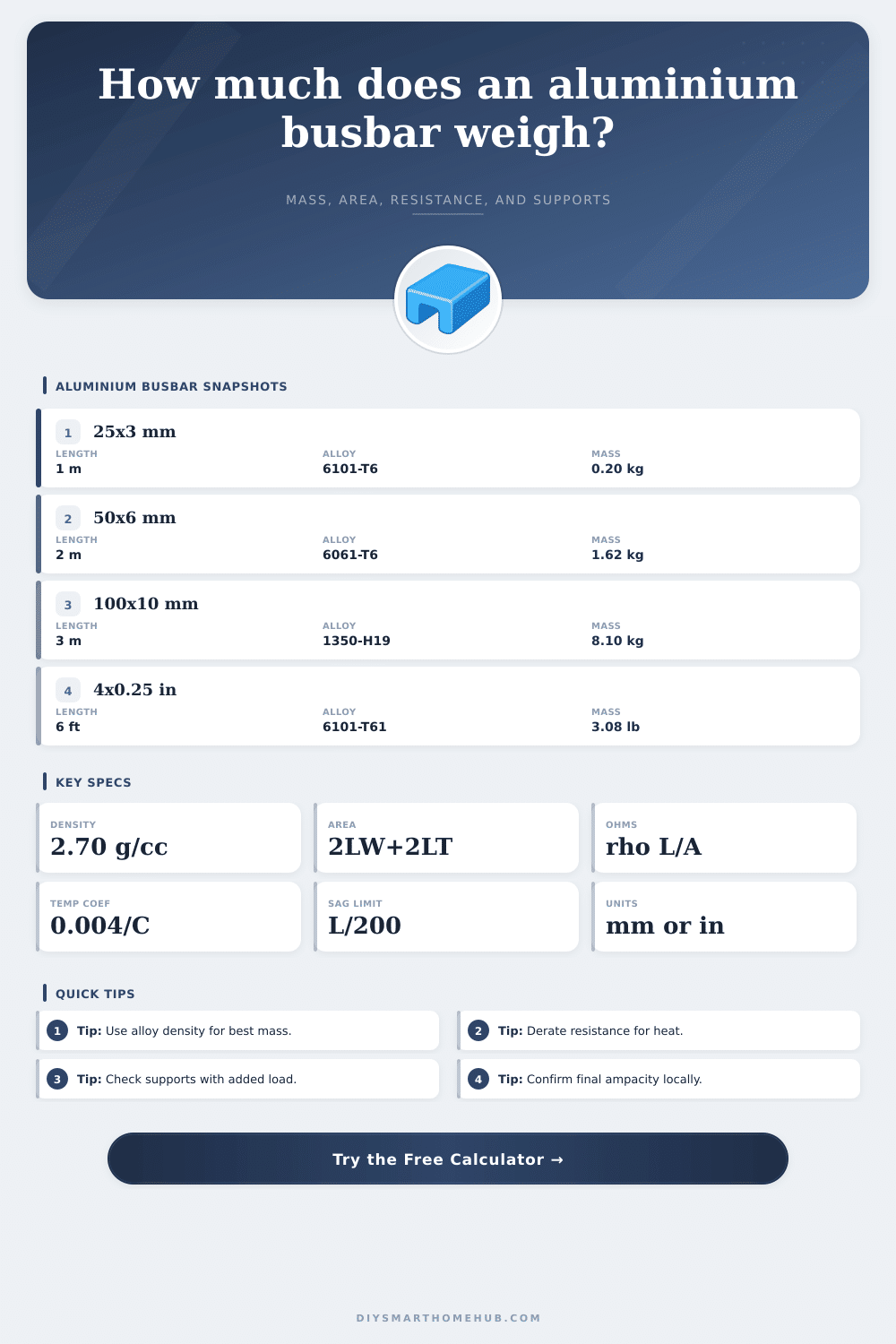
Aluminium Busbar Weight Calculator
Estimate aluminium busbar mass, surface area, cross-section, simple resistance proxy, current density, and support spacing from length, width, thickness, density, and load inputs.
📌Busbar Presets
📏Busbar Inputs
Estimated busbar mass
Results update automatically as dimensions, alloy, current, and support inputs change.
🧪Aluminium Alloy Spec Grid
📊Alloy Reference Table
| Alloy | Density | Resistivity Proxy | Typical Busbar Use |
|---|
📐Common Busbar Size Table
| Nominal Size | Cross-Section | Mass per Metre | Surface per Metre |
|---|
🔌Resistance Proxy Table
| Condition | Formula Input | What Changes | Calculator Effect |
|---|---|---|---|
| Longer bar | Length L | Resistance rises with length | R = rho x L / A |
| Wider or thicker bar | Area A | Resistance drops with area | More mm2 lowers R |
| Hot conductor | Temperature | Aluminium resistance rises | Uses 0.004/C factor |
| Parallel bars | Bar count | Effective area increases | R divided by bars |
🔧Support Spacing Table
| Run Style | Typical Span | Load Concern | Calculator Check |
|---|---|---|---|
| Short panel links | 0.25 to 0.45 m | Terminal strain | Deflection usually low |
| Cabinet bus run | 0.45 to 0.90 m | Own weight plus covers | Use entered span result |
| Long horizontal run | 0.60 to 1.20 m | Sag and vibration | Compare to suggested spacing |
| Stacked bars | Project-specific | Shared supports and heat | Bar count changes load and stiffness |
💡Practical Notes
Before weighing aluminium you can judge its physical characteristics. Its greatest virtue is lightness. In engineering, people may think one metal is heavier then another because they have compared its weight to something else, like copper. With aluminium, they need to understand mechanicals. For example, what will be the amount of force exerted on the clamps at the time of short circuit? How far will a busbar sag under its own weight between supports? Will the panel be able to handle physical load without groaning?
Although heat is more harmful to a circuit than gravity-induced mechanical failure, current capacity is of highest priority for most designers. Yet, mechanical integrity fail silently until it doesn’t.
How to Choose Aluminium Busbars
After selecting your alloy (i.e. After selecting your alloy (i.e 1350-H19, 6101-T6) and entering in your own dimensions, the calculator do all the heavy lifting for geometry math. All you need do is pick out a profile, enter in the cross-sectional area and length, and it will spit out the rest for you. No need for fumbling around with density lookups and clunky volume calculations.
There are two reasons why alloy is important. First, regarding electrical conduction, higher purity means fewer impurities, which allows the alloy to conduct better because it does not scatter electrons in the metal lattice. For example, the 1350 series are electrically graded aluminium. Structural alloys such as 6061 or 6101 has greater mechanical properties, strength, and corrosion resistance, but they have slightly lower conductivity. You need to strike a compromise between having a stiff bar that can withstand stress and an efficient conductor of electricity. Which property is the limiting factor in your application?
Another important aspect that frequently goes undiscussed until there is a problem with heat management or coating is surface area. If you have a wider and thinner bar, you’re spreading out current carrying capacity over a greater area, allowing for better dissipation of heat compared to a thicker narrow bar of equal cross sectional area. Total exposed surface area are calculated from the input parameters. This helps you determine if you need to increase spacing, add fins to avoid heat buildup in the enclosure, or ensure enough ventilation.
The longer the distance, the more efficiency is lost to resistance. Sure, aluminium conducts electricity effectively, but it will still dissipate some of the electrical energy it carries as heat; especially at elevated temperatures. To account for that, the calculator includes a temperature coefficient, recognizing that hotter is not as good as cooler when it comes to a busbar. That’s why when you are designing switchgear with long runs, every volt counts. Each volt helps you stay within code-limited maximums for voltage drop and keeps money in your pocket.
The most useful take away here for people who have installed these bars is the support spacing. If the bars is thicker, then there has been high current. But you also don’t want to leave them hanging for too long. This causes sag, which leads to uneven mechanical stress and possible contact issues at the terminals. So the tool basically gives you an easy way to check the load based off your span length and the weight of the clamps or covers. It is not a replacement for a complete finite element analysis in seismic areas, but it is a sanity check for typical installations.
Creating a design out of aluminium is a combination of science, maths and pragmatism. You need all of these things: It must be conductive but not fragile. It should have strength but not be too bulky. Support structures should not overengineer the problem. A custom-designed calculator helps you take the guesswork out of material choices. There’s no more ‘will it hold’ question; instead, you can be certain about how it will perform. That certainty turns an unverified guess into a sure bet, ensuring your power distribution system supports both its electrical and mechanical loads.