Propane Vaporization Rate Calculator
Estimate how much propane vapor an aboveground tank setup can supply in cold weather, compare that output against appliance demand, and see whether fill level, tank count, or duty pattern is what moves the result.
📌Preset Scenarios
It compares the vapor your tank arrangement can boil off against the connected appliance demand, then converts the same result into cfh, kW, and gallons-to-reserve so the number is easier to act on.
- Cold-weather vaporization limit for the selected tank setup
- Connected load in both BTU per hour and cfh of vapor
- Margin or shortfall under intermittent or continuous draw
- Suggested next tank arrangement if the current setup misses
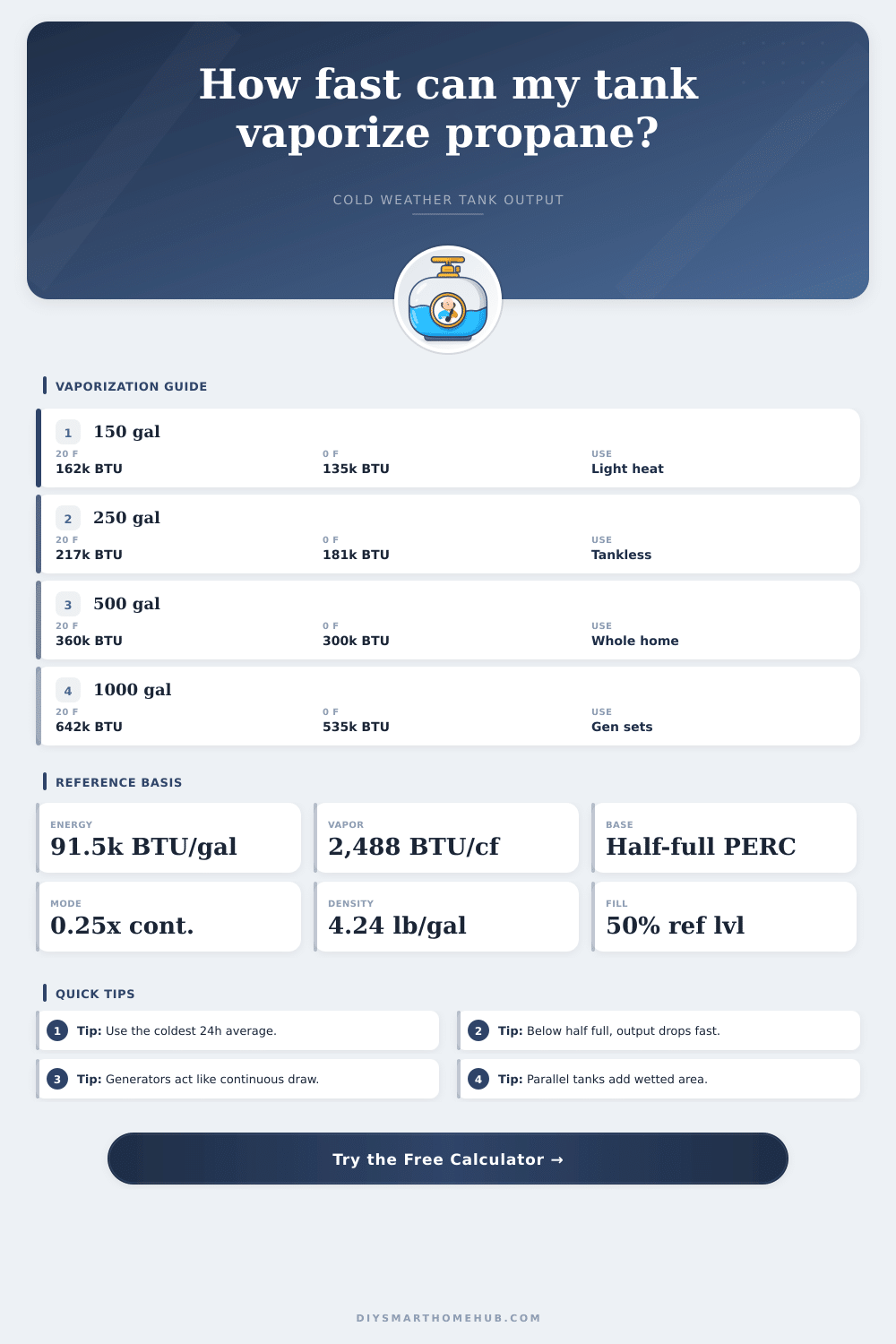
The PERC-style table is the anchor. Fill, manifold count, and exposure are screening modifiers that help approximate how much wetted surface and ambient heat pickup your actual setup has compared with the half-full reference condition.
- Half full is treated as the 1.00 baseline condition
- Continuous withdrawal applies the 0.25 multiplier
- Lower fill means less wetted area and lower vaporization
- Parallel tanks multiply tank-side surface area and output
📋Calculator Inputs
Vaporization Snapshot
The check uses a conservative temperature row, then layers in fill, exposure, and withdrawal pattern so the output stays a screening estimate instead of an optimistic best case.
💡Key Reference Basis
This converts appliance demand or tank capacity into propane vapor flow so you can compare BTU per hour with cfh quickly.
Reserve hours and gallons-to-empty are built from average load, duty cycle, and the gallons available above the chosen reserve floor.
Long steady generator or heater operation is screened at one quarter of the intermittent reference vaporization value.
The table assumes a tank around half full. Fill-level factors shift output above or below that midpoint for planning only.
❄Base Vaporization Table
These values are the half-full intermittent starting point before fill, exposure, or continuous-use adjustments are applied.
| Tank class | 40 F | 20 F | 0 F | -20 F |
|---|
📏Fill-Level Screening Factors
These factors are inference-based planning multipliers relative to the half-full reference condition. They help approximate how current fill changes wetted surface area.
| Fill level | Factor | Relative effect | Planning note |
|---|
🔧Common Load Benchmarks
Use these rows as quick smell tests before you fine tune the actual connected load, duty cycle, and weather conditions.
| Application | Demand | Vapor flow | Typical setup | Comment |
|---|
📊Preset Outcome Table
Each preset is solved with its own tank count, fill, temperature, and draw pattern so you can compare how fast requirements jump once weather and duty get more severe.
| Preset | Tank setup | Demand | Calc limit | Result |
|---|
The reference table is intended for screening, not code approval. Underground tanks, vaporizers, frost-covered cylinders, or unusual manifold piping should be reviewed with the propane supplier and applicable code tables.
A setup can hold enough gallons for a week and still come up short on a bitter day if the tank cannot boil propane off as fast as the appliances demand it.
Dropping from 60% to 25% fill cuts wetted area and often removes the safety margin that made the same tank look acceptable earlier in the season.
Propane are stored in a tank in the form of a liquid. However, when a furnace or generator burns propane, it has to be in the form of a gas. To convert the liquid propane to a gas, the process of vaporization must occur