Propane Vapor Pressure Calculator
Estimate saturated propane tank pressure from liquid temperature, convert between local gauge and absolute pressure, and solve the temperature needed to reach a delivery target before cold weather squeezes your headroom.
📌Preset Scenarios
Propane vapor pressure depends mainly on liquid temperature, not tank size. This tool keeps tank size only for reserve context, then uses local atmospheric pressure to show what a gauge will read at your elevation.
⚙Calculator Inputs
Pressure Snapshot
Run a calculation to compare propane temperature, local gauge pressure, desired target pressure, and service headroom for the selected bottle or tank.
💡Propane Reference Constants
Normal Boiling Point
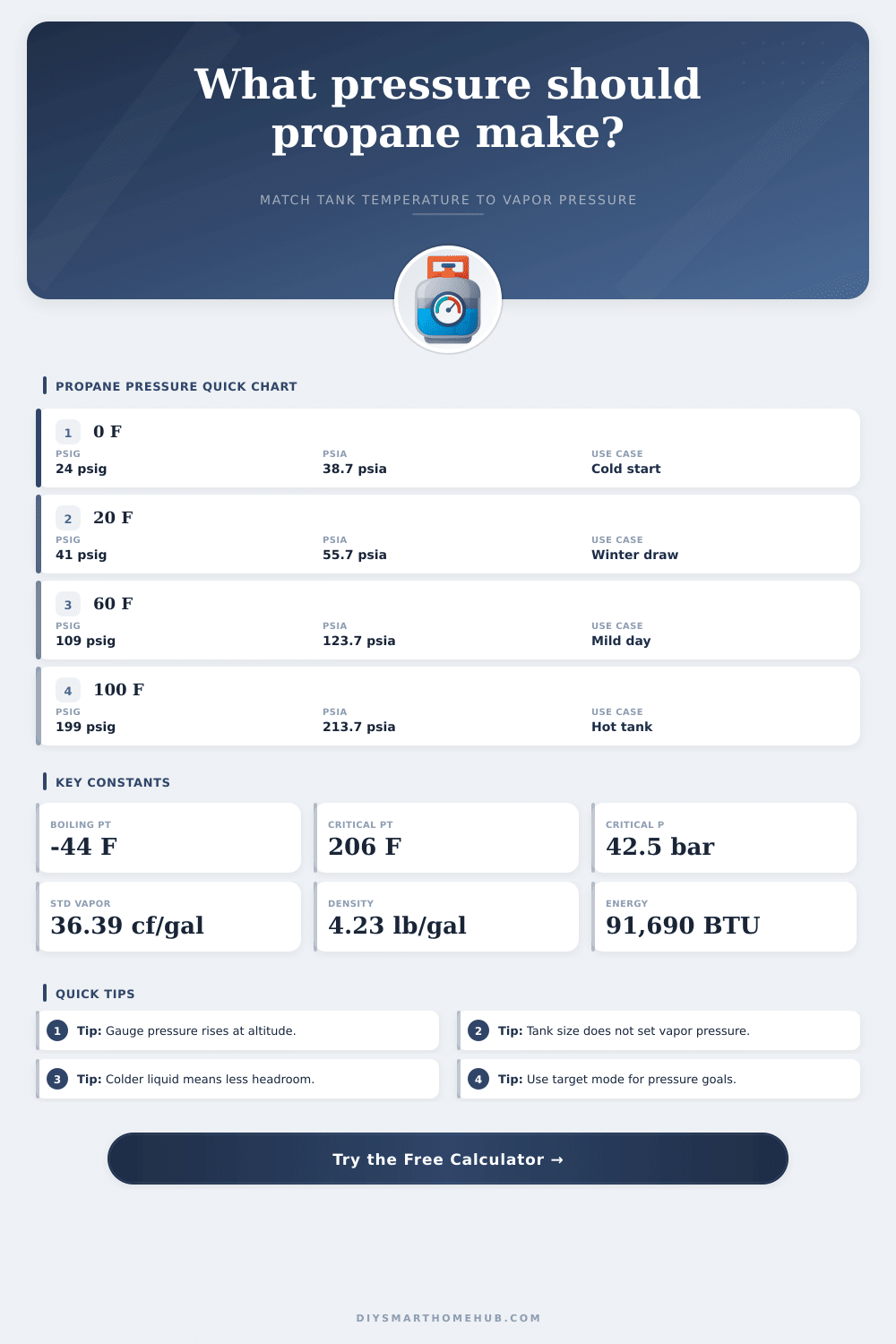
At about -42 C propane saturation pressure matches atmospheric pressure, so gauge pressure trends toward zero near sea level.
Critical Temperature
Above the critical point the liquid-vapor split disappears, so a saturation-pressure model should not be used for a normal cylinder check.
Critical Pressure
This gives the upper pressure ceiling for the saturation curve used in the reverse solver.
Liquid Density
Fuel snapshot results convert remaining service gallons into approximate pounds and liters for quick field planning.
Std Vapor Volume
This common propane conversion is included for cross-checking other tank usage or runtime tools.
Energy Content
Pressure does not equal stored energy directly, but pressure and liquid gallons together describe whether the tank still has both force and fuel.
🌡Temperature vs Pressure Benchmarks
These sea-level values come from the same piecewise Antoine correlation used in the calculator. They are useful when you want a quick mental check before measuring an actual bottle.
| Liquid temp | Local psig | Absolute psia | Absolute bar | Field read |
|---|
🎯Target Pressure Temperature Solver
This table shows the liquid temperature needed to reach selected gauge pressures at sea level. It is useful for deciding whether a target is realistic on a cold day.
| Target psig | Target psia | Required temp F | Required temp C | Planner note |
|---|
⛰Elevation Gauge Adjustment
Absolute vapor pressure stays the same at a given liquid temperature, but a gauge reads slightly higher as elevation rises because local atmospheric pressure drops.
| Elevation | Atmosphere psia | 100 psia reads | 200 psia reads | Shift vs sea level |
|---|
📋Preset Scenario Snapshot
The built-in presets cover cold-grill, mountain RV, generator, greenhouse, and hot-rooftop situations so you can compare conditions quickly without re-entering every field.
| Scenario | Current temp | Elevation | Current psig | Target temp |
|---|
A cylinder sitting on frozen concrete or a shaded tank after a long overnight draw can stay much colder than the air, and the lower liquid temperature is what controls the saturation pressure.
Warm propane can show plenty of pressure even with a low fill level, so pair the pressure result with the fuel snapshot before assuming the tank can carry a full outage or overnight load.
Propane pressures is determined by the temperature of the liquid propane inside of the tank, not by the amounts of propane that is inside of the tank. If you look at the gauge on a propane tank, you may see that the pressure reading are low. However, a low reading dont necessarily indicate that the tank is empty.
Rather, low reading often indicate that the temperature of the liquid propane is low. Propane exist as a liquid inside of the propane tank. The liquid propane create what is referred to as vapor pressure.
Propane tank pressure depends on temperature, not how much fuel
The relationship between the liquid propane and the gas that exists within the tank create this vapor pressure. The vapor pressure can change when the temperature of the tank change. When the temperature of the liquid propane increases, the vapor pressure increase.
Conversely, when the temperature of the liquid propane decreases, the vapor pressure decreases. It is important to understand that the temperature of the liquid propane inside of the tank is what determine the pressure within the tank. The temperature of the air around the propane tank is not necessarily the same as the temperature of the liquid propane.
For instance, a propane tank that is sitting in the sun will have a higher temperature than a propane tank that is sitting in the shade. However, the air temperature may be the same in both instances. Furthemore, the size of the propane tank does not impact the vapor pressure within the tank.
A large propane tank will have the same reading on its pressure gauge as a small propane tank if the temperature of the liquid propane inside of each tank are the same. Elevation can also have an impact on the reading of the propane pressure gauge. The pressure gauge measure the amount of propane pressure within the tank in relation to the atmospheric pressure outside of the propane tank.
The atmospheric pressure outside of the propane tank can vary with elevation. For instance, if you move the propane tank to a higher elevation, the atmospheric pressure will decrease. Consequently, the pressure gauge will indicate a higher reading for the amount of propane pressure within the tank then would be indicated at lower elevations.
It is also important to consider the concept of headroom for the appliance that utilize propane. Headroom is the amount of propane pressure that must remain within the propane tank above the minimum amount of pressure that the propane-using appliance require to perform its functions. For instance, if the appliance (such as a generator) require a minimum of 20 lb/sq in of propane pressure to perform its functions, but the temperature within the tank is very cold such that the vapor pressure of the propane is only 18 lb/sq in, then the appliance will not be able to effectively perform its functions.
The higher the temperature of the liquid propane, the higher the vapor pressure of that propane. Thus, higher vapor pressure mean that there is more headroom for the appliance that use propane. The temperature of the liquid propane within the tank may also differ from the temperature of the air around the propane tank.
For instance, if an appliance that utilizes propane is operated throughout the night, the propane tank may become colder than the air temperature around the tank. A drop in the temperature of the liquid propane will result in a drop in the vapor pressure within the tank, leading to a lower reading on the propane tanks pressure gauge. A tank probe can measure the temperature of the liquid propane within the tank, or by understanding how the pressure gauge read on the propane tank.
Common mistake with propane tanks include assuming that a high reading on the pressure gauge mean that the tank is full of liquid propane. A propane tank that is very warm and that has little propane within the tank can exhibit a high reading on its pressure gauge. Another common mistake with propane tanks is to assume that the temperature of the air around the propane tank is the same as the temperature of the liquid propane within the tank.
The two temperature can often be different from one another. Additionally, it is another mistake to assume that if the reading on the pressure gauge of the propane tank is low, then the propane tank are empty. Similarly, another mistake is to assume that if the reading on the propane tank’s pressure gauge is high, then the propane tank is full of propane.
In order to effectively manage the propane tanks and propane appliances, it is important to plan according to the temperature of the liquid propane. For instance, in the winter months, you may need to invest additional effort to ensure that the propane remains in the tank at a warm temperature. During the summer months, you can monitor the propane tanks pressure to ensure that the temperature of the propane does not become too high.
If there are specific goals for the propane pressure within the tank (especially for the propane-powered appliance), you can determine the temperature that the liquid propane need to be maintained at. Thus, understanding the relationship between propane temperature, elevation, and propane pressure can help to manage the propane appliances in the home more effectiveley.