Propane Pipe Sizing Calculator
Estimate a conservative propane CSST size from connected BTU demand, developed length, extra fitting allowance, and the official pressure-drop table family you want to size against.
📌Scenario Presets
📋Calculator Inputs
Calculated Propane Sizing Snapshot
These results use the selected Gastite propane table family, extra-fitting equivalent length, and adjusted appliance load before recommending the smallest listed size that passes.
📊Propane Reference Snapshot
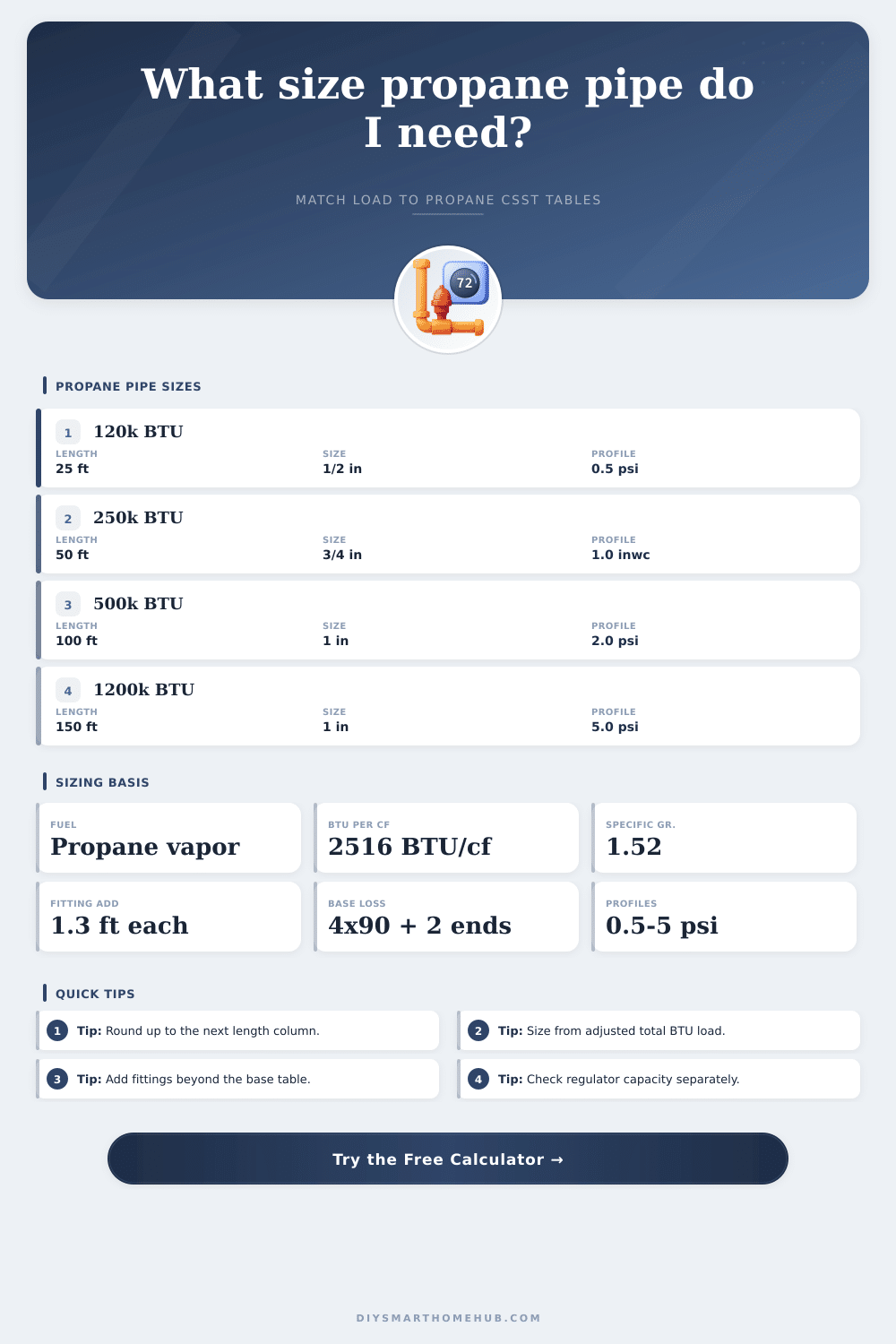
Gastite reference data converts propane BTU demand to CFH by dividing by 2516.
The propane tables are based on 1.52 specific gravity vapor, not natural-gas density.
Add 1.3 ft of equivalent length for each extra fitting or 90-degree bend above the table baseline.
The calculator stores the full published length range for these propane CSST table families.
📑Selected Profile Capacity Table
| Tube Size | 25 ft | 50 ft | 100 ft | 150 ft | 300 ft |
|---|
📚Propane Table Family Comparison
| Profile | Supply | Allowed Drop | Best Use | Outlet Note |
|---|---|---|---|---|
| Table 7-13 | 0.5 psi max | 0.5 in. w.c. | Short low-pressure branches | Matches tight 11 in. w.c. systems |
| Table 7-14 | 0.5 psi max | 1.0 in. w.c. | Typical indoor branches | More room before appliance minimum |
| Table 7-15 | 0.5 psi max | 2.0 in. w.c. | Longer low-pressure headers | Check final appliance inlet pressure |
| Table 7-17 | 0.5 psi max | 3.0 in. w.c. | Large low-pressure manifolds | Confirm appliance minimum remains safe |
| Table 7-18 | 2.0 psi max | 1.0 psi | Before line regulator | Size regulator separately |
| Table 7-19 | 5.0 psi | 3.5 psi | Long elevated-pressure runs | Regulator capacity can be limiting |
🛠Common Propane Project Checks
| Project | Adjusted Load | Run Length | Suggested Size | Profile Match |
|---|
A low-pressure 11 in. w.c. branch and a 2 psi distribution run may serve the same appliance load, but they should not be sized from the same propane table.
Higher-pressure tables can shrink pipe size, yet the pounds-to-inches regulator and appliance inlet requirements still have to be checked after the pipe table clears.
Reference basis: Gastite Design and Installation Guide Section 3 and Section 7 propane CSST tables. The guide states to divide propane BTU load by 2516 for CFH, add 1.3 ft per extra fitting, and size from the table family that matches available supply pressure and allowable drop. Final installation must follow the exact product guide, regulator ratings, local code, and a qualified propane installer.
Propane pipe sizing require that you calculate a few different variables within the propane system to ensure that propane reaches the appliance in which it is to be used. Because propane is more dense than natural gas, the flow of propane requires a different calculation to natural gas flow rates. Propane has a specific gravity of 1.52 times than that of natural gas.
Because of this, in order to find the cubic feet per hour demand of propane, you must divide the BTU load of the appliance by 2516. Using any other number for this calculation will result in incorrect propane pipe sizing. The total load of the propane system is found by calculating the BTU load of each appliance that will be connect to the propane system.
How to Size Propane Pipes
You add these BTU loads up to find the total load of the propane system. In addition to calculating the BTU loads of the appliances, it is common to apply a diversity factor to the total load. This is applied when it is understood that not all of the appliances will be used at the same time.
For example, not all of the burners on a stove will be simultaneously used to cook the meal. A buffer is often introduced to this load to accommodate for appliances that may be added to the propane system in the future. Another of the factors that must be considered in the sizing of propane pipes is the length of the propane piping system.
The length of the propane pipe isnt just the distance between the tank and the appliance. This distance is referred to as the straight length of the propane pipe. The developed length of the propane pipe is the length of the propane pipe including any elbow or tees that are included in the length of the system.
Each elbow or tee in the system add 1.3 feet of length to the total length of the propane pipe. The developed length of the propane pipe must be rounded up to the nearest value in the sizing tables for propane systems. Propane sizing tables do not provide values for pipe lengths that is less than a foot.
The third of the factors that play a role in propane pipe sizing is the pressure profile of the propane system. Propane systems that has low propane pressure have a maximum operating pressure of 0.5 psi. Low pressure systems allow for a certain amount of pressure drop in inches of water column to exit the appliance.
High pressure propane systems can have a maximum pressure of 2 psi or 5 psi. High pressure systems allow for smaller propane pipes to transport the same amount of propane. The wrong profile for propane pressure will result in either overpressuring or starving the propane appliance of propane, leading to incorrect function of that appliance.
Common mistakes in the sizing of propane pipes can result in inefficient operation of propane appliances. One of the most common mistake is using natural gas sizing tables for propane pipes. Natural gas has a different density than propane.
Underestimating the developed length of the propane pipe is another common mistake. People often fail to account for all of the elbows and tees in the system when calculating developed length. Propane also has a different capacity in colder weather than in warmer weather.
At cold temperatures, propane has 10 to 20 percent less capacity for vaporization than at warmer temperatures. This effect can be seen in propane systems in colder climates. In order to size the propane pipe correctly, you should consider the total BTU load of the system, the developed length of the propane pipe, the pressure profile for the propane system, and the capacity of the propane regulator.
You should check the capacity of the propane regulator to ensure that it can handle the total BTU load of the propane system. Should the propane regulator be too small for the system, it will create a bottleneck in the system. Finally, propane system designers should provide a margin of safety for the system by using a propane pipe size that is more slightly larger than the minimum size requirement for the system.
This provides for a propane system that has enough capacity to function during cold weather or when additional propane appliances are added to the system.