Propane Usage Calculator
Estimate propane draw from heated floor area, appliance efficiency, thermostat behavior, and runtime so you can judge gallon use and tank autonomy with the same assumptions across every zone.
📍Preset Propane Scenarios
Preset scenarios change the zone shape, load assumptions, appliance profile, runtime window, and tank size so you can benchmark propane use before entering a custom case.
📏Zone and Appliance Inputs
Propane usage snapshot
Enter a zone profile and calculate to see gallons per hour, daily burn, and reserve runtime.
💡Appliance Profiles At A Glance
📊Reference Tables
Delivered heat and burn guide
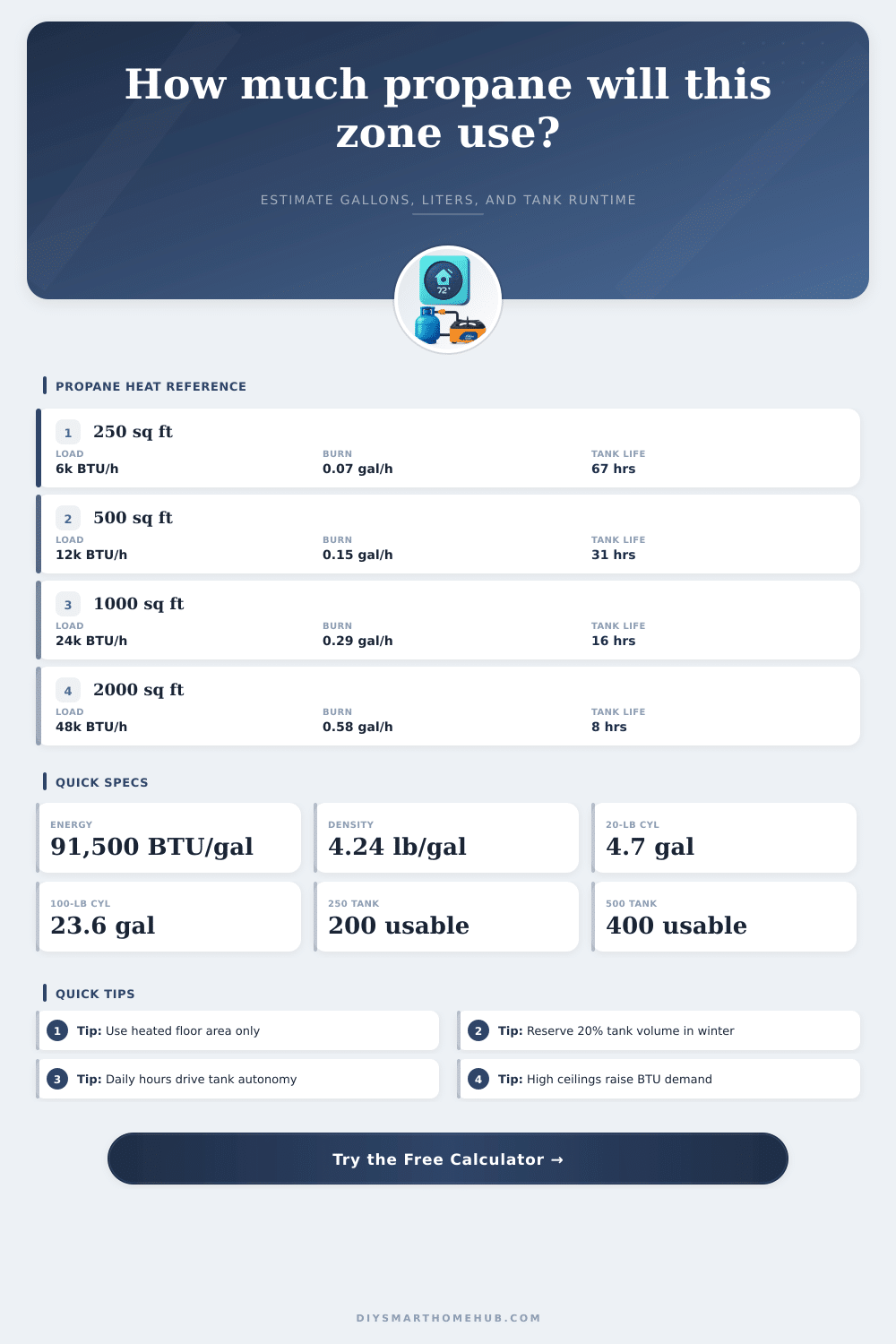
| Heated zone | Delivered load | Propane draw | 20-lb hours |
|---|---|---|---|
| 250 sq ft office | 6,000 BTU/h | 0.07 gal/h | 67 hours |
| 500 sq ft suite | 12,000 BTU/h | 0.15 gal/h | 31 hours |
| 1,000 sq ft floor | 24,000 BTU/h | 0.29 gal/h | 16 hours |
| 2,000 sq ft home | 48,000 BTU/h | 0.58 gal/h | 8 hours |
Common tank autonomy at 0.40 gal/h
| Tank | Usable gal | Burn hours | 8 hr days |
|---|---|---|---|
| 20-lb cylinder | 4.7 | 11.8 | 1.5 |
| 100-lb cylinder | 23.6 | 59.0 | 7.4 |
| 250-gal tank | 200 | 500.0 | 62.5 |
| 500-gal tank | 400 | 1000.0 | 125.0 |
Appliance comparison and preset benchmarks
| Profile | Efficiency | Max input | Typical zone | Support watts |
|---|
Preset project snapshots
| Project | Area | Design load | Avg gal/day | Reserve tank |
|---|
🛠Practical Planning Notes
A 60,000 BTU per hour appliance at 80 percent efficiency does not deliver the same room heat as a 60,000 BTU per hour appliance at 96 percent efficiency, so the gallons per hour change even before runtime does.
Two homes can share the same gallons per hour and still need very different refill timing. Runtime hours, reserve buffer, and thermostat strategy usually drive the service window more than the tank label itself.
Propane usage depend upon the number of gallons of propane that the appliance consumes every hour. Appliances consume propane at varying rates, depending upon the size of the area to be heated and the efficiency of the appliance. For instance, a small propane heater will consume propane slow in a small heated area.
However, a large propane furnace will consume propane quickly when heating a large area like a garage. Many people guess at the amount of propane that they will use for their heating appliances. Unfortunately, many of these guesses is incorrect, which can lead to running out of propane or having propane tanks that contain too much propane.
How Much Propane Will You Use for Heating?
To avoid these problems, you must calculate the burn rate of the propane appliances that you use in order to determine the amount of propane that remains in your tanks. The amount of propane that is required to heat a room depends upon the square footage of the room and the height of the ceilings in that room. For instance, if the area to be heated is 12 feet in length by 14 feet in width, the area contains 168 square feet of space.
The BTU levels required to heat this area may be 24 BTU per square foot, which would be 4,032 BTU for the entire area. However, if the outdoor temperature drop or if the ceilings are higher in the room, more BTU will be required to heat that same area. If the room has a drafty shell or if it contains high ceilings, more propane will be consumed in heating that room.
Furthermore, if the propane appliances are more efficient, they will use less propane to deliver the same amount of heat energy as less efficient appliances. For instance, condensing furnaces may be 96% efficient in heating a space compared to 82% efficiency for older furnaces. Therefore, the condensing furnace will use fewer gallons of propane per hour to heat a space.
The type of propane appliances that people use will also have an impact on the math involved with the consumption of propane. For instance, direct-vent wall heaters are typically small heating appliances that are used to heat a single room. Furthermore, direct-vent heaters use only modest amounts of electricity.
Should zoning be used to heat only areas of the house that have people occupying them, the heater will not have to run as often. Therefore, the propane will last longer. In contrast, a high-capacity heater that is used to heat the entire house will have to run for many hours every day in order to provide sufficient heat to all the rooms in the house.
If the high-capacity water heater that is used to heat a house continuously runs, the autonomy of the tanks propane will decrease quickly. In this situation, you should use 20% of the propane tank as a reserve for cold weather months. The number of hours that the appliance will run will have a bigger impact upon the propane consumption than the number of BTU units that the appliance produces.
Many hours of operation at a lower capacity will use less propane than many hours of operation at a higher capacity of heat output. It is important to distinguish between the load that an appliance is designed to handle and the actual load that is experienced during propane use. The manufacturer calculates the load that is designed into the appliance when they assume that the outdoor temperatures will be at their coldest.
However, the reality of most homes is that the outdoor temperatures are warmer than those specified in the design of the appliance. If the thermostat for the appliance is programmed to enter setback modes during the night or during the winter to protect against freezing temperatures, the amount of heat that will be released will be less. Additionally, the house that is to be heated may have tight insulation in its walls and floors or have a leaky garage bay that will consume propane to heat those areas, as well.
A propane calculator can determine the amount of propane in gallons that the appliance will use hourly and daily. Additionally, a propane calculator can determine the number of days that the propane tanks has remaining within the propane tanks. The size of the propane tanks will depend upon the amount of propane that is used.
A 20-pound propane cylinder contains 4.7 gallons of propane. Therefore, a 20-pound propane cylinder is only suitable for small tasks. For instance, the propane cylinder will not be suitable for heating a 500-square-foot living suite.
A tank of 500 gallons of propane will provide propane for the heating of a house for many months if the hours of operation are limited to a reasonable number of hours per day. However, if the high-capacity heater is running for 24 hours per day in the winter, the propane tank will have to be refilled more frequent. The density of propane is 4.24 pounds per gallon of propane.
This value is important in situations in which people have to move propane tanks by hand. There are some common mistakes that are made in the estimation of propane usage for heating appliances. One mistake is to measure the total square footage of the house that will be heated instead of the number of square feet of the heated zones of the house.
Measuring the total square footage will inflate the number of BTU units that are calculated for heating the house. Another mistake is to fail to consider that areas with high ceilings requires more BTU units to heat those areas effectively. BTU units will rise in the upper portions of the rooms with high ceilings.
Furthermore, the amount of electricity that the heating appliances use must be considered. Appliances that use motors to circulate the heat, such as furnaces, use more electricity than appliances that use less powerful motors. In these instances, it is best to include a buffer of 10 or 20% of the calculated amount for both propane gas and electricity usage.
Finally, if the appliance that is to be used has a modulating burner, the propane will be conserved. A modulating burner will allow the appliance to use lower fire levels to heat the area, conserving the propane within the tank for a longer period of time.