Propane Generator Run Time Calculator
Estimate generator fuel burn, usable propane, runtime, and cold-weather vapor margin for outage plans ranging from a single essentials circuit to a full standby home backup system.
📌Quick Presets
⚙Generator Inputs
Runtime Summary
7.5 kW portable with one 250 gallon tank sized for partial-home outage coverage.
📊Generator Class Comparison Grid
Essentials Circuit
50% burn 0.31 gal/h, 2.5 kW surge, best for refrigerator, modem, and lights.
Quiet Mid-Load
50% burn 0.45 gal/h, 4.5 kW surge, ideal for office gear and a small transfer panel.
Partial Home
50% burn 0.86 gal/h, 9.4 kW surge, common for furnace, freezer, and well pump coverage.
Lean Standby
50% burn 1.52 gal/h, 14.4 kW surge, sized for a tighter whole-panel backup list.
Balanced Standby
50% burn 1.67 gal/h, 16.8 kW surge, works well for average smart homes and gas heat.
High-Coverage Home
50% burn 2.18 gal/h, 24 kW surge, often supports air handlers and more branch circuits.
Whole Property
50% burn 2.80 gal/h, 31.2 kW surge, useful for larger homes with heavy motor loads.
Best Runtime Zone
Most propane generators deliver the best balance of runtime, voltage stability, and engine health here.
📖Typical Propane Burn Rates
| Generator Class | Rated Output | 50% Load Burn | 100% Load Burn | Best Fit |
|---|---|---|---|---|
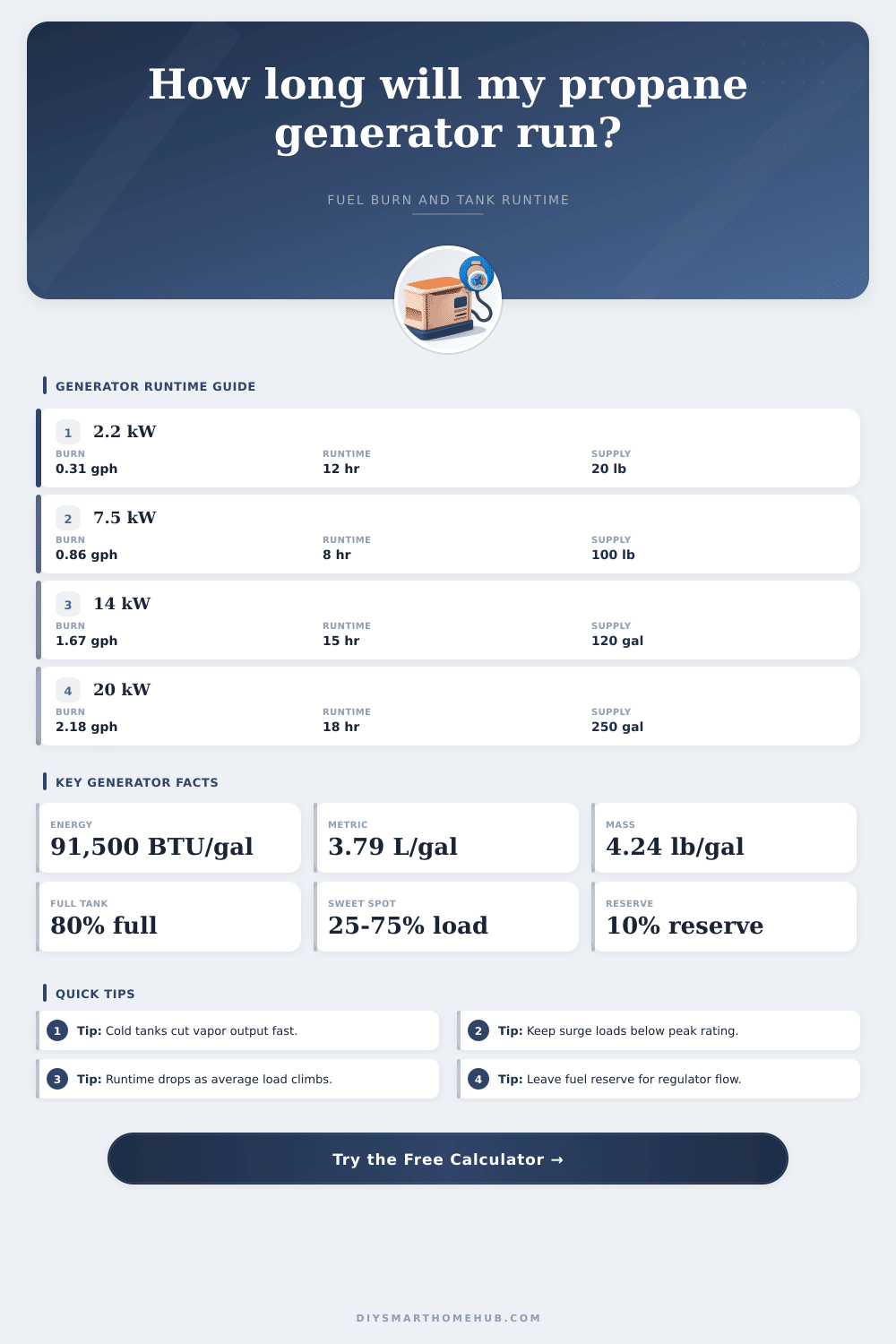
| Inverter Portable | 2.2 kW | 0.31 gal/h | 0.62 gal/h | Refrigerator, modem, lighting |
| Inverter Portable | 4.0 kW | 0.45 gal/h | 0.90 gal/h | Apartment essentials and office gear |
| Portable Transfer | 7.5 kW | 0.86 gal/h | 1.48 gal/h | Furnace, fridge, pump, small panels |
| Standby | 12 kW | 1.52 gal/h | 2.42 gal/h | Lean whole-home transfer list |
| Standby | 14 kW | 1.67 gal/h | 2.71 gal/h | Average home with gas heating loads |
| Standby | 20 kW | 2.18 gal/h | 3.75 gal/h | Large homes with more circuits online |
| Large Standby | 26 kW | 2.80 gal/h | 4.75 gal/h | Heavy multi-zone backup plans |
Burn rates are modeled from typical propane generator classes and interpolated between part-load and full-load operating points.
🔌Common Outage Load Reference
| Load Group | Running Load | Starting Surge | Cycle Pattern |
|---|---|---|---|
| Fridge + Router + Lights | 0.8 kW | 1.6 kW | Compressor cycles 30-50% |
| Gas Furnace + Essentials | 1.8 kW | 3.2 kW | Blower cycles with thermostat |
| Home Office + Network Rack | 2.4 kW | 3.0 kW | Mostly steady electronic load |
| Well Pump + Kitchen | 3.8 kW | 6.8 kW | Pump surge with intermittent draw |
| Partial Home Transfer Panel | 4.5 kW | 7.0 kW | Mixed motors and lighting |
| Whole House with Air Handler | 8.5 kW | 12.5 kW | Seasonal blower and compressor peaks |
Use measured transfer-panel loads when available. The table is a planning reference for realistic outage circuits and surge events.
⛽Tank Runtime Benchmarks
| Supply Size | Propane at 80% Fill | Runtime at 1.0 gal/h | Runtime at 2.0 gal/h |
|---|---|---|---|
| 20 lb Cylinder | 4.7 gal | 4.2 hr with 10% reserve | 2.1 hr with 10% reserve |
| 30 lb Cylinder | 7.1 gal | 6.4 hr with 10% reserve | 3.2 hr with 10% reserve |
| 40 lb Cylinder | 9.4 gal | 8.5 hr with 10% reserve | 4.2 hr with 10% reserve |
| 100 lb Cylinder | 23.6 gal | 21.2 hr with 10% reserve | 10.6 hr with 10% reserve |
| 120 gal Tank | 96 gal | 86.4 hr with 10% reserve | 43.2 hr with 10% reserve |
| 250 gal Tank | 200 gal | 180 hr with 10% reserve | 90 hr with 10% reserve |
| 500 gal Tank | 400 gal | 360 hr with 10% reserve | 180 hr with 10% reserve |
These reference runtimes assume a full 80% starting fill and a 10% reserve left in the tank for stable regulator performance.
❄Single-Tank Vapor Capacity
| Supply Size | 20°F | 40°F | 60°F | Use Note |
|---|---|---|---|---|
| 20 lb Cylinder | 36k BTU/h | 52k BTU/h | 70k BTU/h | Short runs and small inverter sets |
| 30 lb Cylinder | 52k BTU/h | 75k BTU/h | 100k BTU/h | Still limited for larger portable units |
| 40 lb Cylinder | 67k BTU/h | 96k BTU/h | 128k BTU/h | Useful when paired in a manifold |
| 100 lb Cylinder | 130k BTU/h | 180k BTU/h | 240k BTU/h | Better vapor reserve for 7-12 kW sets |
| 120 gal Tank | 460k BTU/h | 620k BTU/h | 820k BTU/h | Common minimum for residential standby |
| 250 gal Tank | 780k BTU/h | 1,050k BTU/h | 1,380k BTU/h | Comfortable vapor support for 20 kW class |
| 500 gal Tank | 1,280k BTU/h | 1,700k BTU/h | 2,200k BTU/h | Supports long runtime and larger standby loads |
Vapor capacity falls with colder tanks and lower fill levels. Multiple manifolded cylinders increase available vaporization for the same engine load.
Keep the average outage load under about 75% of rated output whenever possible. Runtime improves fast, and generator voltage usually holds steadier during refrigerator and pump starts.
Cold weather can limit propane vaporization before you run out of liquid fuel. If the vapor margin goes negative, add tank volume, increase cylinder count, or reduce peak load.
Propane generators can be helpful during the power outages. Propane does not rot like gasoline, and propane does not gel like diesel fuel. Although propane remains stable in a propane tank, the propane in a propane generator must change from a liquid to a vapor in order for the generator to use the propane.
A full propane tank seem like it would provide a propane generator with unlimited runtime. However, how much propane vapor the propane tank can produce limits the runtime for a propane generator. In cold temperature, propane tanks produce less propane vapor, leading to generator shutdown even when the propane tank contain propane.
How Propane Generators Use Fuel and How to Make Them Run Longer
In order to determine how much propane a propane generator will consume during a power outage, it is important to calculate the electrical load of the appliances that will be used. Electrical loads can include appliances like refrigerators, lights, and furnace blowers. A well pump is one type of electrical load that requires three times as much power during the time it starts to run as the well pump use during the time that it is running.
If you dont account for the electrical load of the appliances to be powered by the propane generator, there may be voltage sag with the propane generator or the propane generator may shut off during the power outage. It is important to provide a safety margin in propane generator capacity relative to the electrical load. Depending on the load on the generator, the propane generator will consume propane at a different rate.
For instance, if the propane generator is running at half the capacity of the generator, the generator will consume propane more efficient than if the generator is running at full capacity. If the propane generator is running at 25 to 75 percent of its total capacity, it will operate in an efficient range. However, if it is running at a high capacity, the propane engine will produce more heat, leading to more rapid consumption of propane fuel.
Depending on the sizes and the number of propane tanks used, the amount of vapor that is produced will vary. For instance, small propane tanks may only contain enough propane to power a propane generator for a few hours of operation. However, if there are multiple propane tanks used in the propane generator, there will be an increase in the amount of propane vapor that is produced.
Additionally, large propane tanks is preferred if the propane generator will power all the electrical appliances in a home. This is due to the fact that a larger propane tank produces more vapor because it has more surface area to allow the liquid propane to change into a vapor. The propane tanks should only be filled to 80 percent of their total capacity.
Propane requires space within the tank to expand. Furthermore, there should be a ten percent reserve in the propane tank so that the propane regulator can function properly. The temperature of the environment in which the propane tank is located will play a crucial role in the amount of propane vapor produced by the tank.
For instance, a propane tank can produce enough propane vapor at 60 degrees Fahrenheit to power a residential standby generator. However, at freezing temperatures, the propane tank will only produce half the amount of vapor that it would at 60 degrees. Thus, in subzero temperatures, it will be necessary to use more propane tanks than would normaly be used during periods of more moderate temperatures.
Furthermore, if the temperature drop during a power outage it is possible that the propane tank will not produce the amount of propane vapor that was calculated prior to the occurrence of the power outage. In order to prepare for a power outage, it is important to calculate the amount of propane that the propane generator will consume based off the electrical load that will be powered by the generator. For instance, if the electrical load of a home includes a furnace, refrigerator, well pump, and lights the load might be five kilowatts.
Furthermore, if the duty cycle of the propane generator is 65 percent, the propane generator will consume approximately one gallon of propane per hour of operation. Thus, if there is a 250-gallon propane tank and it is filled to 80 percent of its capacity the propane tank will contain enough propane to run the home for several days provided that the propane tank can produce enough vapor to feed the propane generator. Many people make mistakes in the operation of their propane generator during the power outages.
For instance, they attempt to run too many appliances. An air conditioner, for instance, requires a great deal of power. Furthermore, people do not account for the electrical loads associated with thermostats.
If the thermostat controls the operation of the appliances it is controlling, the electrical load will cycle on and off. As a result, the rate at which the propane generator will consume propane may be different than the calculated amount. To avoid overloading the propane generator, it is important to measure the electrical panel and turn off the circuits for appliances that will not be used during the power outage.
Additionally, it is important to allow the propane generator to idle for a few minutes prior to loading it with the electrical load of the appliances that will be powered by the generator. In order to ensure that the propane generator will provide power during the power outages it is scheduled to provide power to the home it is installed in, it should be maintained. For instance, you should place the propane generator outdoors and at least ten feet away from windows as the exhaust from a propane generator is deadly.
Additionally, it is important to test the generator each month while it is under a load. The hoses of the propane generator should be inspected for cracks and the regulators should be inspected for ice buildup. Furthermore, if someone suspects that there is a propane leak in the generator, someone should treat the hoses with soapy water to locate the leak.
Propane leaks are almost impossible to hear but easy to see when treated with soapy water.